




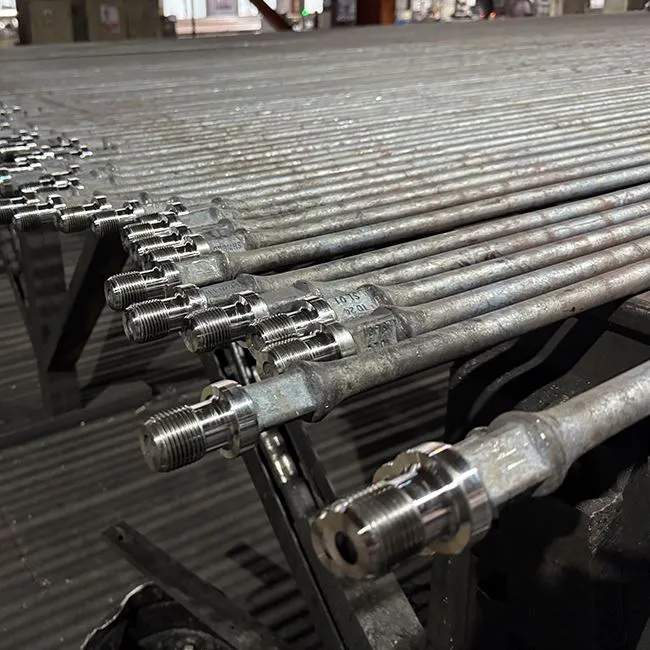


Sucker Rod
Types: Steel rods, pony rods, polished rods, fiberglass rods
Sizes: OD 5/8″–1-3/4″, Length 2–30 ft
Grades: C, K, D, KD, HL, HY
Couplings: Class T / Class SM, wear-resistant options
Features: Heat-treated alloy steels, high strength & fatigue resistance
Applications: Oil wells, beam pumping, corrosive & deep wells
Product Overview
sucker rods are high-strength rod string elements used in beam-pumping (rod lift) systems to transmit reciprocating motion from the surface pumping unit to the downhole pump. A complete rod string typically includes sucker rods, pony rods, couplings, and sinker bars, with a polished rod at the wellhead passing through the stuffing box. Octal Pipe supplies steel (solid) sucker rods in all common sizes and grades, as well as fiberglass sucker rods for weight reduction and corrosion resistance.
Supply scope (typical):
- Outside diameter (OD): 5/8 in to 1-3/4 in (full range per API 11B and Octal legacy catalog).
- Lengths: 25 ft or 30 ft for sucker rods; 2–10 ft pony rods.
- Rod types: Sucker rods, pony rods, polished rods, sinker bars; special variants such as drive/anti-twist/centralized rods available on request.
When your beam pumping wells start losing runtime, the cause is often simple: wrong grade selection, coupling wear in deviated wells, or damaged threads that fail make-up. Procurement then gets stuck with incoming inspection disputes, missing records, and field failures.
What you can order from Octal Pipe
| Item | Typical options | Why buyers choose it |
|---|---|---|
| Steel sucker rods | OD 5/8"–1-3/4" • 25 ft / 30 ft | Standard rod string for rod lift / beam pumping |
| Pony rods | 2–10 ft | Space-out and wellhead configuration adjustments |
| Polished rods | As specified | Smooth sealing surface through stuffing box |
| Fiberglass (FRP) sucker rods | As specified | Weight reduction + corrosion resistance for suitable wells |
| Sucker rod couplings | Class T (FS/SH) • Class SM (FS/SH) • sub-couplings | Connection reliability + wear control in deviated/abrasive service |
| Accessories | Sinker bars, rod string hardware, special variants upon request | Complete rod string supply coordination |
Quick buyer checklist (send with RFQ): OD & length series, grade, coupling type (T or SM; FS or SH), well conditions (corrosion/deviation), required documents, and any NDT scope.
A sucker rod pump setup is only as reliable as the rod string selection. On the PO, buyers usually lock rod grade, pin/box thread, coupling class, and any corrosion/wear protection so the rod string matches pump load and well conditions.
- Pump load profile: Match rod grade and diameter to peak loads and stroke program.
- Corrosion environment: Specify CO₂/H₂S tendency and fluid cut to choose protection options.
- Thread + coupling control: Specify thread form and coupling class to reduce make-up issues.
- Tally discipline: Joint-by-joint marking and packing list to reduce rig-site mix-ups.
API 11B Sucker rod Standards & Grades-octal pipe
Standard: API Spec 11B – "Sucker Rods and Rod-related Products" (latest scope includes steel & FRP rods, couplings, sub-couplings, polished rods and liners, thread gauges, and testing methods).
Steel Grades (API): C, K, D, KD, HL, HY – selected by well depth, load, deviation, and corrosivity. (Octal legacy catalog)
Typical materials (steel rods): AISI 4130M/4138M/4142M/4330M/8630 (Octal legacy resource).
Fiberglass sucker rod (FRP): API 11B-covered FRP rods for weight and corrosion benefits.
Pumping System Basic Operation Flow as below
System Overview: A crank and connecting rod drive the sucker rod to move up and down in deep wells.
Operating Mechanism:
Downstroke: Creates negative pressure.
Upstroke: Lifts oil to the surface through production tubing.
Technical Characteristics:
Operating Load: 15-45 kN
Temperature Range: -40°C to 150°C
Suitable for: Conventional oil fields, offshore platforms, high water cut wells
Key Advantages: High strength, corrosion resistance, precise connections

Dimensions & Connections
- Nominal OD: 5/8", 3/4", 7/8", 1", 1-1/8", 1-1/4", 1-1/2", up to 1-3/4" (project-based).
- Thread forms: API sucker rod threads for pin/box per API 11B; PR (Polished Rod) pin on polished rods where specified; gauges and gauging procedures per API 11B.
- Straightness & tolerances: As specified by API 11B (runout, end upset dimensions, thread tolerances).


Couplings: the real wear point in deviated wells
In deviated wells, the coupling is usually the first component to pay the price-because it's the contact + friction + clearance hotspot. If the coupling choice is vague ("standard coupling") you don't see the problem at the PO stage; you see it later as rapid coupling wear, tubing wear, hot string behavior, and make-up delays.
Octal supplies API 11B couplings as a controlled system item (not a commodity add-on): Class T / Class SM, Full Size (FS) / Slim Hole (SH), with inspection evidence that helps you pass incoming checks and reduce field surprises.
Coupling selection (what you specify, what you get)
| Buyer decision | When buyers choose it | What Octal supplies | Proof that shows up in your pack |
|---|---|---|---|
| Class T (FS/SH) | Standard rod strings where wear is manageable | API 11B-manufactured & inspected Class T couplings (FS or SH per clearance) | Coupling inspection records + thread gaging evidence |
| Class SM (FS/SH) | Deviated / abrasive service where coupling wear drives failures | Class SM spray-metal / hard alloy deposited couplings to mitigate wear/corrosion | Coupling surface integrity / hardness verification + thread gaging records |
| FS vs SH | Clearance-driven decision | FS for standard clearance; SH when tight clearances matter | Marking + dimensional verification records (as specified) |
| Sub-couplings | Transitions between sizes or special string design | Sub-couplings aligned to your rod string design | Traceability map tying rods + couplings by lot/heat |
What makes this "Octal" instead of generic: we don't just list coupling types-we help you order the coupling that matches the actual wear driver (deviation/abrasion/clearance), and we keep the coupling decision "auditable" with records procurement can file and inspectors can sign off.
What we control to reduce coupling-related trouble
Thread integrity (not slogans): full thread gaging (plug/ring) + visual thread checks per API 11B scope.
Post-heat-treatment coupling hardness: Class T couplings typically controlled around HRA 56–62 (and verified as required).
Wear-focused process for Class SM: deposited hard alloy layer with process control aimed at deviated/abrasive service performance.
Thread protection in shipping: thread protectors + space-saving, stable bundles (angle steel/bolts) to reduce damage before the rig ever touches the rods.
Reduced trouble outcome: fewer make-up rejections, fewer coupling scrap issues, and fewer "it looked fine on arrival but failed in service" disputes.


Polished & FRP Sucker Rods: When to Use Them and What to Specify
Polished Rods (Surface Rods) - Procurement Spec Table
| Item | What it means for your order |
|---|---|
| Buyer use case | Stuffing box sealing stability, lower gland wear, smoother sealing surface through the stuffing box |
| What to specify (RFQ) | Length (typ. 8–40 ft), end type (PR pins or standard sucker-rod pins), OD/finish requirement for sealing surface, straightness requirement, hardness/profile requirement |
| What Octal supplies | Polished rods matched to wellhead/connection plan, with controlled surface finish, straightness, and hardness profile for sealing and wear life |
| Proof in your document pack | MTC/CMTR + traceability, dimensional/straightness record, hardness record, thread gaging records (pins), packing/marking to protect sealing surface |
Fiberglass (FRP) Sucker Rods - Procurement Spec Table
| Item | What it means for your order |
|---|---|
| Buyer use case | Deep or highly deviated wells where rod weight and inertial loads drive failures; need lower string weight/torque and improved corrosion resistance |
| What to specify (RFQ) | Depth + load profile, deviation severity, temperature limit, fluid/corrosion drivers, coupling metallurgy requirement, clamp/handling constraints (critical for FRP) |
| What Octal supplies | FRP rods supplied to string design intent, with attention to coupling compatibility, temperature limits, and clamp/handling so the field doesn't treat FRP like steel |
| Proof in your document pack | Material/traceability documents, dimensional inspection records, coupling inspection + thread gaging evidence (where applicable), handling/clamp guidance delivered with shipment |
Manufacturing & Heat Treatment (Steel Rods)

- Steelmaking & forging: Alloy steel selected by grade → billet → upset forging of ends.
- Heat treatment: Normalize + temper (or quench & temper per design) to reach grade mechanical properties and core toughness; controlled end-upset hardness to protect thread roots. (Ref. 4138M practice)
- Finishing: Shot-blasting/straightening, thread cutting/rolling per API, protective coatings, thread dope & protectors.
- Marking & traceability: Grade, OD, length, heat number, and API monogram as applicable.

Sucker Rod End Forging
The rod end is heated to approximately 1200°C in an induction heater, then placed into a die and formed under high pressure. This creates a shoulder larger in diameter than the rod body.
Significance
Grain Structure Refinement: Forging process improves material flow and eliminates internal defects.
Strength Enhancement: Significantly increases fatigue strength and load-bearing capacity.
Critical Reliability: Ensures rod can withstand repeated tensile loading cycles in downhole environments.
CNC Turning of Sucker Rods
Utilizing a Computer Numerical Control (CNC) lathe, the forged rod end is precisely machined to programmed specifications. This creates high-precision connection threads (like API Modified Square Thread) with exact dimensional accuracy.
Significance
Precision Machining: Guarantees consistent thread dimensions, form, and pitch across all rods.
Connection Reliability: Ensures tight, secure rod connections to prevent potential downhole failures.
Production Efficiency: Automated process enables stable, high-volume manufacturing.
Enhanced Durability: Produces superior surface finish, reducing stress points and extending rod fatigue life.


Sucker Rod Heat Treatment
Carefully controlled heating followed by rapid cooling (quenching), then re-heated at a lower temperature (tempering) to optimize material properties.
Significance
Structural Transformation: Quenching creates extreme hardness and strength.
Toughness Enhancement: Tempering reduces brittleness, improving overall material resilience.
Operational Durability: Enables rod to endure millions of stress cycles underground without deformation or failure.
Application Scenario: Deviated Wells Where Couplings Wear First
Condition (what's happening in the field)
A rod-lift well is running in a deviated profile. The string starts showing rapid coupling wear, intermittent torque spikes, and "random" make-up delays on the rig-usually when threads get nicked in handling or when coupling choice doesn't match clearance/wear conditions.
Buyer concerns (what procurement gets blamed for)
- "We bought rods, but couplings are scrapping fast."
- "Rig time is wasted because connections don't make up smoothly."
- "Incoming inspection is slow because the paperwork doesn't prove thread control or hardness."
- "We need a repeatable spec for the next batch, not trial-and-error."
Octal solution (what we do differently, with specifics you can order against)
- Selection built around the wear driver: we confirm deviation severity + clearance constraints, then recommend Class T vs Class SM couplings and FS vs SH based on what actually causes failures in your wells (wear/clearance, not generic "standard").
- Connection control you can verify: rods/couplings ship with thread protectors, and the pack includes thread gaging records (plug/ring) so your inspection team can close acceptance faster.
- Hardness & mechanical evidence where it matters: coupling and rod checks are recorded (hardness + mechanical tests by grade) to reduce arguments later when wear appears early.
- NDT when you specify it: if your ITP/PO requires UT/MT for defined zones, we supply the NDT reports with scope and acceptance basis-no vague "NDT available" language.
Reduced trouble (what improves after delivery)
Fewer coupling-wear-driven failures because the order includes the right coupling class + geometry for deviation/clearance.
Fewer rig-side make-up issues because threads are protected and gaging is documented.
Faster incoming inspection because the document pack matches real acceptance checks (traceability, gaging, hardness/mechanical results, and NDT reports when specified).
Quality Assurance & Testing (API 11B) - What We Check & What You Receive
| QA item | What Octal checks (real scope) | When it matters most | Proof included in your document pack |
|---|---|---|---|
| Dimensional inspection | Rod OD and upset dimensions, shoulder geometry, coupling dimensions; visual acceptance per API 11B scope | Incoming inspection; preventing "doesn't match string design" issues | Dimensional inspection record tied to lot/joint ID + marking list |
| Straightness / runout | Full-length straightness check to reduce buckling tendency and minimize uneven wear in deviated sections | Deviated wells; long strings; high SPM | Straightness/runout report (batch/lot traceable) |
| Thread gaging | Plug/ring gage verification for rod pins and coupling threads; visual thread integrity (burrs, nicks, damage) | Avoiding rig-side make-up rejection and connection damage | Thread gaging record + visual thread inspection record |
| Thread gauge control | Calibration / control records for thread gages used on the batch (project/PO driven) | When your customer audit requires gage traceability | Gauge calibration / control evidence (when specified) |
| Mechanical tests (by grade) | Tensile, yield, elongation, reduction of area per grade/PO scope; sampling and frequency aligned to order requirement | Grade approval; failure investigations; tender compliance | Mechanical test reports + heat/lot traceability (CMTR) |
| Hardness checks (rods & couplings) | Hardness at critical sections; coupling hardness verification after heat treatment; surface integrity focus for wear-critical couplings | Deviated wells; coupling wear issues; corrosion + wear mix | Hardness test record (rods/couplings per PO scope) |
| NDT (UT/MT) - when specified | UT or MT performed on defined zones (per ITP/PO); acceptance basis stated in report | High-risk wells; repeat failures; customer-required ITP | NDT reports showing method, scope, acceptance basis, results |
| Coupling integrity verification (Class T / SM) | Coupling checks aligned to coupling class; surface condition verification for Class SM; fit and thread quality for both | When couplings are the first wear point | Coupling inspection record + traceability + gaging evidence |


Why Procurement Chooses Octal Pipe for Sucker Rod Supply
Octal Pipe works as a sucker rod supplier for rod pumping projects where buyers need consistent grade/length control, joint traceability, and export packing discipline for fast receiving and rig-site tally.
- One PO, one matched system: Steel rods, FRP rods, Class T / Class SM couplings (FS/SH), polished rods, pony rods, sinker bars-so you don't manage multiple vendors and mismatched connections.
- Grade selection that reduces rework: We match API 11B grade + coupling type to your load, deviation, and corrosion drivers, then summarize the selection logic so internal approval is easier.
- Acceptance-ready document pack: Each shipment is backed by MTC/CMTR, dimensional & straightness records, thread gaging evidence, mechanical & hardness reports, and NDT reports when specified-so incoming inspection doesn't turn into email chasing.
- Thread damage prevention is part of QA: Thread protectors + stable bundling/marking help prevent "looks fine, won't make up" problems that only show up when the rig is waiting.
- Delivery you can plan around: Common sizes can be arranged from stock; special requirements are quoted with a clear lead-time and packing plan (so logistics doesn't become the hidden critical path).
If you're sourcing sucker rod for sale, the fastest way to get a comparable quote is to send: grade, diameter, length range, thread type, coupling requirement, and any corrosion or wear protection requirement, plus destination and packing instructions.
FAQ

Q1:How do I choose the right API 11B sucker rod grade (C, D, K/KD, HL/HY)?
Q2:What sizes and lengths are most common for API 11B sucker rods?
Q3:What documents should come with API 11B sucker rods and couplings?
Certifications
CE Certificate
ISO 9001 Certificate
API Q1 Certificate
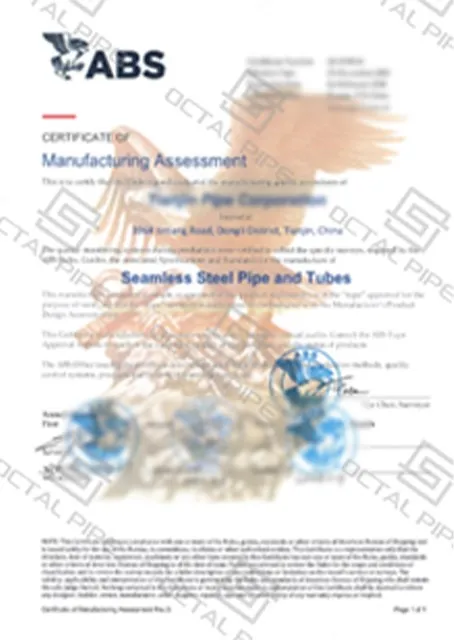
ABS Certificate
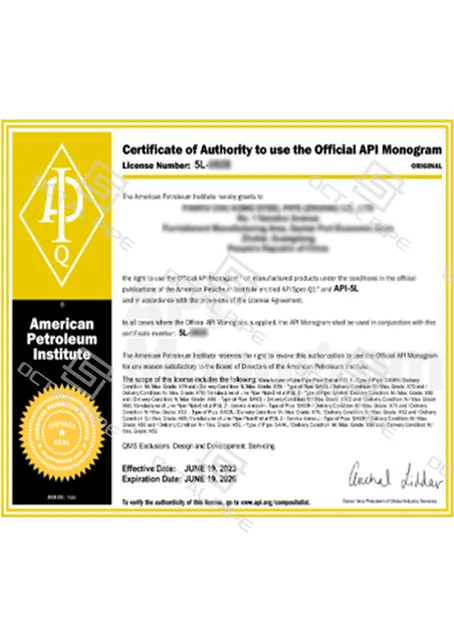
AP-5L Certificate
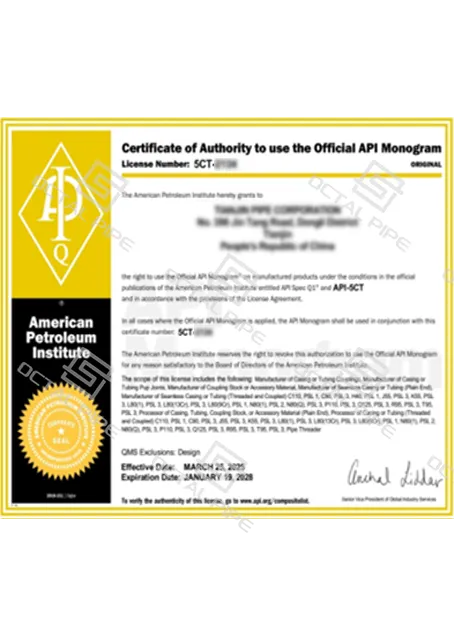
API-5CT Certificate
OD: 5/8", 3/4", 7/8", 1", 1-1/8", 1-1/4", 1-1/2", up to 1-3/4"
Length: 25 ft / 30 ft rods; 2–10 ft pony rods
Grades: C, K, D, KD, HL, HY
Materials: 4130M, 4138M, 4142M, 4330M, 8630
Couplings: Class T (FS/SH), Class SM (FS/SH), sub-couplings
Accessories: Polished rods, sinker bars, centralizers, rod string hardware(Per Octal legacy catalogs and API 11B)
Hot Tags: sucker rod, API 11B sucker rods,steel sucker rods,sucker rod couplings,sucker rod Supply
Previous
No InformationYou Might Also Like



Send Inquiry