




Sour Service & Special Applications
Range of Thickness: ≤150 mm (customized available)
Range of Length: 6m, 12m, 20FT, 40FT, or up to 18m customized
Steel Grade: 10–45#, Q345B, Q345C, 27SiMn, 37Mn5, 40Cr, 45Mn2, 20–40Mn
Standards: API 5L, ASTM A106/A53, EN10216, GB/T8162, GB/T8163
Product Specification Levels: PSL1, PSL2
Ends Type: Beveled ends, Plain ends, Threaded ends with couplings
Surface Appearance: Natural, Black painting, Varnished, 3PE, FBE, Epoxy coating
What is Sour Service?
Sour service meaning in pipeline procurement is not simply "H₂S is present." It means the combination of H₂S partial pressure, temperature, pH, and chlorides can drive hydrogen into steel and trigger SSC/HIC, so the material route and acceptance rules must follow sour-service standards rather than general line pipe practice.
Example: A fluid report showing 1,000 ppm H₂S can look "moderate," but at 100 bar total pressure it translates to ~0.1 bar ppH₂S, which is severe enough for many operators to tighten requirements on hardness control and sour qualification. By contrast, the same 1,000 ppm at 10 bar is only ~0.01 bar ppH₂S, often leading to a very different procurement decision.
That is why sour-service selection is typically driven by the fluid chemistry report and the governing standard (commonly NACE MR0175 / ISO 15156)-and why Octal Pipe usually asks for the service envelope (ppH₂S / pH / temperature) before confirming a sour-service pipe material package.
In the oil & gas, petrochemical, offshore, and high-pressure/high-temperature (HPHT) industries, sour service applications demand stricter requirements on steel grade, chemical composition, heat treatment, welding quality, coating, and dimensional tolerances. Without proper control, sour environments may severely impact pipeline integrity, safety, and operational life.


Standards & Specifications
Octal Pipe supplies sour service and special application line pipes that comply with the world's leading standards and certifications.
|
Standard |
Full Name |
Application Scope / Notes |
|
API 5L |
American Petroleum Institute Specification 5L |
Most widely used standard for oil & gas pipeline transportation, including PSL1 & PSL2 |
|
ISO 3183 |
International Organization for Standardization 3183 |
International specification for seamless and welded line pipes in pipeline transportation systems |
|
NACE MR0175 / ISO 15156 |
National Association of Corrosion Engineers / ISO |
Governs material selection for H₂S-containing (sour service) environments, preventing HIC/SSC failures |
|
DNV-OS-F101 |
Det Norske Veritas Offshore Standard |
Offshore pipelines and subsea projects; emphasizes strength, pressure resistance, and corrosion control |
|
EN 10208 / EN ISO 3183 |
European Norm |
European standards for petroleum and natural gas pipeline systems |
|
GB/T 9711 |
Chinese National Standard |
Widely used in China, covering steel grades from L190 to L625 |
|
CSA Z245 |
Canadian Standards Association |
Canadian oil & gas pipeline standard; focuses on low-temperature toughness and high-pressure environments |
Sour Service H2S ppm vs Partial Pressure
Sour service H₂S ppm is a concentration indicator, but it does not define sour severity by itself. Most sour-service material qualification is driven by H₂S partial pressure (ppH₂S) because cracking risk is governed by the driving force for hydrogen entry, which increases with partial pressure. In engineering terms, ppH₂S must be evaluated together with pH, chlorides, temperature, and water phase availability, because these parameters strongly affect SSC/HIC susceptibility.
A practical conversion for gas-phase screening is:
ppH₂S = (H₂S mole fraction) × (total absolute pressure)
- For gas composition, mole fraction ≈ ppm / 1,000,000 (ppmv basis).
- Use absolute pressure (not gauge).
- Unit notes: 1 bar = 100 kPa; 1 psi ≈ 6.895 kPa.
Worked examples (same ppm, different severity):
- 1,000 ppm = 0.001. At 100 bar total pressure: ppH₂S = 0.001 × 100 = 0.1 bar.
- The same 1,000 ppm at 10 bar total pressure: ppH₂S = 0.001 × 10 = 0.01 bar.
- Even though the ppm is identical, the second case has 10× lower ppH₂S, which commonly leads to different material/testing requirements in project specifications.
Why this matters for pipe procurement:
As ppH₂S increases, projects typically tighten control on the items that drive SSC/HIC outcomes-most often hardness limits (especially weld/HAZ), steel cleanliness/inclusion control, and the required sour qualification/testing scope (HIC/SSC when specified). This is why a purchase order that only states "H₂S = X ppm" is often not enough to finalize a sour-service pipe material package. In practice, H₂S (ppmv or mol%), total operating pressure, temperature, pH, chlorides, and whether a free water phase exists. With these, ppH₂S can be established and the material route (and required documentation/testing) can be set consistently.Octal Pipe usually asks for the service envelope (ppH₂S, pH, temperature, chlorides, and water phase) first, then aligns the material route and documentation scope to the governing standard so the project can clear technical review without late-stage rework.
Sour Service Material Requirements
Sour service material requirements are set to prevent SSC/HIC failures, so the order should define the pipe as a sour service pipe material package-not only OD/WT and grade. In practice, the purchase order should clearly state:
- Governing sour standard: NACE MR0175 / ISO 15156 (and which part applies), plus any operator/company specifications.
- Service envelope (basis of selection): ppH₂S (or H₂S composition + total pressure), pH, temperature, chlorides, and whether free water is present.
- Material control scope: chemistry control (incl. cleanliness/inclusions), steelmaking route as required by spec, heat treatment route, and the hardness control basis.
- Sour testing (when required by spec): HIC / SSC qualification, sampling frequency, and acceptance criteria.
- PSL / supplementary requirements: e.g., API 5L PSL2 with sour-service supplementary requirements where applicable.
- Weld/HAZ control (if welded pipe is allowed): weld seam NDT scope and any hardness/qualification requirements referenced by the project ITP.
How Octal Pipe supports sour-service procurement: Octal Pipe typically starts with the service envelope and then builds a review-ready package around it-confirming whether carbon steel line pipe is acceptable or whether upgrades (tighter hardness control, stricter qualification testing, CRA/clad/lining) are needed for approval. For EPC submittals, we can provide a lot-based traceability map (heat/coil → pipe marking → test records), and align the document set (MTC + inspection/testing reports) to the project ITP so the client's technical review and material release are not delayed by missing links.
Sour Service Region 3 (Severe Sour)
Some operator charts classify sour severity into regions; Region 3 is commonly used to represent severe sour service on pH vs ppH₂S diagrams. In Region 3, buyers usually tighten the material route and qualification scope (hardness control + sour testing + stricter documentation) because SSC margins are smaller
Special Applications
Sour-service pipe selection is usually triggered by a measurable operating envelope-ppH₂S, pH, chlorides, temperature, and water phase-rather than a project label. The scenarios below describe the actual field conditions that drive SSC/HIC risk and procurement requirements.
- High-pressure gas with "moderate ppm" H₂S (ppH₂S-driven severity):
The same H₂S ppm can become severe when total pressure is high, pushing ppH₂S into a region where SSC margins shrink. Projects typically tighten hardness control and require sour qualification evidence rather than relying on grade name alone.
- Wet gas / multiphase flow with free water + chlorides:
When a water phase is present (condensation, produced water, or upset conditions), chlorides and low pH increase hydrogen entry and corrosion activity. Procurement usually specifies HIC control/testing (when required) and clearer material cleanliness requirements.
- Low-pH environments from CO₂ + water (carbonic acid), with H₂S present:
CO₂ dissolved in water forms carbonic acid and accelerates corrosion; even small H₂S can shift the failure mode toward SSC/HIC. Buyers often add stricter acceptance on sour resistance plus corrosion allowance/coating/lining decisions tied to the fluid report.
- Temperature cycling and shutdown/startup transients:
Many "failures" are driven by operating transients: temperature swings, pressure ramps, and periods of wetting/drying. Specifications often tighten weld/HAZ control, because hardness peaks and local stress concentrators become more critical under cycling.
- Offshore/coastal exposure with salt spray + wet–dry cycling (plus sour media):
External environment adds corrosion stress (salt, humidity, splash zones) on top of internal sour risk. Procurement commonly combines sour qualification requirements with coating system + inspection acceptance (holiday criteria, repair method).
- Acidic process fluids with contaminants (H₂S, NH₃, CO₂, chlorides):
Refining/chemical lines can see mixed contaminants and localized corrosion drivers, which shifts the decision from "standard line pipe" to "service-envelope qualified material." Requirements typically become document-heavy: clear qualification scope, hardness basis, and traceability mapping.
Octal Pipe note: In sour-service enquiries, Octal Pipe typically starts by confirming the service envelope (ppH₂S/pH/temperature/chlorides/water phase) and then aligns the material route, testing scope (when specified), and documentation package to the governing standard so the selection is review-ready-not guesswork.


Octal Pipe Sour Service - Capabilities & Quick Specs
| Item | Octal Pipe Capability | Quick Spec Snapshot |
|---|---|---|
| Material Supply | Sour-service grades for seamless & welded routes; API 5L with sour options where applicable | Gr.B through X-grades (per PO) |
| Testing / Qualification | HIC/SSC testing (when required), UT, weld control, inspection records | Test scope per standard + project ITP |
| Heat Treatment | Heat treatment route + PWHT when specified to support hardness control | As required by PO/spec |
| OD / WT / Length | OD×WT and lengths tailored to project | WT typically ~6–50 mm+; SRL/DRL/CTL |
| Ends / Coating | BE/PE/T&C; FBE / 3LPE / epoxy + internal lining options | Coating/ends per service + installation |
| Compliance & Docs | API 5L + NACE MR0175 / ISO 15156 aligned; lot traceability pack | MTC + inspection reports; 3.2/witnessing optional |
Why Choose Octal Pipe for Sour Service
Sour-service procurement usually breaks down at the same two places: technical review (scope is unclear) and site release (evidence doesn't map to the pipe). Octal Pipe treats sour service as a controlled, review-ready package built from the service envelope-ppH₂S, pH, temperature, chlorides, and water phase-so the material route, testing scope, and documentation are aligned before production starts.
Real-world examples of where this approach saves time and rework:
- Example 1 - "ppm looks moderate," pressure makes it severe:
A fluid report may state H₂S = 1,000 ppm, which can appear manageable at first glance. But if the line operates at high pressure, the H₂S partial pressure (ppH₂S) can move the service into a much more demanding sour regime. In these cases, owners typically tighten requirements on hardness control and the qualification basis under MR0175/ISO 15156 (or an operator spec). Octal Pipe flags this early and converts the chemistry report into a procurement scope that can pass review-rather than letting the discussion surface late as "unexpected sour requirements."
- Example 2 - wet gas / produced water + chlorides changes the failure mode:
When free water is present and chlorides are high, the risk shifts from "general corrosion" toward SSC/HIC sensitivity, and the project may require HIC/SSC testing (or specific acceptance criteria) instead of generic compliance statements. Octal Pipe aligns the material and testing plan to the ITP upfront so the lot can be released on documented evidence rather than case-by-case interpretation.
What Octal Pipe delivers for sour-service projects (auditable, not generic):
- Service-envelope-driven material selection: Carbon steel sour line pipe when acceptable, with the required controls; and when the envelope demands it, Octal Pipe can propose upgrades such as tighter hardness control, stricter qualification scope, or CRA/clad/lining options to clear owner/EPC review.
- Qualification and inspection evidence aligned to the PO/ITP: HIC/SSC testing when specified, UT/NDT per the project scope, and controlled welding/HAZ practices where applicable-so sour-service acceptance is supported by records.
- Traceability that survives site reality: Lot-based mapping that connects heat/coil → pipe marking → test records → MTC, reducing the most common sour-service delay: "pipe delivered but not released" due to missing links in documentation.
FAQ

Q: What is sour service meaning in oil & gas pipelines?
Q: Sour service H2S ppm - is ppm enough to judge severity?
Q: What are sour service material requirements for sour service pipe material?
Q: What are sour service welding requirements?
Certifications
CE Certificate
ISO 9001 Certificate
API Q1 Certificate
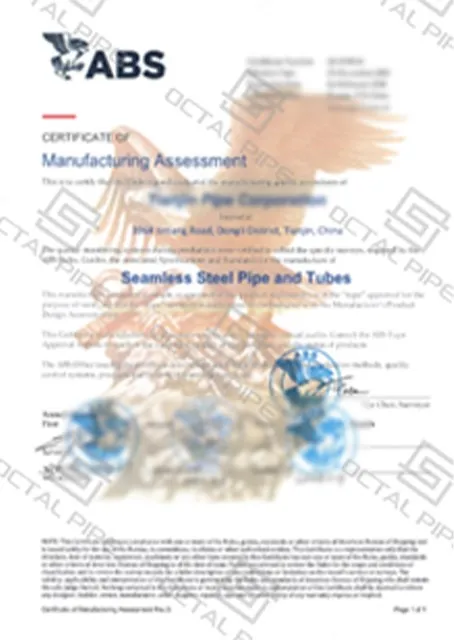
ABS Certificate
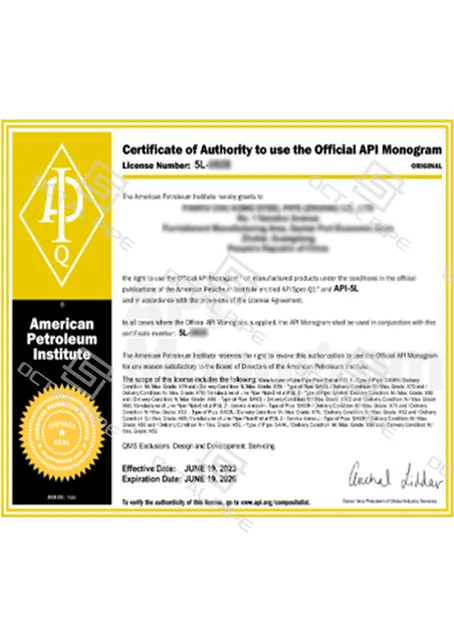
AP-5L Certificate
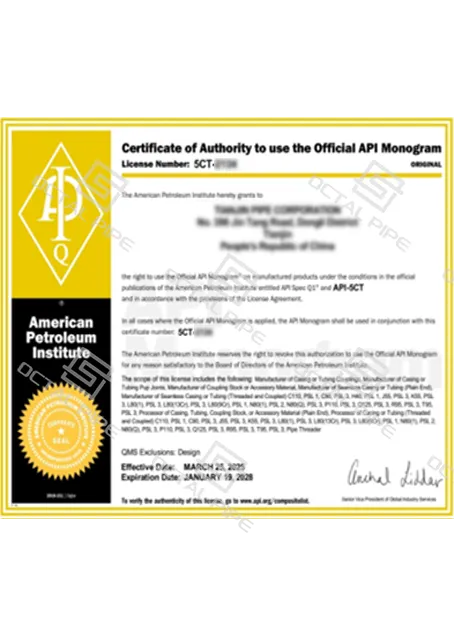
API-5CT Certificate
| Item | Typical Requirement / Scope |
|---|---|
| Governing Standard | NACE MR0175 / ISO 15156 (plus API 5L PSL2 or project spec) |
| Service Envelope (Basis) | ppH₂S (or H₂S + total pressure), pH, temperature, chlorides, water phase |
| Material / Grade | Carbon steel line pipe (Gr.B–X grades) or upgraded solutions (CRA/clad/lining) per envelope |
| Hardness Control | Hardness limits and verification as specified (incl. weld/HAZ where applicable) |
| Sour Qualification Tests | HIC / SSC testing when required by spec, with defined acceptance criteria |
| Inspection & Documents | NDT per ITP; lot traceability (heat/coil → marking → records); EN10204 3.1 (3.2 optional) |
Hot Tags: sour service & special applications, China sour service & special applications manufacturers, suppliers, factory, stainless steel hose pipe, galvanized electrical conduit, steel conduit pipe, welded elbow, flex steel hose, metric stainless steel tubing
Previous
SSAW PipeYou Might Also Like


Send Inquiry