


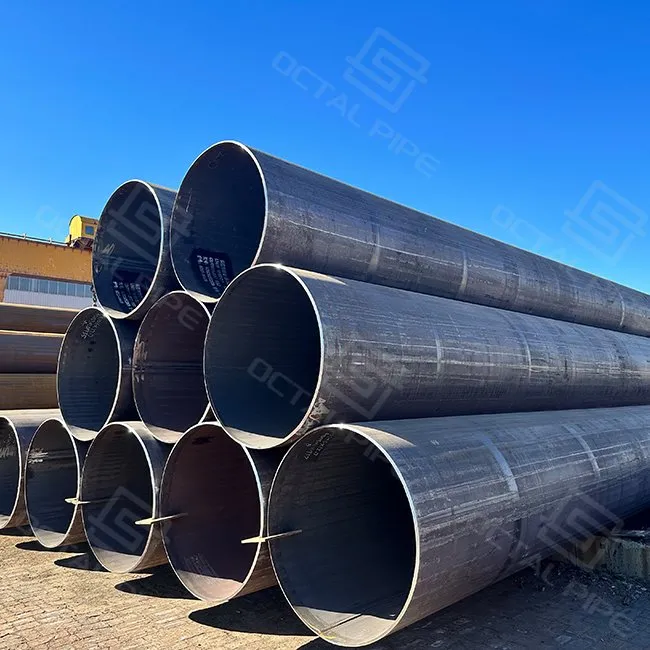

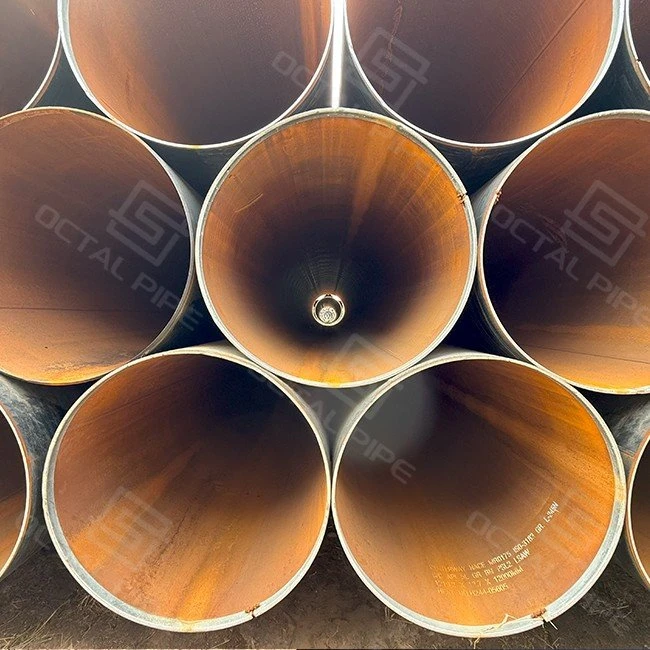
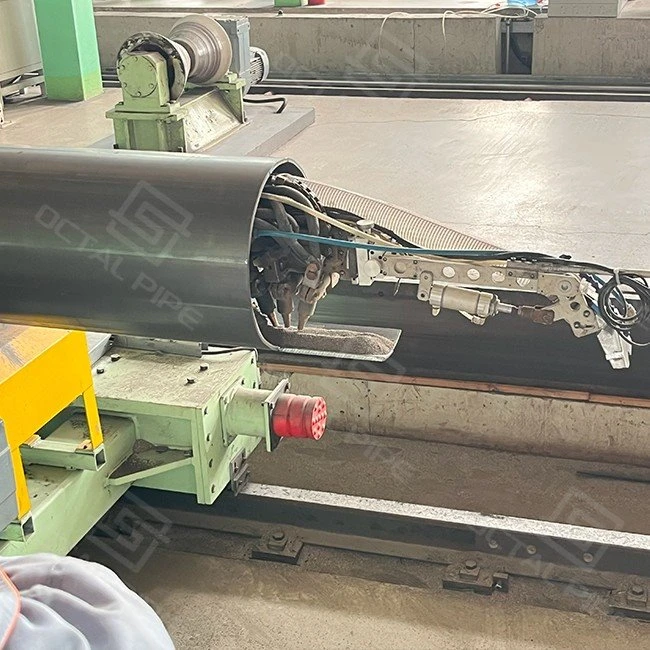
In refineries, petrochemical complexes, LNG plants and fertilizer units, large-bore LSAW pipe is applied on flare and blowdown lines, plant headers, tank farm manifolds, vapour recovery lines and utility corridors where diameters exceed the typical seamless range. Matching API, ASTM and EN grades, plus internal and external coating options, allow one LSAW family to cover high-flow, moderate-pressure services with consistent documentation and inspection.

LSAW Pipe
Supply outer diameter range: 16" to 64"
Steel Grade: API 5L Grade B, X42, X46, X52, X56, X60, X65, X70, X80, X90, X100
Product Specification Levels: PSL1, PSL2
Range of Thickness: 6 ~ 75mm(customized)
Ends Type: Beveled ends, Plain ends
Range of length: 20FT, 40FT or customized
Protection Caps in plastic or iron available
Surface appearances: Natural, Varnished, Black painting, 3PE, FBE, etc
Steel Grade: API 5L Grade B, X42, X46, X52, X56, X60, X65, X70, X80, X90, X100
Product Specification Levels: PSL1, PSL2
Range of Thickness: 6 ~ 75mm(customized)
Ends Type: Beveled ends, Plain ends
Range of length: 20FT, 40FT or customized
Protection Caps in plastic or iron available
Surface appearances: Natural, Varnished, Black painting, 3PE, FBE, etc
Send Inquiry
Product Introduction
Lsaw Pipe Meaning
Large-diameter cross-country pipelines, river crossings, jetties and deep foundations rarely use the same pipe as a boiler or a short process line. Here, designers usually call for LSAW (Longitudinal Submerged Arc Welded) steel pipe, because it lets them combine wide plate, heavy wall thickness and straight-seam welds that are easy to examine and trace.
Octal Pipe focuses on this type of work. We supply plate-based LSAW pipe produced by the JCOE process with double-sided SAW welding, covering API 5L Grade B–X100 and matching structural grades. Diameters from 400–1626 mm and wall thickness up to 75 mm allow one LSAW range to cover trunk lines, station headers, offshore piles and large water mains, so you don't have to manage different mills for every part of the project.
Octal Pipe LSAW Welded Steel Pipe Specification
Dimensional Characteristics
| Item | Specification |
|---|---|
| Diameter range | Φ400 – Φ1626 mm |
| Wall thickness | 6 – 75 mm |
| Single pipe length | 6.5 – 12.6 m |

Material Grades and Classifications
| Category | Grade / Range | Description |
|---|---|---|
| Pipeline steel | L245 / B – L690 / X100 | Coverage from conventional to high-strength line pipe |
| Carbon steel | Q235 – Q460 | Standard structural and piping grades |
| Special carbon steel | C60, C65 | For higher mechanical performance / special service |
| API steel grades | Grade A, B; X42 – X100 | For API line pipe applications, from low to ultra-high strength |

Compliance and Standards
Octal Pipe supplies LSAW pipe in strict accordance with recognized line-pipe and pressure-pipe specifications. Typical standards we support include:
- API SPEC 5L (PSL1 / PSL2) – Line pipe for oil, gas and water transmission; CVN, HIC/SSC by project.
- GB/T 9711-2017 – Petroleum and natural gas industries-Steel pipe for pipeline transportation (L245–L555).
- ISO 3183 (on request) – International line-pipe standard harmonized with API 5L.
- ASTM A671 / ASTM A672 – EFW/SAW pipe for atmospheric to high-pressure service, moderate to elevated temperatures.
- GB/T 3091-2015 – Welded steel pipe for low-pressure fluid service (for designated civil/utility applications).
- SY/T 5037-2018 – SAW pipe for ordinary fluids (for SSAW alternatives when specified).
- Additional domestic & international standards – e.g., CSA Z245.1, project sour-service requirements (NACE MR0175/ISO 15156 material selection), and third-party 3.2 inspection can be arranged.
Mill test certificates (EN 10204 3.1 / 3.2) and full NDT records are available with each shipment.


LSAW Pipe Manufacturing Process (JCOE / UOE)
- Plate preparation → edge milling
- Forming (JCOE or UOE)
- Tack welding + internal/external SAW
- UT/RT (when specified)
- Expansion + straightening + end beveling
- Hydrotest + final inspection (when specified)

LSAW Pipe Production Line Controls
Raw Material Preparation
- Hot-rolled plate/coil from qualified mills under strict incoming inspection
- Surface checked by magnetic particle / visual inspection to rule out laminations and surface defects
- Chemical composition verified to match the required API 5L / project grade
- High-pressure water descaling to ensure a clean steel surface before forming and welding
Forming Technology
- Precision uncoiling and leveling to stabilize plate shape
- Hydraulic straightening and servo-controlled forming for accurate pipe diameter and roundness
- Digital bend/edge alignment control to keep weld gap uniform along the full length
- Forming process optimized to avoid weld seam "bulging" and mismatch at the joint
Welding Process
- High-efficiency automatic welding stations for root and fill passes
- Multi-wire submerged arc welding (4–5 wires) to achieve full penetration and high deposition rate
- Continuous, full-length welding to secure joint integrity on long LSAW pipes
- In-line welding parameter monitoring and recording to trace weld quality
Non-Destructive Testing
- Automatic ultrasonic testing (UT) on weld seam and adjacent base metal
- 100% X-ray (RT) or panoramic examination on the weld according to project/API requirements
- Weld qualification rate designed to exceed 99.5% through process control and re-work loop
Surface Treatment & Coating
- Internal and external surface cleaning/blasting to coating grade
- Multiple anti-corrosion coating systems available: 3PE/3LPE, FBE, epoxy, or project-specified systems
- Coating adhesion and thickness checked; salt-spray / aging tests can reach ≥1000 h depending on system
- Finished pipes supplied with end caps and marking for transport and field installation


LSAW vs SSAW vs ERW – When Designers Select LSAW Pipe
For many projects, the first question is not "which size is available", but which pipe type is suitable: LSAW, SSAW or ERW. Octal is involved in all three, but there are clear reasons why designers and owners deliberately choose LSAW steel pipe in certain cases.
LSAW vs SSAW (spiral welded)
SSAW (spiral welded) pipe works well for lower to medium pressure water lines and some onshore pipelines where cost is the main driver. However, many high-pressure transmission pipelines, river crossings, offshore pipelines and structural piles are specified as LSAW because:
- the weld seam is straight, easier to examine and qualify for AUT and fracture mechanics;
- heavy wall thickness (up to 40–75 mm) is more practical from plate than from spiral;
- some design codes and client specs limit or exclude spiral welds in high-consequence areas.
As a result, API 5L projects that call for X60–X80 with CVN / DWTT and optional HIC often end up using straight-seam LSAW for the critical sections, even if SSAW is allowed elsewhere.
LSAW vs ERW (electric resistance welded)
ERW is common for small and medium diameters in distribution networks, casing and general structural work. Once OD goes above roughly 400–508 mm and wall thickness becomes heavier, most owners switch to plate-based LSAW because:
- the heat input, weld shape and NDT access in SAW seams are better suited to thick-wall, large-diameter pipe;
- API 5L PSL2 requirements and additional tests (DWTT, CTOD, etc.) are easier to meet and document on plate-based longitudinal seams;
- for piles and structural tubulars, the combination of wall thickness, ovality control and straightness favours LSAW.
For Octal's customers, this usually means: ERW for small bore, SSAW where low/medium pressure and cost dominate, and LSAW wherever the line or structure is high consequence, high pressure or subject to strict third-party review.
Octal Pipe LSAW Pipe Core Advantages
When you order LSAW welded steel pipe, you are not just buying steel by the ton. You are buying the ability to match drawings, pass AUT and third-party inspection, and keep construction on schedule.
Octal Pipe's own large-diameter LSAW mill in China is set up around exactly these points, so it works the way pipeline and foundation projects actually run.
From Buyer Concerns to What Octal Pipe Delivers
| What buyers worry about | What you actually get from Octal Pipe LSAW mill |
|---|---|
| Hidden plate defects that later fail weld UT / RT | Each plate is 100% ultrasonically scanned across the full width; laminations are removed before forming, reducing UT / RT rejections on finished LSAW pipe. |
| Pipes not matching field welding & bending tolerances | NC JCO forming with automatic pre-bending and expanding keeps OD, ovality and straightness tight, so internal clamps, automatic welding and field bends work as intended. |
| Seam quality and toughness on heavy-wall, high-grade pipe | Inner and outer multi-wire SAW seams are welded with recorded parameters (current, voltage, speed, wire/flux batch), supporting CVN, DWTT and optional HIC / SSC programs for API 5L PSL2 LSAW line pipe. |
| Paperwork and approvals at owner / TPI level | Production runs under ISO & API-style quality control. Each batch is delivered with EN 10204 3.1 / 3.2 MTCs, NDT & hydrotest reports and coating records, ready for SGS / BV / DNV or owner review. |
What Stands Behind This in the Octal Pipe Mill
Octal Pipe's LSAW facility is dedicated to big, straight-seam pipe, not a mixed small-bore workshop. The production window – typically OD 400–1626 mm, wall 8–50+ mm, in API 5L B–X80 and matching structural grades – is built around real use cases: trunk and gathering lines, city gas, water transmission, jackets, piles and heavy pipe-rack members. That means your specification usually falls inside the mill's "sweet spot", instead of being forced to the edge of what the equipment can do.
Behind the brand Octal Pipe, there is a line that is built to do the same thing right, again and again:
- CNC plate edge-milling and unattended pre-bending give a clean, repeatable weld groove, so every longitudinal seam starts from the same geometry.
- Automatic tack welding and internal / external SAW stations keep the joint aligned and the heat input under control, cutting down on manual adjustments and unpredictable weld behaviour.
- On-line UT of seams plus full-length hydrostatic testing ensure that only pipes with verifiable weld integrity leave the mill and enter your project.
The quality system behind this is aligned with ISO 9001 and API-style requirements, supported by national licences for pressure-pipe manufacture and coating, and product certifications such as API 5L where required. In practice, that means you receive structured data books – MTCs, NDT and hydrotest summaries, coating logs – in a format that fits international pipeline and foundation projects, instead of loose reports you have to re-organise yourself.
Finally, the way Octal Pipe works with the mill is project-oriented, not just mill-output-oriented. We connect LSAW production, coating, third-party inspection and ocean freight into one schedule, and we speak both "project language" and "mill language". For you as a buyer, the result is that Octal Pipe LSAW line pipe and piles arrive on site ready to weld, drive and install, backed by documentation and process control that match what your project teams and end clients actually expect.
Choosing an LSAW Pipe Supplier in China
If you're sourcing LSAW pipe from China, the real risk isn't "can they make pipe" - it's whether the supplier can deliver a comparable, auditable scope (forming route + inspection + traceability + export packing) so your receiving and project QA don't get stuck on missing evidence. At Octal Pipe, we run LSAW supply as a procurement-controlled package: base pipe to the ordered standard, inspection hold points aligned to your ITP, and shipment identification that your warehouse can reconcile fast.
- Export packing that matches handling reality: For long-haul/export shipments, specify end protection, edge/bevel protection, lifting points, and seaworthy packing so damage doesn't happen between mill, port, and yard.
- China-local coordination advantage: When you bundle pipe + beveling + coating/packing under one PO, inland moves and re-handling steps are reduced - which is often where bevel damage, ID contamination, and paperwork gaps occur.
- Weld inspection scope made comparable: Write UT/RT requirements as method + coverage + acceptance basis; otherwise two "China LSAW pipe suppliers" can quote the same grade with completely different inspection deliverables.
What you receive when specified in PO/ITP: MTC/CMTR (EN 10204 3.1/3.2), NDT report (method/coverage/acceptance/results), hydrotest record (pressure/hold/result), dimensional report, and packing/marking list tied to pipe/bundle IDs (digital file available when requested).
Key Application Areas
Structural support and foundations
Beyond pure transport, Octal LSAW pipe is widely used as structural steel: subsea and near-shore piles, jacket legs, skirt piles, dolphins, jetty and quay wall supports, bridge piers and heavy pipe-rack columns. The combination of plate-based wall thickness and controlled straightness provides the compressive strength and bending resistance needed for driving, grouting and long-term cyclic loading.
Transmission and gathering of liquids and gases
Octal LSAW pipe is used for long-distance and regional pipelines carrying crude oil, refined products, natural gas, rich gas, produced water and multi-product batches. Heavy-wall, large-diameter sizes allow designers to combine high through-put with stable pressure control, while documented CVN / DWTT / optional HIC programs support both sweet and sour service requirements.

Terminals, storage and loading infrastructure
At oil and chemical terminals, tank farms and loading jetties, Octal LSAW pipe is used for inlet/outlet lines, manifold headers, loading lines to marine berths and SPM / buoy connections. Controlled OD, bevel geometry and coating quality help reduce on-site fit-up time and coating repairs, so construction teams can tie in tanks, pumps and loading arms with fewer field adjustments.

Petrochemical and industrial systems


View related project cases
Typical LSAW Steel Pipe Configurations by Service Type
| Service type | Typical OD range | Typical wall range | Common grades | Standards / specs | Coating / lining options |
|---|---|---|---|---|---|
| Long-distance oil & gas pipeline | 508–1219 mm (20"–48") | 12.7–32 mm | API 5L L360–L555 (X52–X80) | API 5L PSL2, ISO 3183, GB/T 9711 | 3LPE / 3LPP, FBE, internal epoxy / flow coating |
| Regional gas / product pipelines | 406–1016 mm (16"–40") | 9.5–25.4 mm | API 5L B, X42–X60 | API 5L PSL1/PSL2, GB/T 9711 | FBE, 3LPE, bitumen / epoxy, PE sleeves |
| Water transmission & desalination | 508–1626 mm (20"–64") | 8–25 mm | L290–L415 (X42–X60), Q345/Q420 | API 5L, GB/T 9711, AWWA / project spec | External 3LPE / FBE, internal cement mortar/epoxy |
| Structural piles, jackets & dolphins | 609–1626 mm (24"–64") | 16–75 mm | Q345–Q460, API 5L X52–X70 | GB, EN, API 5L (for line-pipe piles) | Bare, shop-primer, heavy-duty offshore coatings |
| Plant headers & utility manifolds | 406–914 mm (16"–36") | 9.5–32 mm | API 5L B–X60, ASTM A671/A672 | API 5L, ASTM A671/A672, EN / GB | FBE, epoxy, zinc-rich + PU / acrylic topcoat |
Why Choose Octal Pipe LSAW Welded Steel Pipes?
For high-consequence pipelines and foundations, buyers don't just need a mill; they need control, traceability and fast support when something goes wrong. Octal Pipe builds its LSAW supply around exactly that.
1. "100% control" philosophy – every critical step is checked
Instead of sampling a few pieces and calling it good, our LSAW mill runs a nine-point 100% control scheme from raw material to packing:
| Stage | 100% control item | What it means for you |
|---|---|---|
| Raw material & plate | 100% re-check of chemical & mechanical properties of steel; 100% UT of steel plate | Off-spec heats and laminations are stopped at the plate stage, not discovered later in pipe UT / RT. |
| Pipe body & weld seam | 100% ultrasonic testing of plate and weld seams; 100% X-ray inspection of weld seams as required | Every longitudinal seam is fully examined, so weld defects are found and repaired before shipment. |
| Pressure integrity | 100% hydrostatic test of finished pipe | Each pipe is pressure-tested to verify that it can safely carry the design pressure. |
| Dimensions & appearance | 100% measurement of pipe size; 100% visual inspection of pipe surface quality | OD, wall, length and straightness are confirmed against drawings and project tolerances; no "surprise" out-of-tolerance pipes on site. |
| Packing & identification | 100% inspection of pipe marking and packing | Every pipe can be traced on site to its heat number, test records and line section. |
For you, this means that whatever piece an owner or third-party inspector picks up, there is a complete test trail behind it, instead of gaps in the records.
2. Digital, automated line for repeatable weld quality
Our production line is designed to take as much randomness as possible out of seam welding and forming:
- Fully digital, networked production line – key units such as UT, edge milling, forming, welding, expanding and hydrotest are under central monitoring, so process parameters can be traced back to each individual pipe.
- Double-submerged-arc welding with online phased-array UT – after internal and external SAW welding, each seam is immediately checked by online ultrasonic testing with spot X-ray inspection. Weld parameters and results are fully recorded, keeping the repair rate very low and allowing first-pass weld acceptance to reach 99.99%.
- Full-length mechanical expansion – every pipe is mechanically expanded after welding, which evens out residual stresses and improves roundness and straightness. This makes field bending, girth welding and pile driving more predictable.
- CNAS-accredited laboratory support – all experimental programs and procedure qualifications (CVN, DWTT, HIC / SSC, etc.) are carried out in a national-accredited laboratory, so test data can be accepted in international projects without re-testing.
The result is that the seam behaviour of Octal Pipe LSAW is not a matter of luck: pipes of the same size and grade behave consistently in welding, NDT and service.
3. Service system built around projects, not just orders
Control in the mill only solves half of the problem. Octal Pipe also runs a service model that follows the rhythm of real projects:
- High-end customized processing – we can deliver LSAW pipe cut to project lengths, pre-bevelled, marked, with openings or sleeves prepared according to drawings, so material arrives on site close to "ready to weld / ready to drive" and not as semi-finished stock that needs heavy re-work.
- Clear problem-response commitment – once a product issue is confirmed, we aim to be on site in 48 hours for domestic projects and within 96 hours for overseas projects, or arrange trusted local / third-party partners to assist. The goal is to help you identify root cause and agree a practical solution quickly, not just exchange emails.
- 24/7 technical support by an experienced team – sales, technical, QA and logistics staff work as one project team. They know API 5L, GB/T 9711, ASTM A671 / A672 and regional requirements in the Middle East, Southeast Asia, Africa and other markets, and can flag clauses that owners or supervisors usually focus on before they become issues.
For EPCs and procurement teams, Octal Pipe is therefore not just a name on a mill certificate, but a supplier that combines:
- 100% controlled LSAW production,
- traceable, audit-ready documentation, and
- responsive project support when you need help on site.
Common Problem
Q1:What is LSAW steel pipe?
A: LSAW steel pipe (Longitudinal Submerged Arc Welded pipe) is a large-diameter welded pipe made from plate by JCOE/UOE forming and double-sided SAW welding. It is mainly used for high-pressure oil, gas and water transmission pipelines and structural piles.
Q2: What are the typical LSAW pipe sizes and wall thickness ranges?
A: Octal supplies LSAW pipe in typical sizes OD 400–1626 mm with wall thickness 6–75 mm, in single lengths around 6.5–12.6 m, covering most large-diameter line pipe and piling requirements.
Q3: What is the difference between LSAW pipe and SSAW / ERW pipe?
A: LSAW pipe has a straight longitudinal SAW seam made from plate, suitable for large diameter, heavy wall and high-pressure / high-consequence lines. SSAW has a spiral seam and is often used for lower-pressure, cost-sensitive lines; ERW is mainly for small and medium diameters.
Q4: Which standards and grades does Octal API 5L LSAW line pipe comply with?
A: Octal API 5L LSAW line pipe is produced to API 5L PSL1 / PSL2, GB/T 9711 and ISO 3183, in grades L245/B up to L690/X100, with EN 10204 3.1 / 3.2 certificates and full NDT / hydrotest records on request.
Certifications

CE Certificate

ISO 9001 Certificate

API Q1 Certificate

ABS Certificate

AP-5L Certificate

API-5CT Certificate
API SPEC 5L (PSL1 / PSL2) – Line pipe for oil, gas and water transmission; CVN, HIC/SSC by project.
GB/T 9711-2017 – Petroleum and natural gas industries-Steel pipe for pipeline transportation (L245–L555).
ISO 3183 (on request) – International line-pipe standard harmonized with API 5L.
ASTM A671 / ASTM A672 – EFW/SAW pipe for atmospheric to high-pressure service, moderate to elevated temperatures.
GB/T 3091-2015 – Welded steel pipe for low-pressure fluid service (for designated civil/utility applications).
SY/T 5037-2018 – SAW pipe for ordinary fluids (for SSAW alternatives when specified).
Additional domestic & international standards – e.g., CSA Z245.1, project sour-service requirements (NACE MR0175/ISO 15156 material selection), and third-party 3.2 inspection can be arranged.
Mill test certificates (EN 10204 3.1 / 3.2) and full NDT records are available with each shipment.
Hot Tags: LSAW Pipe, China LSAW Pipe manufacturers, suppliers,LSAW Pipe Manufacturing, stainless steel hose pipe, galvanized electrical conduit, steel conduit pipe, welded elbow, flex steel hose, metric stainless steel tubing
Previous
No InformationYou Might Also Like


Send Inquiry