




Casing and Tubing
Grades J55 – Q125 for shallow to ultra-deep well applications
Complete OCTG range: casing, tubing, couplings and pup joints
Standard and premium connections – BTC, LTC, STC, EUE, NUE
Fully traceable manufacture with MTC 3.1 / 3.2 and third-party inspection
Engineered for strength, collapse resistance and sour-service durability
OCTG Casing Manufacturing Process | API 5CT High-Strength Oilfield Casing
Introduction to API 5CT Standard
Casing and tubing in an oil & gas well work as one OCTG system. The casing strings stabilize the hole, isolate formations and protect surface and groundwater, while the tubing provides a replaceable flow path for oil, gas or injection fluids. When we design an API 5CT casing and tubing program, we look at the full load path – burst, collapse, tension and annular pressure – so the casing body,
Octal Pipe works exclusively with API 5CT–licensed mills listed on the official API Composite List, guaranteeing traceable manufacturing, verified metallurgy, and complete certification in compliance with API 5CT (11th Edition) and API Q1 / ISO 9001:2015 quality management systems.


Steel Grades and Mechanical Properties
API 5CT grades are designed to meet a wide range of well conditions - from shallow, low-pressure oil wells to ultra-deep HPHT gas fields.
Each grade has specific limits for yield strength, tensile strength, and elongation, ensuring mechanical stability under compression, tension, and internal pressure.
| Grade | Typical Application | Yield Strength (MPa) | Tensile Strength (MPa) | Min. Elongation (%) |
|---|---|---|---|---|
| J55 | Shallow, low-pressure wells | 379–552 | 517 min | 19–21 |
| K55 | Moderate depth, sweet service | 379–552 | 655 min | 19–21 |
| N80 Type 1 | Medium-depth, standard service | 552–758 | 689 min | 18–20 |
| N80 Q | Q&T variant with uniform hardness | 552–758 | 689 min | 18–20 |
| L80 (13Cr / 9Cr) | CO₂ / H₂S sour environments | 552–655 | 655 min | 18–20 |
| C90 | Deep wells, sour service | 621–758 | 689 min | 15–18 |
| T95 | HPHT / severe sour | 655–758 | 724 min | 15–18 |
| P110 | Deep, high-pressure applications | 758–965 | 862 min | 15–18 |
| Q125 | Ultra-deep HPHT wells | ≥ 862 | ≥ 931 | 12–15 |
Elongation refers to the minimum longitudinal strain before fracture per API 5CT Appendix F.
Octal Pipe assists operators and EPCs with grade selection, collapse and burst resistance analysis, and H₂S / CO₂ compatibility evaluation to ensure each string meets the project's geological and design envelope.
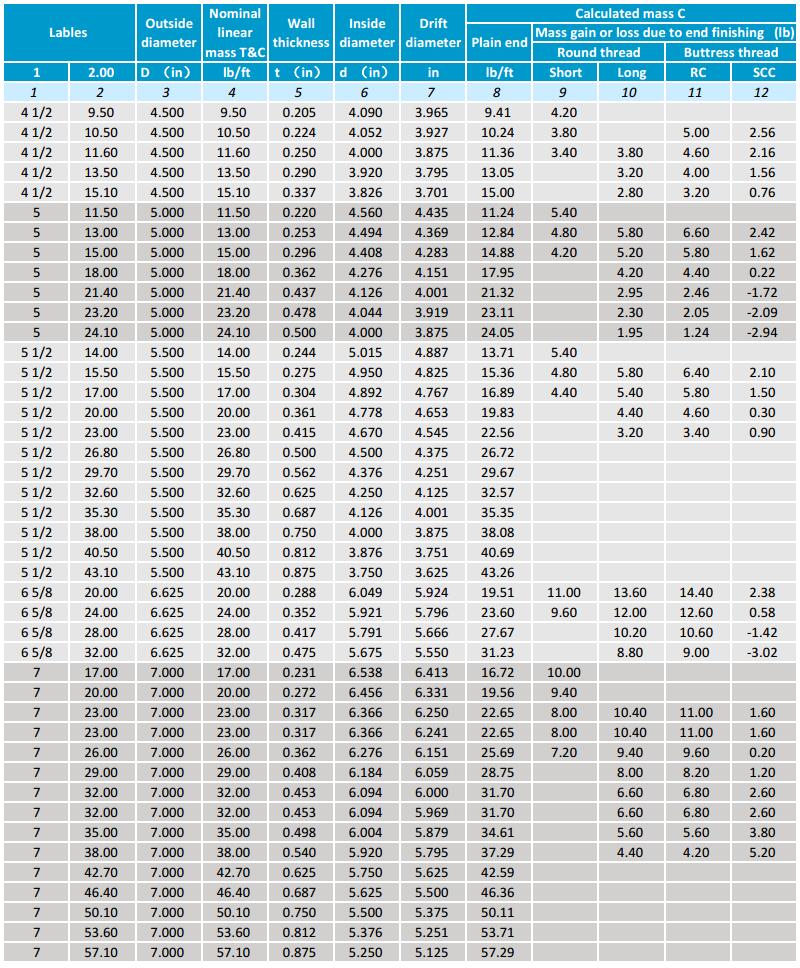
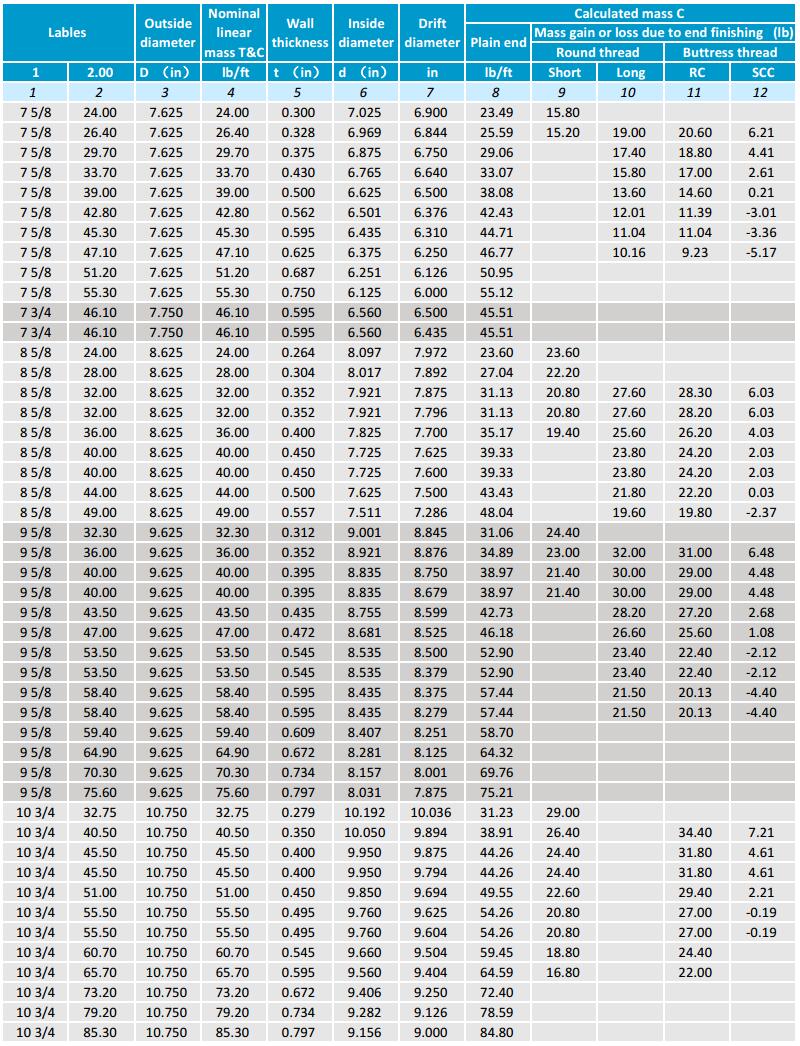
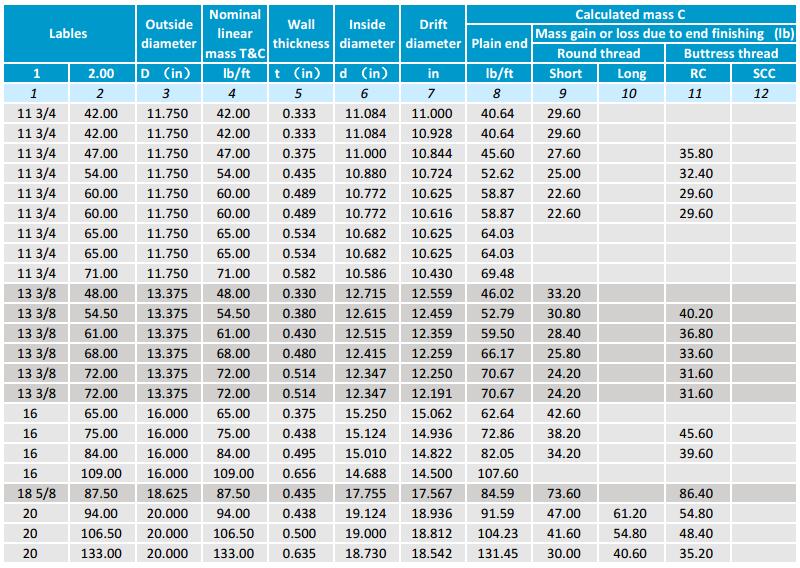
API 5CT Casing and Tubing: The Field Problems Buyers Want to Prevent
API 5CT casing and tubing pipes are not purchased to "meet a standard." They're purchased to keep a well stable and flowing-without leaks, plugging, annular pressure surprises, or acceptance disputes that turn into downtime and rework.
Most of the cost doesn't come from one big failure. It comes from predictable operational headaches that start as small scope gaps on the PO.
1.Casing integrity and annular pressure build-up
Operators may see abnormal annulus pressure, sustained pressure, or pressure imbalance between annuli. The triggers are often integrity issues, poor isolation, corrosion, or damaged threads/couplings-and the problem escalates because it becomes a barrier/well integrity discussion, not just a production problem.
2.Plugging and restriction (wax/scale/sand/debris)
During artificial lift or production, restrictions show up as declining rate, unstable pressure, higher pump load, or frequent cleanouts. The root cause is rarely "pipe quality" alone-it's a combination of flow regime + deposits + internal roughness + debris control and cleanliness.
3.Corrosion-driven failures (CO₂/H₂S, high chloride water cut)
Corrosion issues don't look dramatic at receiving. They show up later as pitting, leakage, and shortened run life, especially in sour or wet CO₂ service when metallurgy, hardness control, and inspection scope are not clearly written into the order.
4.Make-up delays and cross-threading on the rig
The most expensive failure is the one that happens while the crew is waiting. If the string won't make up smoothly, you lose time fast. Typical causes: mixed connection types, damaged threads, missing thread gauging evidence, or unclear coupling scope.
Octal Pipe Controls That Prevent Field Problems
| Field problem you want to avoid | What Octal Pipe controls before shipment | What we provide as proof (in your document pack) |
|---|---|---|
| Tubing leaks after start-up or workovers | We lock the connection + coupling scope to your PO (NUE/EUE or gas-tight premium), and treat connection readiness as a release gate (no "default" threads). | Connection identification + traceability, and thread gauging evidence when specified; torque-turn results when specified for seal verification. |
| Rig-side make-up delays / cross-threading | We manage thread condition through handling: thread protectors, stable bundling, and clear marking to prevent mixed-string and transport damage. | Packing list showing protector scope + bundle mapping, marking list / tally support tied to lot/bundle IDs. |
| Annular pressure surprises / integrity disputes | We align inspection scope to your PO/ITP so integrity-related verification is defined (not "testing available"). | Hydrotest record when specified, drift record when specified, and NDT reports (UT/ECT/MPI) only when specified with method + scope + results. |
| Plugging / restrictions during pumping (wax/scale/sand/debris) | We treat internal clearance control and receiving clarity as part of delivery scope-so the string runs without avoidable restrictions. | Drift evidence when specified, plus dimensional records and tally/marking that reduce wrong-string running and rework. |
| Corrosion-driven failures in CO₂/H₂S service | We confirm service notes early (CO₂/H₂S / water cut / temperature) and scope the order so material selection and inspection are not left to assumptions. | MTC/CMTR with traceability; sour-service related requirements and any additional inspection records when specified in PO/ITP. |


Connection Types and Technical Options
Casing Connections
| Type | Description | Typical Use |
|---|---|---|
| STC – Short Round Thread Coupling | Standard round thread, easy make-up | Shallow wells / moderate pressure |
| LTC – Long Round Thread Coupling | Longer thread engagement, better load distribution | Medium to deep wells |
| BTC – Buttress Thread Coupling | Trapezoidal form with high tensile efficiency | Deep / high-pressure wells |
| Premium Gas-Tight | Metal-to-metal seal, torque shoulder design | HPHT and offshore operations |
Tubing Connections
| Type | Description | Typical Use |
|---|---|---|
| EUE – External Upset End | Thickened end and coupling connection for high pull loads | Standard production tubing |
| NUE – Non-Upset End | Straight end, lower weight and cost | Moderate service applications |
| Integral / Premium Tube | Machined integral joint or metal-seal type | Gas / condensate / sour service |
All threaded connections conform to API 5B gauging standards and are verified through torque-turn testing, seal-integrity checks, and mechanical load simulation.
What You Get With Octal Pipe
Octal Pipe operates as a China-based OCTG Casing and Tube manufacturer with a practical local advantage-tight coordination across pipe, threading and couplings, plus factory-side digital control of marking, bundle lists and traceability-so the casing package arrives run-ready and avoids preventable delays at receiving and on the rig.
When you buy OCTG pipe, the "advantage" isn't a slogan-it's whether the supplier's equipment and process controls consistently produce threads, couplings, and pipe bodies that pass acceptance the first time. With Octal Pipe, you get a supply program built around controllable steps and auditable outputs:
- Controlled threading built for repeatable make-up: production is organized around stable threading practices and inspection gates, so the connection you order is the connection you receive-supported by thread gauging evidence when specified and clear connection identification (STC/LTC/BTC; EUE/NUE; premium options).
- Couplings treated as a critical component, not an accessory: coupling processing is managed to match the ordered grade and service, with inspection checkpoints that reduce the most common field complaint-connection-related rejections and premature wear.
- Inspection capability that matches project reality: when your PO/ITP calls for it, verification is executed with defined scope (method + coverage + acceptance basis) and delivered as reports-so "NDT / hydrotest / drift" are not marketing words but measurable outputs.
- Traceability built into the workflow: heat/lot mapping and marking are carried through to packing, and the release package (MTC 3.1/3.2, third-party inspection when required) is organized for QA/TPI review, not post-shipment document chasing.


Working with Casing and Tubing Running Services Companies
Most delays happen at the interface with casing and tubing running services companies-not because the pipe grade is wrong, but because the string can't be released and run smoothly: tally doesn't match bundles, threads arrive dirty or damaged after re-handling, or drift/make-up expectations were never locked. From a procurement view, good OCTG pipes services depend on whether the supply package is organized for rig-floor reality, not just mill paperwork.
Octal Pipe manages this handover as part of the delivery: shipment is bundled and identified to match the running sequence, threads are protected for transport and yard moves, and the document pack is prepared so receiving can clear the lot without chasing missing evidence. The aim is simple-when the running crew starts picking up joints, they don't stop to re-check IDs, re-clean threads, or argue about acceptance basis.
Two things to lock on the PO (so the running crew doesn't lose rig time):
- Tally + receiving discipline: joint ID format, bundle grouping, packing/marking list alignment, and traceability mapping (when specified in PO/ITP).
- Run-ready acceptance: drift basis (API vs special drift), connection type, and any thread gauging / torque-turn evidence required (when specified in PO/ITP).
OCTG Pipe Head Interface
- Casing and tubing head compatibility: Confirm hanger and wellhead interface requirements early so drift/ID and connection selections don't conflict at installation.
- Connection and sealing: Match OCTG pipe connection type to the wellhead and make-up practice to avoid leaks during pressure-up.
- Field joint discipline: Keep protectors and clean threads through transport so the wellhead make-up is not fighting contamination.
FAQ

What's the difference between casing and tubing in a well?
Why do "to-standard" casing/tubing strings still leak or fail early in the field?
What documents should come with casing and tubing for incoming inspection?
Certifications
CE Certificate
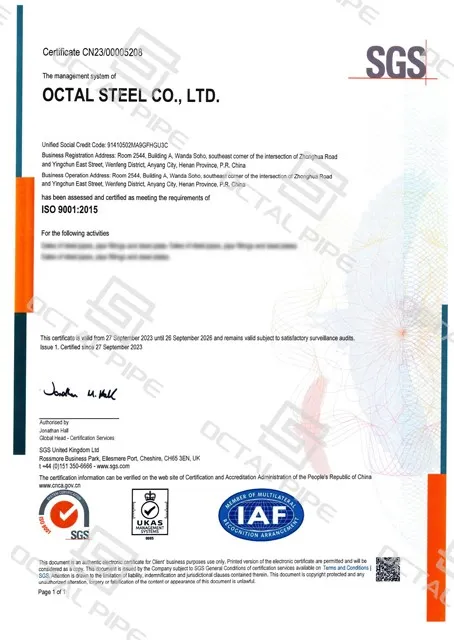
ISO 9001 Certificate
API Q1 Certificate
ABS Certificate
AP-5L Certificate
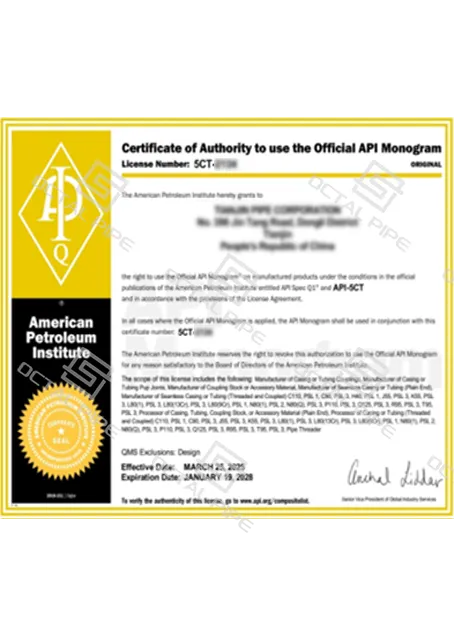
API-5CT Certificate
| Item | Parameter |
|---|---|
| Standard | API 5CT (11th Edition) |
| Product | Casing / Tubing + Couplings (OCTG package) |
| Grades | J55, K55, N80 (N80Q), L80 (13Cr/9Cr), C90, T95, P110, Q125 |
| Connections | BTC, LTC, STC, EUE, NUE (premium optional) |
| Key selection basis | Burst / Collapse / Tension / Annular pressure |
| QA scope (optional) | NDT, hydrotest, drift, thread gauging (as required) |
| Documents | EN 10204 3.1/3.2 MTC + traceability pack (as required) |
Hot Tags: Casing and Tubing, China Casing and Tubing manufacturers, suppliers, factory, well casing pipe steel, glow tubing, apollo casing pipe, submersible casing pipe, 2 well casing, copper pipe with insulation
Previous
No InformationNext
Casing PipeYou Might Also Like


Send Inquiry