




Butt Weld Fittings
Materials: Carbon Steel, Alloy Steel, Stainless Steel, Duplex / Super Duplex
Size Range: ½″ – 48″
Wall Thickness: SCH 5 – SCH XXS
Types: Elbows (45°, 90°, 180°), Tees, Reducers, Caps, Crosses, Stub Ends
Ends: Beveled ends (standard), Plain ends available
Heat Treatment: Normalized, Annealed, Quenched & Tempered, Solution Annealed
Testing & QA: Dimensional checks, NDT (UT, MT, PT, RT), Hydrostatic
Applications: Oil & Gas, Chemical, Power, Water Treatment, Industrial Piping
Butt weld fittings are weld-end components (elbows, tees, reducers, caps, stub ends) used to build full-penetration welded joints on process and transmission lines. The key procurement value of butt weld fittings is dimensional repeatability-center-to-end, bevel geometry, and schedule alignment-so field welding, NDT, and commissioning can follow the ITP without fit-up rework. Octal Pipe supplies ASME/ASTM/EN compliant fittings with documented heat treatment, NDT options, and traceable MTC for project release
Octal Pipe manufactures butt weld pipe fittings for oil & gas, petrochemical, power, and water projects. We produce DN15–DN1200 in carbon steel (ASTM A234 WPB/WPC, P235GH), alloy steel (ASTM A234 WP11/WP22, P91/P92), and stainless steel (ASTM A403 WP304/304L/316/316L), with a monthly capacity of 10,000 tons.
Production & Quality Control:
- Formed and heat-treated for consistent strength and durability
- Dimensional checks using calipers, micrometers, and gauges to ensure proper fit
- UT (ultrasonic) inspection for weld quality, with 100% of welds verified defect-free
- Material testing with spectrometers and mechanical testing machines to verify chemical composition and mechanical properties
Technical support includes:
- Selecting the right material and schedule for high-pressure or corrosive environments
- Advising on welding and installation practices for smooth flow and long service life
Our fittings have been used in EPC projects across the Middle East, Africa, and the Americas, meeting ASME, ASTM, and ISO standards, and delivered on project schedules.


Standards & Material Grades
| Item | Typical Supply (Octal Pipe) |
|---|---|
| Standards | ASME B16.9, ASTM A234/A403, EN 10253 (plus MSS SP-43 where applicable) (Octal Pipe Co., Ltd.) |
| Materials | Carbon / alloy / stainless; duplex on request (Octal Pipe Co., Ltd.) |
| Size range | 1/2"–48" (DN15–DN1200) (Octal Pipe Co., Ltd.) |
| Wall (schedule) | SCH 5 to XXS (Octal Pipe Co., Ltd.) |
| Types | 45/90/180 elbows, tees, reducers, caps, crosses, stub ends (Octal Pipe Co., Ltd.) |
| Ends | Beveled ends standard; plain ends available (Octal Pipe Co., Ltd.) |
| QA options | Dimensional checks + UT/MT/PT/RT per ITP; hydro/pneumatic on request (Octal Pipe Co., Ltd.) |
Sizes: ½″ – 48″
Wall thicknesses: SCH 5 to SCH XXS
Ends: Beveled (standard), Plain Ends (special)
Compatible with flanges, valves, and pipes in integrated systems
Types of Butt Weld Fittings
| Fitting type | Common variants (what to call out) | What it's used for on site (workfront context) | Key spec detail to avoid rework |
|---|---|---|---|
| Elbows | 45° / 90° / 180°; LR (1.5D) vs SR (1.0D) | Route around racks, sleepers, skids; keep slope/drain on process and utility lines | Confirm LR vs SR, NPS/SCH (or OD×WT), and bevel per standard so fit-up doesn't require grinding |
| Tees | Equal tee / Reducing tee | Branch off headers to instruments/equipment tie-ins; fabricated spool branches | Specify branch size clearly; confirm branch schedule and tolerances so branch mismatch doesn't open root gap |
| Reducers | Concentric / Eccentric (flat-on-top / flat-on-bottom) | Concentric for vertical lines; eccentric for pump suction and drainable runs | State orientation (FOT/FOB) + transition schedule to prevent air pockets or slope loss |
| Caps | Standard cap; heavy wall / pressure cap | Close pipe ends for hydrotest blinds, dead-ends, future tie-ins | Match cap to pipe schedule; confirm end prep so cap doesn't become a thin-to-thick weld problem |
| Crosses | Equal cross / reducing cross (less common) | Compact manifolds and instrument take-offs when space is tight | Confirm feasibility: crosses are sensitive to dimensional tolerance-often better to use two tees unless spec requires cross |
| Stub Ends / Lap Joints | Short / long pattern stub ends; used with lap-joint flange | Frequent maintenance spools, lined pipe connections, corrosion allowance strategies | Call out pattern, face length, and mating flange standard so bolt-up and gasket seating are predictable |


Butt Weld Fittings Manufacturing Process (Factory Sequence)
- Forming (forging / hot pressing): the fitting blank is formed into the elbow/tee/reducer shape. This step largely determines wall uniformity and basic geometry, which is why it directly affects fit-up on butt weld pipe fittings.
- Cutting & shaping: the formed blank is trimmed and profiled to the target dimensions (e.g., center-to-end and overall length). Consistent shaping keeps spool fabrication repeatable-especially on skid work with many repeated joints.
- Beveling & end preparation: weld ends are machined to the required bevel profile and end squareness. Stable end prep helps welders hold a consistent root condition; it becomes even more sensitive when butt weld tube fittings are ordered by OD×WT and tight fit-up is expected.
- Heat treatment (by material grade): normalizing/annealing/solution annealing is applied as required by the material and standard. For stainless steel butt weld pipe fittings, correct heat treatment is part of the release basis for weldability and property compliance.
- Surface finishing + final release: stainless fittings are typically pickled/cleaned, then the lot is inspected, marked, and released with traceable documentation (MTC/lot mapping) so the shipment can be accepted as controlled butt weld fittings, not mixed loose pieces.
Inspection & Quality Assurance
Octal Pipe enforces a comprehensive multi-stage quality control program from raw material to finished fitting:
| QC item | What we check | Typical control / acceptance numbers buyers use | What you receive in the release pack |
|---|---|---|---|
| Chemistry verification (PMI/OES) | Grade confirmation to prevent mix-ups (esp. 304L/316L) | 100% heat-level verification; for mixed-grade orders many buyers require 100% piece PMI | PMI/OES report + heat/lot mapping |
| Mechanical tests | Tensile / yield / elongation (per heat/lot) | 1 set per heat (or per lot) as baseline; extra tests per ITP for critical duty | MTC + lab test report |
| Billet/body UT (laminations) | Internal soundness before/after forming | Often specified as 100% UT scanning for critical fittings or heavy wall | UT report with scope + acceptance result |
| Dimensional control | OD/ID, WT, ovality, center-to-end | Typical shop controls: ovality ≤ 1.0% of OD; WT not under nominal by > 12.5% (common minimum rule); center-to-end checked per B16.9/EN 10253 | Dimensional inspection sheet (lot-based) |
| Bevel & end prep | Bevel angle / root face / squareness | Common bevel basis (ASME B16.25 style): 37.5° ± 2.5°; root face typically ~1.6 mm (1/16") (project may tighten); end squareness often controlled to ≤ 1.0 mm | End-prep inspection record + photos on request |
| Heat treatment control | Normalizing / annealing / solution annealing (as applicable) | Furnace traceability with controlled cycle; many owners ask for temperature charts per batch and hardness checks where required | Heat-treatment chart / record + hardness report (if specified) |
| Surface examination | Folds, laps, cracks, inclusions | 100% visual; for stainless "clean surface" expectation is often written into PO (no embedded scale, no sharp edges/burrs) | Visual inspection checklist |
| NDT (per material & ITP) | MT/PT/UT/RT as required | Typical ITP patterns: MT/PT 100% on critical surfaces; RT 10–100% only when welded fittings are supplied / when ITP calls it | NDT reports with coverage scope + results |
| Pressure / leak testing (when required) | Hydro / pneumatic | If specified: hydro commonly 1.5 × design pressure; hold time often ≥ 30–120 s (ITP-defined) | Test report (pressure/hold/time/lot) |
Technical Advantages
- Stable high-volume output: Octal Pipe runs multiple forming lines year-round to keep supply steady for bulk EPC packages-elbows, tees, reducers, and caps-without creating schedule pressure on site.
- Repeatable fit-up quality: Process control focuses on the dimensions welders actually feel in the field-wall thickness uniformity, ovality control, and consistent bevel geometry-so butt weld pipe fittings align cleanly with pipe ends and reduce grinding/rework during welding.
- Inline end-prep consistency (bevel as a controlled output): Instead of treating beveling as a "last-minute" step, Octal Pipe uses dedicated end-facing/beveling stations with angle/land checks, keeping bevel profile consistent across lots-so root conditions stay stable during RT/UT-driven weld acceptance.
- Forming + heat-treatment discipline at line level: Elbows/tees/reducers are produced through controlled forming routes and matched heat-treatment cycles (normalizing/annealing/solution annealing by grade), with batch traceability maintained through each station-so mechanical properties and weldability are repeatable, not dependent on operator habit.
- Engineering support that prevents ordering mistakes: Before shipment, Octal Pipe can review isometrics/MTOs to confirm LR/SR, concentric vs eccentric orientation, schedule transitions, and end-prep requirements-avoiding "wrong fitting type" delays that typically surface only at fit-up.
- Export-ready protection: Standardized marking, end protection, and bundle/crate packing keep bevels and sealing faces protected during handling, so fittings arrive ready for receiving inspection and welding rather than touch-up work.


Butt Weld Fittings "Fit-Up Risk Map" (Pipe vs Tube vs Stainless)
Butt weld fittings (baseline pipe packages):
- In butt weld pipe fittings, the main control point is schedule alignment-the fitting must match the pipe's OD/WT family so the welder is not forced to "make it fit" by grinding the root land or opening the gap. On Octal Pipe packages, we normally confirm NPS + schedule (or OD×WT) and lock the fitting standard (e.g., B16.9) so center-to-end and bevel geometry stay consistent across the spool run.
Butt weld tube fittings (tube OD mismatch risk):
- Butt weld tube fittings are where projects lose time because "size wording" can hide different OD systems. Tube-based BOMs often quote OD×WT directly, while pipe-based BOMs use NPS/SCH-and a small mismatch becomes a big fit-up problem when many joints are orbital-welded or prefabricated on skids. The practical fix is simple: treat tube fittings as OD-controlled components and specify the mating tube OD standard (and exact OD×WT) in the PO, not just a nominal size.
Stainless steel butt weld pipe fittings (release risk is not only grade):
- For stainless steel butt weld pipe fittings, the common failure isn't "wrong 316L"-it's release and fabrication surprises: surface condition that stains during storage, heat-affected issues that complicate welding, and mixed-lot traceability that slows receiving inspection. Octal Pipe keeps stainless fitting release audit-friendly by aligning the PO to grade clarity (304L/316L) plus finish/cleaning expectation, and shipping with lot mapping (marking → MTC) so fittings can be staged by heat and size without re-sorting on the shop floor.
Applications / Workfront Scenarios (Where Butt Weld Fittings Are Actually Used)
- Shutdown tie-ins on a live rack line (brownfield revamps):
Crews usually cut in 90° LR elbows + reducing tees to reroute around supports, add instrument take-offs, or tie a new skid into an existing header during a short outage window. The "real" challenge is fit-up speed-if center-to-end or bevel is inconsistent, welders end up grinding land/root gap, and the joint becomes harder to pass RT/UT. On Octal Pipe packages, we typically stage fittings by ISO line list (size/schedule/material), so the welding team can pick the correct elbow/tee set per spool without mixing walls.
- Pipe spool prefabrication for modular skids (repetitive welds, tight tolerances):
Skid shops run hundreds of repeated joints-concentric reducers, caps, tees, and short-radius elbows-where one wrong schedule can cascade into rework across a whole batch. In practice, the risk is "thin-to-thick" transitions that force parameter changes mid-run and slow production. Octal Pipe supports skid fabrication by aligning the PO to NPS/SCH (or OD×WT) and delivering fittings with clear marking and a lot-mapped release pack, so spools stay consistent from the first weld to final hydrotest.
- Pump suction / drainable process runs (orientation-sensitive fittings):
In pump stations and process units, eccentric reducers are used specifically to avoid air pockets and maintain stable suction-usually flat-on-top (FOT) on horizontal suction lines, and oriented reducers/tees are used to keep drain slopes. The workfront pain is not "the reducer exists," it's that the reducer arrives without orientation defined, so the field team flips it wrong and later chases vibration/cavitation or drainage issues. Octal Pipe often confirms the reducer orientation requirement (FOT/FOB) during quoting to prevent that avoidable site correction.
- High-temperature utility headers (steam, heat-transfer, heater connections):
These packages rely heavily on reducers, tees, and elbows that must match alloy pipe schedules and heat-treatment states. The inspection focus is usually material traceability + heat-treatment evidence + NDT scope because owners don't want undocumented fittings installed on a header that will cycle thermally for years. Octal Pipe typically ships alloy fitting lots with the release evidence mapped to markings so owner inspection can clear the batch without hold points.
FAQ

Q: Butt weld fittings vs butt weld pipe fittings vs butt weld tube fittings - what's the difference?
Q: What bevel do butt weld pipe fittings normally come with (and what should be checked before fit-up)?
Q: How thin can a B16.9 fitting be compared with the pipe schedule (wall-thickness control)?
Q: For stainless steel butt weld pipe fittings, what should be specified to avoid wrong-grade releases (304L vs 316L)?
Certifications
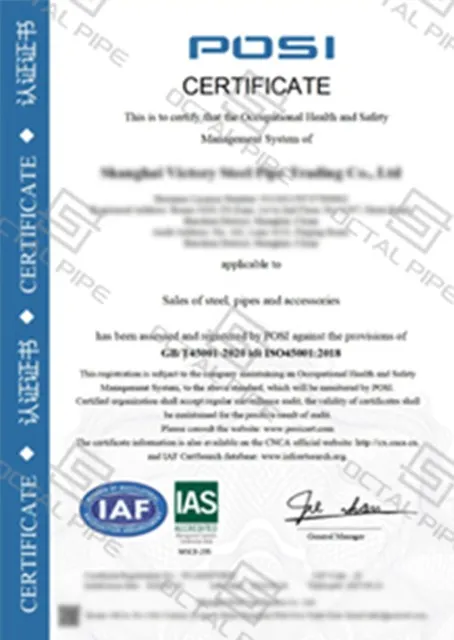
CE Certificate
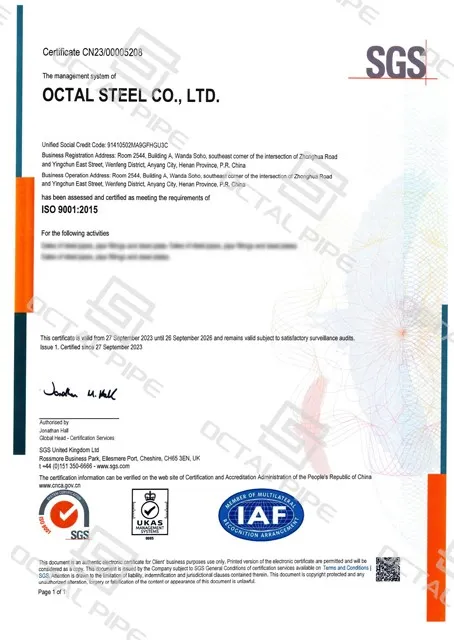
ISO 9001 Certificate
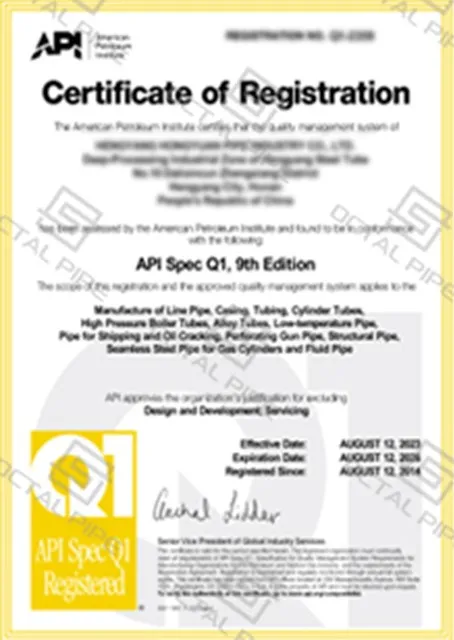
API Q1 Certificate
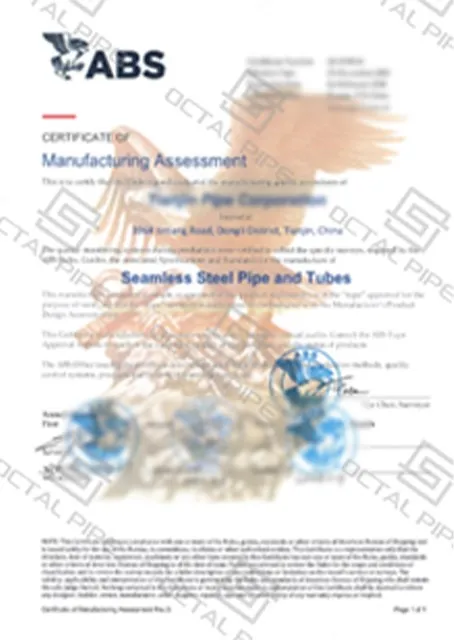
ABS Certificate
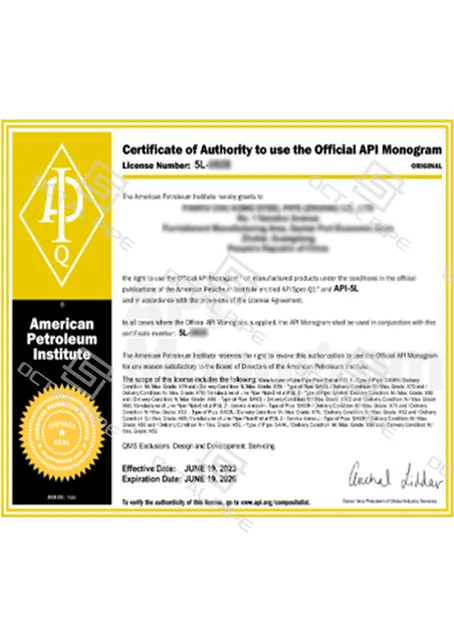
AP-5L Certificate
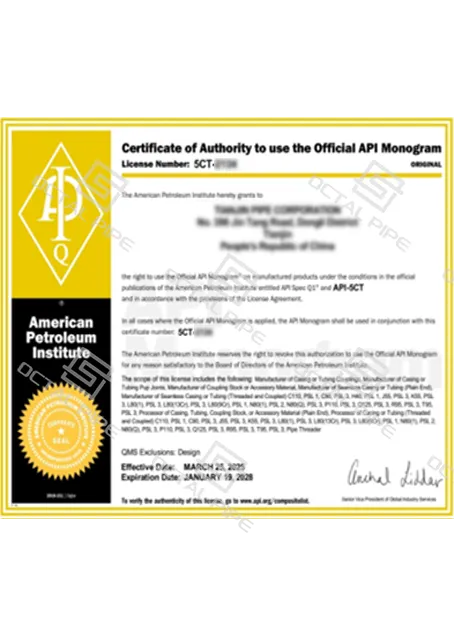
API-5CT Certificate
Standards: ASME B16.9, ASTM A234, ASTM A403
Materials: Carbon, Alloy, Stainless, Duplex Steel
Sizes: ½″ – 48″
Wall Schedules: SCH 5 – XXS
Types: Elbow, Tee, Reducer, Cap, Cross, Stub End
Connections: Butt weld (standard), Socket/Threaded (smaller sizes)
Hot Tags: butt pipe fittings, China Butt Weld Fittings manufacturers, suppliers, factory
Previous
No InformationYou Might Also Like



Send Inquiry