




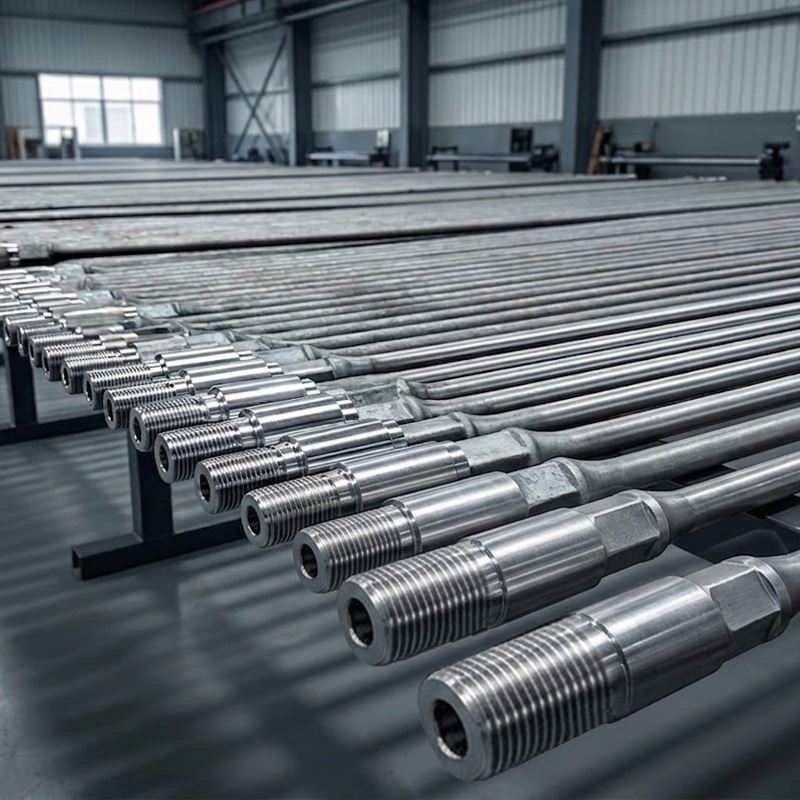
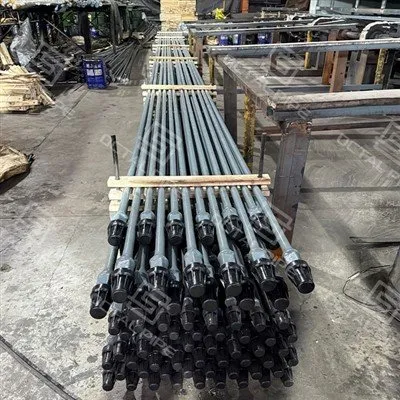
AISI 4130 Sucker Rod
Material: AISI 4130 alloy steel
Design Standard: API 11B
Thread Form: Straight sucker rod thread, 10 TPI
Nominal rod length: 25FT, 30FT
Pony rod length: 2FT, 4FT, 6FT, 8FT, 10FT, 12FT
End Connection: Pin x Pin, Pin x Box with coupling
Coupling Type: Class T, Class SM
An AISI 4130 Sucker Rod is a heat-treated alloy steel rod used to transfer reciprocating load from the surface unit to the downhole assembly in a sucker rod pump system. In actual service, the rod body carries repeated axial loading, the upset transition sees stress concentration, and the threaded ends must maintain stable makeup over long pumping cycles. For that reason, the steel grade alone is not enough to define the product. The finished rod condition, the thread form, the thermal route, and the traceability of each heat all matter to field performance. API 11B defines sucker rod thread form requirements, including straight threads at 10 threads per inch with Class 2A-2B tolerances.
The aisi 4130 standard question on this product usually covers two layers at the same time. One layer is the chemistry and heat-treatment response of aisi 4130 alloy steel itself. The other is the finished-product requirement of the rod string component under API 11B. AISI 4130 is a chromium-molybdenum low-alloy steel with reference chemistry of 0.280–0.330% C, 0.40–0.60% Mn, 0.80–1.10% Cr, and 0.15–0.25% Mo, which makes it suitable for a quenched-and-tempered route with higher strength and better hardenability than plain carbon steel.
AISI 4130 Sucker Rod Specifications
Standard sucker rod dimensions follow the API 11B size system. Common nominal sizes are 5/8 in., 3/4 in., 7/8 in., 1 in., and 1-1/8 in., and standard sucker rod nominal lengths are 25 ft and 30 ft. Pony rod lengths commonly include 2, 4, 6, 8, 10, and 12 ft. These dimensions are used because interchangeability in the rod string depends on standard rod sizes, thread compatibility, and coupling fit, not only on steel chemistry.
| Item | Typical Range |
|---|---|
| Product name | AISI 4130 Sucker Rod |
| Finished-product standard | API 11B |
| Material route | AISI 4130 alloy steel |
| Common rod sizes | 5/8 in., 3/4 in., 7/8 in., 1 in., 1-1/8 in. |
| Standard rod lengths | 25 ft, 30 ft |
| Pony rod lengths | 2 ft, 4 ft, 6 ft, 8 ft, 10 ft, 12 ft |
| Thread form | Straight sucker rod thread, 10 TPI |
| Supply condition | Upset forged ends, heat treated, threaded, with coupling and protectors as required |
| Release documents | MTR, dimensional inspection, mechanical properties, marking and lot traceability |
Practical specification goes well beyond rod diameter and length. The rod shoulder, pin length, upset profile, thread finish, and coupling condition all influence how the connection performs under cyclic loading. In deeper wells or higher-load strings, even small variations at the upset transition or thread area can shorten fatigue life well before the rod body itself becomes the limiting section. That is why API 11B does more than standardize nominal sizes. It also defines the thread form and the dimensional system that keep the connection consistent from one rod to the next.

AISI 4130 Chemistry and Strength
AISI 4130 alloy steel is a low-alloy Cr-Mo steel designed to respond well to heat treatment. Its reference composition includes Cr 0.80–1.10%, Mo 0.15–0.25%, C 0.280–0.330%, Mn 0.40–0.60%, Si 0.15–0.30%, with P 0.035% max and S 0.040% max. That chemistry gives the steel better hardenability than plain carbon grades and helps maintain strength through the upset and threaded-end manufacturing route.
The term aisi 4130 yield strength should be understood in the context of the finished rod, not just the steel grade itself. For normalized AISI 4130, the commonly referenced values are about 460 MPa / 66.7 ksi yield strength and 560 MPa / 81.2 ksi tensile strength. These figures are useful for understanding the base material, but they do not fully represent the condition of a finished sucker rod. After upsetting, heat treatment, machining, and threading, the rod is no longer just 4130 bar stock. It is a completed oilfield component, and its released mechanical properties need to match the final production condition of the actual lot.
| AISI 4130 Reference Data | Value |
|---|---|
| Carbon | 0.280–0.330% |
| Manganese | 0.40–0.60% |
| Silicon | 0.15–0.30% |
| Chromium | 0.80–1.10% |
| Molybdenum | 0.15–0.25% |
| Phosphorus | 0.035% max |
| Sulfur | 0.040% max |
| Ultimate tensile strength | 560 MPa / 81,200 psi |
| Yield strength | 460 MPa / 66,700 psi |
AISI 4130 Sucker Rod Manufacturing Process
The manufacturing sequence for an AISI 4130 Sucker Rod generally starts from alloy steel bar, followed by end upsetting, heat treatment, straightening, machining, thread cutting, gauging, and coupling assembly when required. In this route, the most sensitive areas are the upset transition and the threaded ends, because those locations see repeated load reversals and the highest concentration of local stress during pumping. A stable upset profile and controlled thermal cycle matter more than a polished description of the base steel.
For 4130 itself, typical fabrication guidance includes forging at 954–1204°C (1750–2200°F), quench-related heat treatment beginning around 871°C (1600°F), and further heat-treatment practice in the 899–927°C (1650–1700°F) range, with tempering commonly in the 399–566°C (750–1050°F) range depending on the required strength level. These numbers explain why 4130 is suitable for a controlled strength route: it can be forged, heat treated, and tempered into a stronger finished condition while still remaining practical for machining and threading.
Threading is not a cosmetic step. API 11B requires the sucker rod connection to use 10 TPI straight threads with Class 2A-2B tolerances, and it gives specific dimensional limits for pin threads by nominal size. When thread form, pitch diameter, and shoulder condition stay consistent, the connection works as a load path instead of becoming the first weak point in the string.


AISI 4130 Sucker Rod Quality Control and Traceability
Quality control starts at the raw material stage. A stable supply route typically checks incoming steel by electromagnetic and/or ultrasonic methods before final manufacture so that internal discontinuities, steel soundness issues, or material mix-ups are screened out before upsetting and machining. On alloy rod production, that early screening matters because defects below the surface can later show up as reduced fatigue life or unstable performance near the upset and thread zones.
API 11B also makes the finished inspection route very clear. Steel sucker rods and steel pony rods must be traceable to the heat of raw material, and the chemical composition must be an AISI-series steel or equivalent that can be effectively heat treated to the required mechanical properties. Mechanical property testing is performed in accordance with ASTM A370 or ISO 6892, and the standard requires a minimum of two mechanical tests on at least two rod bodies, one near the beginning and one near the end of each heat, after final thermal processing. That requirement is important because it ties the released test result to the actual finished rod condition.
Thread protection and handling control are equally practical parts of quality. API 11B requires thread protectors to protect the pin or box thread and contact face during normal transportation and handling, with external protectors on all external threads and internal protectors in the open ends of installed couplings. During storage, rods are to be separated by grade and size and stacked off the ground to minimize deterioration. Those are simple controls, but they directly affect whether a shipment arrives ready for use or ready for reinspection.
Marking and lot traceability stay with the product through storage and field preparation. API 11B requires permanent marking on the wrench square including the manufacturer's mark, nominal size, grade, identification code, month of manufacture, and year of manufacture. The identification code must link the rod to the date of manufacture, grade of steel, heat number, and metallurgical treatment, and that record must be available on request for five years from the date of manufacture.
AISI 4130 Sucker Rod for Sucker Rod Pump Service
In a sucker rod pump system, the rod string is exposed to repeated upstroke and downstroke loading rather than a single static pull. The highest stress is usually not in the middle of the rod body, but around the upset transition, pin thread, and coupling contact area, where cyclic load is transferred again and again during long-term pumping service. That is why rod selection is closely tied to actual well conditions, not just nominal size.
In field operation, this becomes more noticeable in situations such as:
- Deeper pumping wells, where rod load rises with string length and the connection sees higher repeated tensile stress.
- High-stroke or high-cycle service, where the number of load reversals increases and fatigue life becomes more important than simple static strength.
- Frequent workover or partial-string replacement, where thread condition, metallurgy consistency, and lot traceability affect how easily the replacement rods can be put back into service.
- Progressive cavity pumping service, where the rod may carry both axial load and torsional stress, making the connection area more sensitive than in conventional beam pumping.
This is where AISI 4130 shows its value in sucker rod service. Compared with basic carbon steel, it responds better to heat treatment while still remaining suitable for upsetting, machining, and threading. In actual operation, the advantage of 4130 is not just a higher strength figure on the test report. It is the more dependable combination of hardenability, fatigue resistance, and manufacturing consistency in the finished rod. That becomes more important in wells where cyclic loading is continuous, connection performance has to stay stable over time, and replacement rods need to match the existing string without adding unnecessary running risk.
Why Choose Octal for AISI 4130 Sucker Rod
Octal can supply AISI 4130 Sucker Rod with attention to the details that decide whether the finished rod is easy to release and easy to use: controlled alloy sourcing, stable upsetting, heat-treatment discipline, API-based thread machining, protective packing, and a document package linked back to heat and lot records. That combination is more useful than a broad strength claim because it keeps the steel chemistry, finished dimensions, mechanical properties, and shipment identity in one traceable chain.
A clear order normally includes rod size, nominal length, alloy route, coupling condition, protector requirement, and release documents. When these items are defined early, the finished rod is easier to inspect, easier to store by lot, and easier to place back into the working string without unnecessary sorting or compatibility checks.
FAQ

01.Is an AISI 4130 Sucker Rod ordered to API 11B or only to a material grade?
02.What should be included in an RFQ for AISI 4130 Sucker Rod?
03.Is published aisi 4130 yield strength enough to accept a finished sucker rod?
04.Can AISI 4130 Sucker Rod Be Used in Beam and PCP Service?
Certifications

CE Certificate

ISO 9001 Certificate

API Q1 Certificate

ABS Certificate

AP-5L Certificate

API-5CT Certificate
Hot Tags: AISI 4130 Sucker Rod, aisi 4130 alloy steel, aisi 4130 standard, aisi 4130 yield strength, sucker rod pump, API 11B sucker rod
Previous
Sucker RodYou Might Also Like


Send Inquiry