




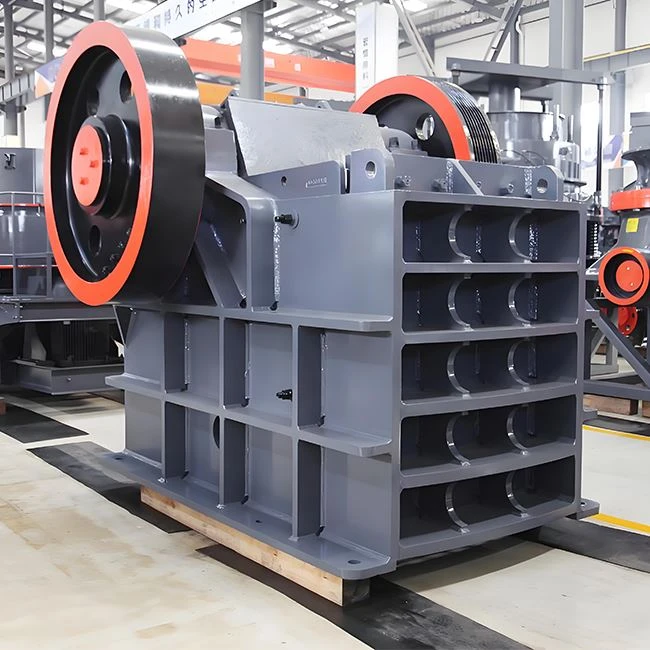
Rock Crusher
Scope: Feeding → Crushing (primary/secondary) → Screening/Recirculation → Washing/Transfer
RFQ inputs: Material condition (abrasiveness/moisture/clay), Max feed size, Target capacity (t/h), Target gradation/mesh, Power standard, Site footprint
Core equipment: Vibrating Feeder, Heavy Hammer Crusher, Jaw Crusher (PE), Impact Crusher,
YK Vibrating Screen, Drum Sieve, Spiral Washer, High-Efficiency Sand Washer, Bucket Elevator
Common checkpoints: Feed limit, Discharge/mesh range, Capacity band, Motor power (kW), Dimensions/weight, Wear parts & spares scope
Delivery pack: Equipment list, Packing list, Manuals/parts list, Inspection records (if required)
Rock crushers are industrial-size machines that break down large rock, stone, ore, and demolition concrete into controlled, usable sizes for aggregate production, recycling, and mining feed preparation. Depending on the material and target output, they reduce size mainly by compressive crushing (such as jaw, cone, or gyratory crushing) or by impact crushing (impact crushers for shaping and secondary reduction). Rock crushers are supplied as stationary, portable, or mobile units, allowing processing either in a fixed plant or directly on-site to minimize hauling, control product gradation, and improve overall jobsite efficiency.
Send us your feed size, target gradation, tph requirement, and whether your site needs portable/mobile equipment. We'll recommend a configuration that meets your output and installation constraints with clear deliverables and documentation for export shipment.
Rock Crushing Process and RFQ Checklist
A rock crusher for sale should be compared by measurable RFQ inputs, not catalog capacity alone. In real projects, abrasive feed can push wear cost up fast unless liner/hammer scope and start-up spares are defined up front. On clay or sticky feed, screening can blind and recirculation rises, so pre-scalping and washing scope should be confirmed against your fines target and water/slurry handling plan.
Before PO, confirm these acceptance points:
- Rated capacity band at the specified feed condition and setting
- Max feed size limit and any required pre-screening
- Target gradation and whether the circuit is open or closed (recirculation)
- Power standard (kW, voltage/frequency, starting method)
- Installation envelope (footprint, clearance, lifting points)
- Wear-part scope + start-up spares, plus nameplate/packing list consistency
How Does a Rock Crusher Work?
On a typical quarry or mining site, the rock crusher machine sits upstream of the screening and conveying system. Its role is to control the max particle size entering the line, which directly affects screen efficiency, belt loading, and downstream wear-part consumption.

| Stage (Closed Circuit) | What Happens | What You Should Confirm (Procurement/Acceptance) |
|---|---|---|
| 1. Feed Control (Before the Crusher) | A feeder meters material into the crusher at a stable rate to avoid surges, bridging, and uneven wear. | Material type, moisture/clay, max lump size; stable feed requirement for site conditions (especially portable/mobile). |
| 2. Primary Crushing (Make it "processable") | Jaw crusher uses compression to reduce large feed into a stable size for downstream stages. | Jaw opening vs max feed size; target discharge to next stage; bridging risk; wear-part plan. |
| 3. Secondary/Tertiary Crushing (Make it "saleable") | Choose crusher type based on reduction, shaping, and wear cost. | Selection depends on hardness/abrasiveness, target gradation, wear cost, uptime. |
| 3a. Impact / Hammer Crushing | Impact reduction + shaping; fast reduction on suitable materials. | Material suitability; wear parts (hammers/liners); contamination strategy for recycling feed. |
| 3b. Cone Crushing | Compression secondary/tertiary; stable output in harder rock. | Liner profile; recirculation load; stable capacity requirements. |
| 3c. Vertical Shaft Crushing (VSI-type) | Sand shaping + controlled fines; often used for 0–5mm manufactured sand. | Required particle shape; fines control; screening/washing integration. |
| 4. Screening Recirculation (Final size is decided here) | Screens split on-size product vs oversize return; recirculation locks final gradation. | Screen deck sizing; target product sizes; recirculation ratio; avoid over-crushing and capacity loss. |
| 5. Washing (Optional) | Removes clay/fines when cleanliness or grading curve requires it. | Fines limit, water availability, recovery/dewatering plan, discharge requirements. |
| Portable/Mobile vs Stationary Note | Principle is the same; portable/mobile faces more variable feed and tighter footprint. | Transport envelope, setup time, site power, screening loop design, start-up spares. |
| Acceptance Inputs (RFQ Checklist) | Defines whether the circuit works as quoted. | Material + max feed + target gradation + tph + layout + screening/washing scope. |
If you're comparing rock crushers for sale, start by locking the job inputs-material, max feed size, target products, and required capacity (t/h). These decide whether you need a jaw crusher as primary, an impact/hammer/cone stage for secondary reduction, and a closed-circuit screening loop to control final gradation.
Jaw Crusher PE Series
PE series jaw crushers are widely used for primary crushing where larger feed openings and stable throughput are required. To help buyers avoid re-quoting and configuration changes, Octal Pipe aligns PE jaw crusher selection to measurable RFQ checkpoints: feed opening size, maximum feed size, discharge range, capacity band, installed power, and the installation envelope (overall dimension and weight).
In line design, the jaw crusher typically sets the front-end capacity ceiling. If the jaw is undersized relative to feeder/hopper loading, it becomes the bottleneck; if oversized, CAPEX increases without improving finished output unless downstream stages can absorb the throughput. For procurement approval, treat the jaw crusher as the "primary throughput anchor," and confirm its discharge range matches the next stage (impact crusher or screening) to keep the line balanced and acceptance-ready.
Jaw crushers are widely used as primary crushers for coarse crushing where stable throughput and a large reduction ratio are required. Typical features include:
- Large reduction ratio for efficient coarse crushing and fewer stages in the front end of the line.
- High throughput with steady operation for primary crushing duty.
- More uniform discharge size, supporting smoother downstream screening and secondary crushing.
- Simple structure with practical design, making installation and on-site service easier.
- Convenient maintenance, with wear parts that can be inspected and replaced without complex procedures.
- Lower operating cost driven by straightforward mechanics and reduced maintenance complexity.
- Material strength boundary: suitable for materials with compressive strength up to 320 MPa (confirm by material type and abrasiveness for final selection).
Strengths: strong coarse crushing capability and broad application range.
Considerations: product shape is typically not final; a secondary stage plus screening is commonly required.
Key RFQ data points: feed opening (mm), max feed (mm), discharge range (mm), capacity (t/h), eccentric speed (r/min), power (kW), weight (t), overall dimension (mm).


| Model | Feed Opening (mm) |
Max Feed (mm) |
Discharge (mm) |
Capacity (t/h) |
Eccentric Speed (r/min) |
Power (kW) |
Weight (t) |
Overall Dimension (L × W × H) (mm) |
|---|---|---|---|---|---|---|---|---|
| PE-150×250 | 150×250 | 125 | 10–40 | 1–3 | 250 | 5.5 | 0.8 | 720×660×850 |
| PE-200×300 | 200×300 | 180 | 15–50 | 2–6 | 260 | 7.5 | 1.2 | 910×750×990 |
| PE-200×350 | 200×350 | 180 | 18–70 | 3–10 | 260 | 11 | 1.5 | 1000×870×990 |
| PE-250×400 | 250×400 | 210 | 20–60 | 5–20 | 300 | 18.5 | 2.8 | 1300×1090×1270 |
| PE-400×600 | 400×600 | 340 | 40–100 | 16–60 | 275 | 30 | 7 | 1730×1730×1630 |
| PE-500×750 | 500×750 | 425 | 50–100 | 40–110 | 275 | 55 | 12 | 1980×2080×1870 |
| PE-600×900 | 600×900 | 500 | 65–160 | 50–180 | 250 | 75 | 17 | 2190×2206×2300 |
| PE-750×1060 | 750×1060 | 630 | 80–140 | 110–320 | 250 | 90 | 29 | 2660×2430×2800 |
| PE-900×1200 | 900×1200 | 750 | 95–165 | 220–450 | 200 | 110 | 52 | 3380×2870×3330 |
| PE-1000×1200 | 1000×1200 | 850 | 195–265 | 315–500 | 200 | 110 | 55 | 3480×2876×3330 |
| PE-1200×1300 | 1200×1300 | 1000 | 180–330 | 400–650 | 220 | 200 | 62 | 4539×2984×3959 |
| PE-1200×1500 | 1200×1500 | 1020 | 150–350 | 400–800 | 180 | 250 | 80 | 4200×3300×3500 |
| PE-1500×1800 | 1500×1800 | 1200 | 220–350 | 450–1000 | 180 | 280 | 122 | 5160×3660×4248 |
Vibrating Feeder
A vibrating feeder meters raw stone from a hopper to the primary crusher at a controlled rate. For procurement, selection is mainly driven by the groove size (to match hopper/loader), the allowable feed particle size, and the capacity band needed to keep the primary crusher stable without surging.
In a typical line, this unit protects downstream equipment by smoothing the feed rate and reducing sudden overload events that accelerate jaw/hammer/impact wear. The "right" feeder is the one that maintains stable mass flow under the site's real feed condition (moisture + clay + mixed size distribution), not only under ideal test feed.
• Strengths: stabilizes crusher loading, reduces bridging risk, improves wear consistency on the primary stage.
• Considerations: hopper outlet geometry and feed condition (moisture/clay) can cause uneven flow if not sized correctly.
• Key RFQ data points: groove size, max feed particle size, processing capacity (t/h), motor power (kW).


| Model | Groove Size (mm) |
Feed Particle Size (mm) |
Processing Capacity (t/h) |
Motor Power (kW) |
|---|---|---|---|---|
| GZD6523 | 650 × 2300 | ≤ 400 | 40–80 | 1.1 × 2 |
| GZD9836 | 980 × 3600 | ≤ 500 | 80–200 | 2.2 × 2 |
| GZD1136 | 1100 × 3600 | ≤ 700 | 160–210 | 3.7 × 2 |
| GZD1238 | 1200 × 3800 | ≤ 750 | 250–400 | 5.5 × 2 |
| GZD1250 | 1200 × 5000 | ≤ 750 | 250–450 | 5.5 × 2 |
| GZD1538 | 1500 × 3800 | ≤ 1000 | 400–500 | 7.5 × 2 |
| GZD1550 | 1500 × 5000 | ≤ 1000 | 500–800 | 9.5 × 2 |
| GZD2038 | 2000 × 3800 | ≤ 1200 | 800–1000 | 12.5 × 2 |
| GZD2050 | 2000 × 5000 | ≤ 1200 | 800–1200 | 15 × 2 |
Heavy Hammer Crusher
A heavy hammer crusher is selected when the material and target product allow a high reduction ratio in a simplified flow, often enabling one-stage crushing and reducing the need for a traditional secondary crushing train. In many aggregate jobs it can produce a controlled discharge band (commonly up to 0–60 mm in one pass, depending on material and configuration), which helps shorten the layout and reduce transfer points.
From a procurement standpoint, this is a cost-per-ton decision: the flow can be simplified, but uptime depends on abrasiveness, feed variability, and wear-part planning. Typical design points that matter on site include a no-grate structure with adjustable gap (lower plugging sensitivity under variable moisture), wear-focused rotor/fastening design, reinforced hammer shaft/hammer-hole protection, and maintenance-friendly access (hydraulic opening/inspection where configured).
Strengths: high reduction ratio in suitable materials; can simplify the line layout.
Considerations: wear exposure is sensitive to stone hardness/abrasiveness; practical spares are required.
Key RFQ data points: material & abrasiveness, max feed size, target discharge band, capacity (t/h), motor power (kW), and Heavy vs Standard configuration.


| Type | Model | Feed Size (mm) |
Capacity (t/h) |
Motor Power (kW) |
|---|---|---|---|---|
| Heavy | PCZ1312 | ≤ 500 | 150–200 | 110 × 2 |
| PCZ1512 | ≤ 600 | 250–400 | 160 × 2 | |
| PCZ1615 | ≤ 650 | 400–700 | 220 × 2 | |
| PCZ1815 | ≤ 650 | 400–900 | 250 × 2 | |
| PCZ1820 | ≤ 800 | 800–1500 | 800-6 | |
| PCZ2125 | ≤ 1200 | 2000–3000 | 1250-6 | |
| Standard | PC-0706 | ≤ 400 | 50–70 | 75 |
| PC-1010 | ≤ 500 | 80–150 | 90 × 2 | |
| PC-1012 | ≤ 200 | 150–250 | 110 × 2 | |
| PC-1213 | ≤ 200 | 250–300 | 132–160 × 2 | |
| PC-1216 | ≤ 250 | 300–400 | 160–200 × 2 | |
| PC-1220 | ≤ 250 | 400–600 | 200–220 × 2 |
Impact Crusher
Impact crushers are selected for secondary crushing and shaping when particle form and adjustable output size are required. They are commonly run in closed circuit with vibrating screens to meet target gradation and reduce flaky output. For RFQ alignment, Octal Pipe recommends confirming max feed size and feed opening first, because these control throughput and wear exposure; typical hydraulic impact crusher ranges include 250–700 mm feed and 60–548 t/h capacity depending on material and configuration.
This category is often chosen for maintenance efficiency: hydraulic opening improves access, replaceable wear liners (wear-resistant alloy) help manage wear cost, and an adjustable discharge setting supports stable grading with a practical screening loop.
Strengths: good shaping and adjustable discharge; strong fit for closed-circuit screening.
Considerations: abrasive feed increases liner consumption; stable feeding improves uptime.
Key RFQ data points: material & abrasiveness, max feed (mm), feed opening (mm), target discharge band, capacity (t/h), motor power (kW).


| Model | Specifications (mm) |
Feed Opening (mm) |
Max Feeding Side Length (mm) |
Capacity (t/h) |
Motor Power (kW) |
Weight (t) |
|---|---|---|---|---|---|---|
| PF-0807 | φ850 × 700 | 400 × 730 | ≤ 100 | 15–30 | 30–45 | 6.5 |
| PF-1008 | φ1000 × 800 | 400 × 830 | ≤ 150 | 30–50 | 37–55 | 10.5 |
| PF-1010 | φ1000 × 1050 | 400 × 1080 | ≤ 150 | 50–80 | 55–75 | 12.5 |
| PF-1210 | φ1250 × 1050 | 400 × 1080 | ≤ 200 | 70–120 | 110–132 | 15.8 |
| PF-1214 | φ1250 × 1400 | 400 × 1430 | ≤ 300 | 130–180 | 132–160 | 19.8 |
| PF-1315 | φ1320 × 1500 | 860 × 1520 | ≤ 350 | 160–250 | 200 | 26 |
| PF-1320 | φ1320 × 2000 | 860 × 2030 | ≤ 350 | 200–300 | 280 | 32 |
| PF-1515 | φ1550 × 1500 | 900 × 1650 | ≤ 400 | 300–350 | 160 × 2 | 38 |
YK Series Round Vibrating Screen
YK series screens grade crushed material into saleable fractions and support closed-circuit recirculation control. Procurement should align screen area, deck count, and mesh size range to the required output fractions, then confirm frequency and amplitude for site conditions.
In a line, the screen is the "quality gate" that defines the final fraction output and controls recirculation load. If the screen is undersized or blinded by sticky feed, the entire plant output becomes unstable. Procurement checks should align mesh size ranges to your target products and confirm that the screen configuration (layers, sieve area) can sustain rated throughput without chronic recirculation overload.
• Strengths: scalable throughput, supports multi-fraction grading, suitable for recirculation control.
• Considerations: sticky feed can cause blinding; screen media selection drives uptime.
• Key RFQ data points: layers, sieve area (m²), mesh size (mm), max feeding size (mm), capacity (t/h), frequency (r/min), amplitude (mm), motor power (kW), weight (t).


| Model | Layers | Sieve Area (m²) |
Mesh Size (mm) |
Max Feeding Size (mm) |
Capacity (t/h) |
Vibrating Frequency (r/min) |
Double Amplitude (mm) |
Motor Power (kW) |
Weight (t) |
|---|---|---|---|---|---|---|---|---|---|
| 2YK1235 | 2 | 4.2 | 5–50 | 80 | 15–100 | 800–970 | 8 | 5.5 | 3.2 |
| 3YK1235 | 3 | 4.2 | 5–50 | 80 | 30–100 | 800–970 | 8 | 7.5 | 4.4 |
| 2YK1545 | 2 | 6.75 | 5–50 | 100 | 50–180 | 800–970 | 8 | 15 | 5.3 |
| 3YK1545 | 3 | 6.75 | 5–50 | 100 | 50–210 | 800–970 | 8 | 15 | 6.1 |
| 4YK1545 | 4 | 6.75 | 5–50 | 100 | 50–240 | 800–970 | 8 | 18.5 | 6.9 |
| YK1848 | 1 | 8.8 | 5–100 | 200 | 56–330 | 755 | 11 | 15 | 7.2 |
| 2YK1848 | 2 | 8.8 | 5–100 | 200 | 56–330 | 750 | 11 | 15 | 6.2 |
| 3YK1848 | 3 | 8.8 | 5–100 | 200 | 56–330 | 970 | 7 | 22 | 7 |
| 2YK1860 | 2 | 10.8 | 5–80 | 200 | 50–330 | 800–970 | 8 | 22 | 8 |
| 3YK1860 | 3 | 10.8 | 5–80 | 200 | 50–360 | 800–970 | 8 | 22 | 8.6 |
| 4YK1860 | 4 | 10.8 | 5–80 | 200 | 100–400 | 800–970 | 8 | 30 | 9.2 |
| 2YK2160 | 2 | 12.6 | 5–100 | 200 | 100–430 | 970 | 8 | 30 | 8.8 |
| 3YK2160 | 3 | 12.6 | 5–100 | 200 | 100–460 | 970 | 8 | 30 | 9.45 |
| 4YK2160 | 4 | 12.6 | 5–100 | 200 | 120–460 | 970 | 8 | 30 | 10.9 |
| 2YK2470 | 2 | 16.8 | 5–100 | 200 | 150–500 | 970 | 8 | 37 | 9.63 |
| 3YK2470 | 3 | 16.8 | 5–100 | 200 | 150–550 | 970 | 8 | 37 | 11.5 |
| 4YK2470 | 4 | 16.8 | 5–100 | 200 | 180–600 | 970 | 8 | 37 | 12.78 |
| 2YK2860 | 2 | 16.8 | 5–100 | 400 | 200–700 | 970 | 8 | 37 | 16 |
| 3YK2860 | 3 | 16.8 | 5–100 | 400 | 200–700 | 970 | 8 | 37 | 16 |
| 2YK3072 | 2 | 21.6 | 5–100 | 400 | 250–800 | 750 | 8 | 30 × 2 | 18 |
| 3YK3072 | 3 | 21.6 | 5–100 | 400 | 250–800 | 750 | 8 | 30 × 2 | 18 |
Drum Sieve
A drum sieve is typically selected where feed is sticky, mixed, or prone to blinding traditional screen media. Procurement should focus on cylinder size, rotation speed, gradient, and the separation cut required by the process.
This unit is frequently used as a pre-separation stage to protect downstream crushers and improve line stability when the feed contains high clay content or mixed sizes that cause screen blinding. Procurement selection should confirm that the intended separation objective (scalping, pre-screening, or simple grading) matches drum design capacity and site feed condition.
• Strengths: strong anti-blinding behavior, suitable for mixed/wet feed pre-separation.
• Considerations: grading precision is generally lower than multi-deck vibrating screens for tight fraction control.
• Key RFQ data points: cylinder diameter/length (mm), rotate speed (r/min), gradient (°), power (kW), capacity (t/h), overall dimension (mm).


| Specification | Cylinder Diameter (mm) |
Cylinder Length (mm) |
Rotate Speed (r/min) |
Gradient (°) |
Power (kW) |
Capacity (t/h) |
Overall Dimension (L × W × H) (mm) |
|---|---|---|---|---|---|---|---|
| GS1.0 × 3.0 | 1000 | 3000 | 22 | 2–2.5 | 1.5 | 20–60 | 3500×1400×2200 |
| GS1.2 × 4.5 | 1200 | 4500 | 17 | 2–2.5 | 4 | 30–80 | 5700×1600×2400 |
| GS1.5 × 5.0 | 1500 | 5000 | 14 | 2–2.5 | 7.5 | 80–160 | 6860×1900×2810 |
| GS1.8 × 6.0 | 1800 | 6000 | 12 | 2–2.5 | 11 | 110–260 | 7300×2000×3000 |
| GS1.8 × 8.0 | 1800 | 8000 | 11.5 | 2–2.5 | 11 | 150–360 | 10000×2200×3200 |
Spiral Sand Washer (Screw Washer) - Clay and Silt Removal
A spiral stone washing machine (spiral sand washer / screw washer) is used in wash and screening plants to remove clay, silt, and light organics from sand and aggregates when "cleanliness" and grading stability are acceptance requirements. The unit performs continuous washing by combining conveying and agitation with controlled overflow, separating fine contaminants into the slurry stream while delivering cleaner material to the discharge.
Procurement evaluation should focus on the variables that directly determine washing efficiency and operating stability: residence time (screw diameter + trough length), agitation level (spiral speed), hydraulic condition (water flow rate and overflow setting), and solids loading (t/h and feed mud content). If these variables are not matched to the upstream screening load, typical issues include carry-over of fines, unstable discharge moisture, and capacity loss due to slurry bottlenecks.
Because washing performance is constrained by the site's slurry system, the scope should be defined together with slurry discharge, settling/clarification, and water recycling. A workable plan for settling tank sizing, overflow control, and water reuse is often the difference between "washed sand" on paper and consistent quality in production.
For accurate sizing and quotation from Octal Pipe, please confirm: feed material type, estimated clay/silt level, target capacity (t/h), required cleanliness (fines limit if specified), available water supply, discharge arrangement, and whether a settling/clarification circuit is included. We will align screw size and operating range to your real solids and water balance, and define the matching interfaces for pumps, chutes, and slurry handling.


| Item | XS1050 | XS1275 | XS1575 | XS1875 | XS2080 |
|---|---|---|---|---|---|
| Screw Diameter (mm) |
1000 | 1200 | 1500 | 1800 | 2000 |
| Length (mm) |
5000 | 5400 | 7200 | 7200 | 8000 |
| Spiral Speed (r/min) |
18 | 16 | 14 | 12 | 8 |
| Capacity (t/h) |
10–30 | 30–50 | 50–80 | 80–150 | 100–200 |
| Motor Power (kW) |
11 | 15 | 30 | 37 | 45 |
| Dimension Length (m) |
8 | 9.7 | 9.9 | 10 | 10.5 |
| Dimension Width (m) |
1.25 | 1.44 | 1.85 | 2.1 | 2.5 |
| Dimension Height (m) |
2.2 | 2.4 | 2.8 | 3.2 | 3 |
High Efficiency Sand Washing Machine
High-efficiency sand washing machines are used to reduce impurities and improve finished sand cleanliness and consistency. Procurement should confirm reel diameter, feed-in size limit, required capacity band, and the installation dimensions.
This unit is commonly used where finished sand quality must be more consistent and where capacity targets require stable washing performance. Procurement definition should include water availability, sediment management, and whether the site will run a water recycling loop, as these factors influence operating stability and compliance requirements.
• Strengths: improves finished sand quality and process stability in sand-making lines.
• Considerations: water usage and sediment management must match the site's recycling/clarification capability.
• Key RFQ data points: reel diameter (mm), feed-in size limit (mm), capacity (t/h), power (kW), dimensions (mm).


| Model | Reel Diameter (mm) |
Feed-in Size (mm) |
Capacity (t/h) |
Power (kW) |
Dimensions (L × W × H) (mm) |
|---|---|---|---|---|---|
| HY2600 | φ2600 | ≤ 10 | 20–50 | 5.5 | 3195×2100×2700 |
| HY2800 | φ2800 | ≤ 10 | 30–70 | 5.5 | 3270×2100×2900 |
| HY3000 | φ3000 | ≤ 10 | 50–120 | 11 | 3766×2382×3100 |
| HY3216 | φ3200 | ≤ 10 | 120–180 | 15 | 4100×2800×3250 |
| HY3624 | φ3600 | ≤ 10 | 140–220 | 18.5 | 4300×3970×3685 |
| HY4530 | φ4500 | ≤ 10 | 180–250 | 22 | 6010×4450×4622 |
Bucket Elevator
A bucket elevator is used for vertical transfer when the plant layout favors compact elevation instead of long inclined conveying. Procurement should confirm the max material size, capacity band, bucket distance, transport speed, and the installed power range.
This unit is typically chosen for compact plant layout and enclosed vertical lifting. Procurement checks should confirm the actual material size distribution and foreign object risk, as oversize lumps or debris can cause jams and unplanned stops. Maintenance access, inspection doors, and safe servicing space should be confirmed as part of the installation envelope.
• Strengths: compact footprint and enclosed vertical lifting in tight layouts.
• Considerations: oversized lumps and foreign objects increase jam risk; maintenance access and inspection doors should be planned.
• Key RFQ data points: max material size (mm), capacity (m³/h), transport speed (m/s), bucket distance (mm), power (kW).


| Model | Max Material Size (mm) |
Capacity (m³/h) |
Transport Speed (m/s) |
Bucket Distance (mm) |
Power (kW) |
|---|---|---|---|---|---|
| 200 | ≤ 25 | 3.5–8 | 1–1.25 | 400 | 3–7.5 |
| 250 | ≤ 30 | 5.5–12 | 1–1.25 | 500 | 3–7.5 |
| 300 | ≤ 40 | 15–30 | 1–1.25 | 500 | 3–11 |
| 400 | ≤ 40 | 50–90 | 1.4 | 512 | 7.5–18.5 |
| 500 | ≤ 40 | 70–110 | 1.5 | 688 | 11–22 |
| 630 | ≤ 50 | 110–180 | 1.5 | 688 | 11–22 |
Rock Crusher Production Line Configurations for Sale
This diagram shows four standard stone crushing production line layouts by capacity: 150–200 TPH, 350–400 TPH, 600–800 TPH, and 1000–1200 TPH. Each layout combines feeding, crushing, and screening to deliver multi-size aggregates with a closed-circuit return. Share your material, max feed size, target products, and required tph-Octal Pipe will match the appropriate line configuration.

Pre-Shipment Inspection and Release Checks
Before dispatch, a practical release routine is typically built around finished-product conformity, traceability, and packing readiness:
• Dimensional verification for key interfaces and critical size points (where applicable by model/spec)
• Visual checks for damage risks, fastener integrity, and assembly completeness
• Identification check: model and nameplate references aligned with packing list and order scope
• Packing verification: item count, accessories/spares separation, and label visibility to reduce receiving mix-ups
Additional release details commonly confirmed for smoother receiving:
• Clear marking and identification per crate or unit (model, quantity, gross/net weight where required)
• Accessories and spare parts packed separately with clear labeling to avoid site installation delays
• Document pack alignment to PO scope and packing list items
FAQ

Q1: How does a rock crusher work?
Q2: Portable rock crusher vs mobile rock crusher-what's the difference for buyers?
Q3: How do I choose the right spiral sand washer size (single vs double screw)?
Q4: Do you offer rock crusher rental or only rock crushers for sale?
Certifications

CE Certificate

ISO 9001 Certificate

API Q1 Certificate

ABS Certificate

AP-5L Certificate

API-5CT Certificate
| Key Item | What to Provide | What to Confirm (Acceptance) |
|---|---|---|
| Material & Abrasiveness | material type + wear sensitivity | crusher type + wear-part plan (liners/hammers) |
| Max Feed Size (mm) | max lump size / feed size limit | feed opening & pre-screen requirement |
| Capacity (t/h) | tph requirement + feed condition | rated capacity band at specified condition |
| Target Products / Gradation | target sizes + grading curve | stage selection + screen meshes/recirculation |
| Circuit Type | open or closed circuit | screening loop stability & recirculation ratio |
| Crusher Stages | primary + secondary needs | jaw + impact/cone/hammer + optional VSI shaping |
| Power Standard | voltage/frequency + starting method | motor kW alignment & electrical compatibility |
| Acceptance Deliverables | required checks/docs | discharge setting range + wear-part scope + nameplate/packing list match |
Hot Tags: rock crusher for sale,portable rock crusher, rock crusher machine, jaw crusher, impact crusher, cone crusher,mobile rock crusher, mini rock crusher, small rock crusher
Previous
No InformationNext
No InformationYou Might Also Like



Send Inquiry