




Chrome Moly Pipe
Length Range:20 FT,40 FT or Customized
Material Grades:ASTM A335 P5/P9/P11/P22/P91 Protection Caps: Plastic or Iron Available
Surface Finish: Natural,Varnished,Black Painting,3PE,FBE Coated
Chrome moly pipe(chromium-molybdenum) is a type of alloy steel tubing that contains chromium and molybdenum as key alloying elements.Chromium improves oxidation and corrosion resistance, while molybdenum enhances strength, toughness, and hardenability-making these materials exceptionally suited for high-temperature, high-pressure, and corrosive environments.
Common applications include power generation, oil & gas, and petrochemical process piping where durability and long-term performance are essential.


Chrome moly pipe Material Grades and Standards
Chrome moly pipe (also written as chrome-moly steel pipe) is specified when temperature, pressure, and long-term creep strength drive material choice in power and refinery piping. For most high-temperature circuits, buyers start from chrome moly seamless pipe grades under ASTM/ASME and then lock size, schedule, heat treatment, and documentation for receiving.
Buyers often reference a P22 pipe schedule chart during RFQ comparison, but the practical control is to lock NPS + schedule (or exact wall thickness) and the governing thickness standard for the project. Your quote is only comparable when the wall basis is identical across suppliers.
|
Standard Specification |
Grade Designation |
Description / Application |
|
ASTM A335 / ASME SA335 |
P1, P5, P9, P11, P22, P91 |
Seamless ferritic alloy-steel pipes for high-temperature service such as steam lines, superheaters, and refinery piping. |
|
ASTM A213 / ASME SA213 |
T5, T9, T11, T22, T91 |
Seamless alloy tubes for heat exchangers, superheaters, and boilers. |
|
ASTM A387 / ASME SA387 |
Gr.5, Gr.11, Gr.22, Gr.91 |
Chrome-moly steel plates used for pressure vessels and fabrication of welded piping systems. |
|
ASTM A691 |
5CR, 9CR, 22CR |
Welded alloy steel pipes produced from A387 plates, used in high-temperature or corrosive environments. |
|
API 5L (optional) |
X60–X100 |
For specific high-strength line-pipe applications where chrome-moly properties are beneficial. |
Common RFQs include 1/2 inch chrome pipe for instrument/auxiliary steam services and 1-1/4 chrome pipe for small-bore high-temperature lines, with schedule selected from the project's wall-thickness basis.
Chrome Moly Pipe Grades (1-1/4Cr, 2-1/4Cr, 5Cr, 9Cr - Buyer Short Names)
| Buyer shorthand | What it usually refers to | Typical pipe grade family on RFQs | Why buyers use the shorthand |
|---|---|---|---|
| 1-1/4 chrome material | ~1.25% Cr alloy family | Often mapped to P11/P12-type selections (project-specific) | Fast way to indicate low-alloy Cr-Mo class before final grade lock |
| 2-1/4 chrome material | ~2.25% Cr-1Mo family | P22 is the common procurement anchor | Widely used for hot piping where creep strength and oxidation resistance are needed |
| 5 chrome pipe | ~5% Cr family | P5 (and plate/welded equivalents by spec) | Chosen for higher oxidation resistance than low-Cr alloys |
| 9 chrome (welding-sensitive) | ~9% Cr family | P9 / P91 depending on design | This is the family where 9 chrome pipe welding controls (WPS/PWHT discipline) become critical |
Key Features and Advantages (Chrome Moly Pipe - What Buyers Actually Gain)
- High-temperature oxidation control: In fired heaters, superheater lines, and hot transfer piping, chrome-moly is selected to slow scaling and metal loss where carbon steel would thin out too fast. Octal Pipe focuses on keeping the grade family and delivery condition consistent so the pipe performs predictably after long heat exposure.
- Creep-strength where pressure stays on: For steam, high-pressure headers, and refinery circuits that run hot for years, the real value is creep resistance under sustained load-not headline tensile numbers. Octal Pipe helps buyers lock the correct Cr-Mo family (e.g., P11/P22/P91 by project spec) so long-term deformation risk is controlled at the material-selection stage.
- Fabrication-ready weldability (shop and tie-ins): Chrome-moly projects often lose time on re-cutting ends, mixed material in the yard, or welding procedure rework. Octal Pipe ships with clear identification and packing discipline so welders and inspectors can match WPS/PWHT requirements to the correct lot without "guessing by color" at the spoolbase.
- Thermal cycling stability: Hot lines don't just sit at one temperature-startups, shutdowns, and load swings drive fatigue. Octal Pipe's focus is to deliver pipe with consistent dimensional control and end prep so fit-up and welding are stable, reducing localized stress raisers that show up after repeated cycles.
- Cost control vs full nickel alloys: Many buyers only need alloy performance in specific hot, corrosive circuits-not across the entire unit. Octal Pipe supports that decision by supplying the chrome-moly scope with a receiving-ready document pack and traceability discipline, so the project can use Cr-Mo where it's justified without creating downstream QA delays.


Chrome Moly Pipe Welding & Bending Notes (What to Clarify Before Ordering)
Chrome moly pipe welding is usually where projects win or lose time-because WPS qualification, heat input control, and any PWHT requirements determine whether hardness and long-term creep performance stay within the design intent. For 9 chrome pipe welding (P9/P91 families), buyers typically treat procedure discipline as non-negotiable, especially at tie-ins and repairs.
If your scope includes hot/induction bends, state whether pipe is supplied straight for your chrome moly pipe bender or whether bends are supplied as prefabricated items under an approved bending procedure.
Don't let pipe and fittings mismatch drive late holds: for spool fabrication, specify matching chrome moly fittings / chrome moly pipe fittings (grade family + heat treatment condition) so elbows/tees/reducers weld and PWHT as one system.


Chrome Moly Pipe Procurement Controls (Avoid "Wrong Grade / Wrong Condition" Holds)
Chrome-moly projects rarely fail on "pipe exists." They fail when grade family is correct but the delivered condition isn't-mixed heats in one shipment, unclear heat-treat status, or pipe/fittings that don't weld/PWHT together. Octal Pipe treats chrome-moly sourcing as a control problem, not a catalog sale: the quote is built around how the material will be fabricated and accepted, so the lot can be released without re-identification work at the yard.
| Buyer risk (what causes delays) | How Octal Pipe controls it | What the buyer can file for receiving |
|---|---|---|
| Grade family confusion (P5/P9/P11/P22/P91) | RFQ is locked to the grade family + intended service temperature/pressure before quoting | MTC/CMTR set + heat/lot/bundle mapping |
| Mixed heats / mixed markings in one batch | Bundle discipline + readable joint marking aligned to packing list | Packing list + marking list aligned to bundles |
| Heat-treat condition unclear | Heat-treat condition is stated in the quote and shown in the document pack | Heat-treat statement + supporting mill records (as required by project QA) |
| PMI surprises at the spoolbase | PMI is planned as part of the acceptance workflow for alloy verification | PMI record template / report (if required by the project) |
Use this PO/RFQ checklist (fast comparable quotes):
- Grade family (P5/P9/P11/P22/P91) + service temperature range
- NPS + schedule (or exact WT) + tolerance basis
- Heat-treat / delivery condition requirement
- End finish (BE/PE), cut length, and any bend/spool scope
- Document pack checklist for receiving and fabrication release
Fabrication-Ready Chrome-Moly Delivery (Welding, PWHT, and Matching Fittings)
For chrome-moly, "pipe" is only half the system-the other half is whether the delivered package can be fabricated without rework. Field teams care about weldability, PWHT compatibility, and matching fittings, especially on P22 and 9Cr families where procedure discipline is tight. Octal Pipe builds the supply scope around those fabrication realities so the material arrives ready for shop welding and tie-ins.
- Chrome moly pipe welding readiness: Connection ends, bevel quality, and consistent material identification reduce avoidable cross-mixing and re-cut work at the shop.
- 9 chrome pipe welding discipline (P9/P91 families): Buyers typically treat WPS/PWHT requirements as "must-align" items-so the pipe package is quoted with fabrication expectations in mind, not left to site interpretation.
- Matching chrome moly fittings: For spool work, pipe and fittings need the same grade family and compatible heat-treat assumptions so elbows/tees/reducers don't become the late hold that stops welding progress.
| Fabrication question buyers ask | What to clarify before shipment |
|---|---|
| Can this lot be welded and PWHT as one system? | Grade family + heat-treat condition + fabrication expectation |
| Will fittings match the pipe on WPS/PWHT? | Matching fitting grade family + compatibility note |
| Are schedules comparable across quotes? | Lock NPS + schedule (or WT) so "P22 schedule chart" comparisons are apples-to-apples |
Chrome moly pipe Typical Applications (Enhanced Version)
Chrome-moly alloy pipes are extensively used across energy and process industries where high mechanical and thermal performance is required:
• Power Generation:
Used in superheater, reheater, and boiler systems where the pipe must withstand temperatures exceeding 500 °C.
• Petrochemical and Refinery Plants:
For hydrocracking, reforming, and catalytic processes requiring corrosion-resistant and high-strength piping.
• Oil & Gas Production:
Ideal for steam injection, deep-well tubing, and refinery transfer linesoperating under extreme pressure and temperature gradients.
• Process Piping and Pressure Vessels:
Fabricated into headers, heat-exchanger tubes, and pressure vessel shells, ensuring long-term reliability in high-stress environments.
• Industrial Infrastructure:
Applied in chemical, fertilizer, and metallurgical plants for hot gas or fluid transmission systems.
FAQ

FAQ 1 - What are the most common chrome moly pipe grades on RFQs?
FAQ 2 - What should I specify to avoid mix-ups when buying chrome moly seamless pipe?
FAQ 3 - Any practical tips for chrome moly pipe welding (especially higher-Cr families)?
FAQ 4: I searched "chrome moly pipe suppliers near me"-what should I send to get a comparable quote?
Certifications
CE Certificate
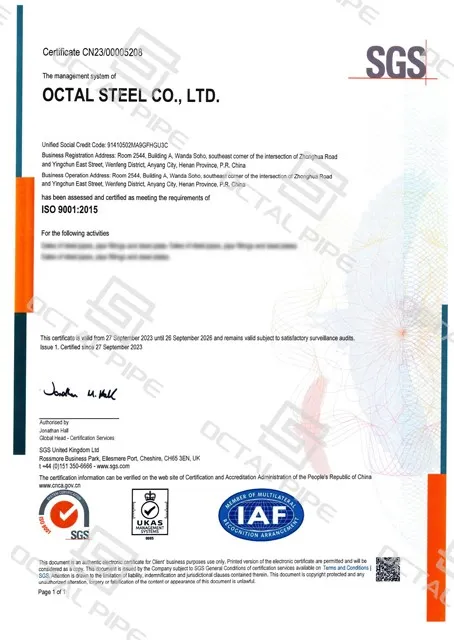
ISO 9001 Certificate
API Q1 Certificate
ABS Certificate
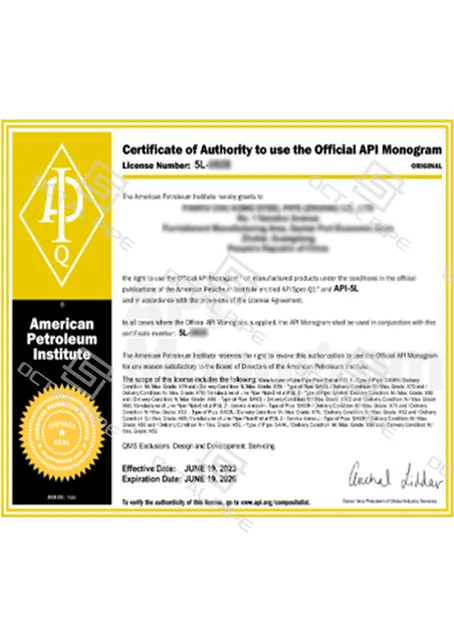
AP-5L Certificate
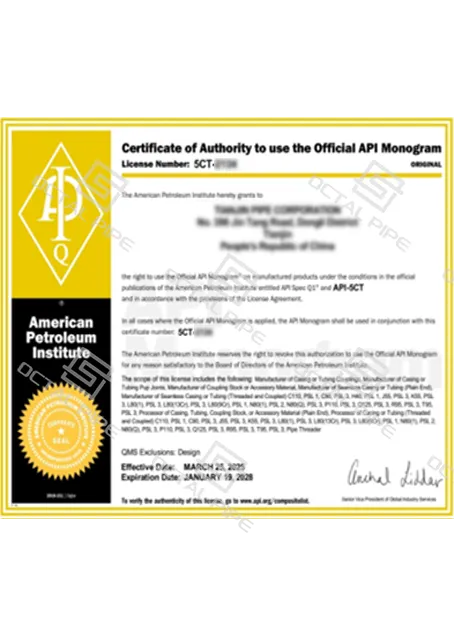
API-5CT Certificate
| Item | Parameter |
|---|---|
| Product | Chrome-moly alloy steel pipe (Cr-Mo) |
| Standard | ASTM/ASME A335 |
| Grade range | P5 / P9 / P11 / P22 / P91 |
| Size range | 1/2" to 26" |
| Wall thickness | SCH 10 to SCH 160 |
| Manufacturing | Seamless (typical for A335) |
| End finish | Plain / Beveled (as specified) |
| Documents | MTC/CMTR + traceability pack (as required) |
Hot Tags: Chrome Moly Pipe, China Chrome Moly Pipe manufacturers, suppliers, factory, stainless steel hose pipe, galvanized electrical conduit, steel conduit pipe, welded elbow, flex steel hose, metric stainless steel tubing
Previous
CRA Clad PipeYou Might Also Like




Send Inquiry