




CRA Clad Pipe
Base steel: API 5L, ASTM A106, A333, A516
Manufacturing by explosive bond, roll bond, or weld overlay
Size range: ½″–60″, thickness up to 80 mm
Certified to API 5LD, ASTM, ASME, DNV, NACE MR0175
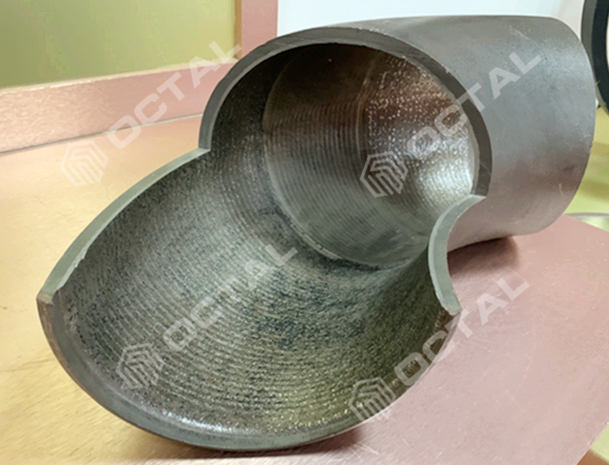
Clad pipe meaning: a carbon-steel pipe with a thin corrosion-resistant alloy (CRA) layer metallurgically bonded to the inside surface (clad), or a separate CRA tube installed inside the carbon-steel pipe (lined). The purpose is to keep CRA corrosion resistance where the fluid touches, while retaining the strength and cost structure of a carbon-steel carrier.
In oil, gas, and chemical transportation, corrosion is not just a maintenance issue-it defines the lifespan of the entire system. Traditional carbon steel pipelines, though mechanically robust, degrade rapidly under sour-gas or seawater exposure. On the other hand, using solid corrosion-resistant alloy (CRA) pipes is technically ideal but economically unsustainable.
To bridge this gap, engineers developed the CRA Clad and Lined Pipe, an advanced metallurgical solution that merges strength, corrosion resistance, and cost-efficiency in a single engineered product.
Claded Pipe Material Options (Base + CRA Layer)
| Clad pipe material item | Typical options buyers specify | Why it matters on a CRA pipeline |
|---|---|---|
| Base pipe | Carbon steel line pipe / pressure pipe (per project spec) | Sets strength, wall thickness, code compliance |
| CRA clad/liner | 316L/317L, Duplex, Super Duplex, Alloy 625, Alloy 825 (as specified) | Sets corrosion resistance vs CO₂/H₂S/chlorides |
| Construction route | Clad (metallurgically bonded) / Lined (mechanically lined) | Drives field welding method and inspection scope |

The Solution: Dual-Metal Composite Concept
At its core, the CRA Claded Pipe is a bimetallic pipeline, combining two metals that serve distinct but complementary roles:
Structural Layer (Outer Shell): High-grade carbon or low-alloy steel (e.g., API 5L X60/X65, ASTM A106, A333) provides the mechanical load-bearing capacity.
Corrosion Barrier (Inner Layer): Nickel-based or stainless alloys such as 316L, Inconel 625, Alloy 825, or Duplex 2205 create a stable protective lining against CO₂, H₂S, and chloride-rich fluids.
This metallurgical pairing achieves what neither metal could alone: a pipe that withstands extreme pressure, temperature, and corrosive attack for decades, even in subsea or high-salinity fields.
clad pipe Manufacturing & Metallurgical Integrity
Unlike conventional carbon steel, CRA cald pipes demand precise bonding between the alloy layer and the steel substrate. The methods used depend on performance requirements and service severity:
| Process Type | Bonding Principle | Key Advantages |
|---|---|---|
| Explosion Bonding | Controlled detonation bonds CRA to steel plate without melting. | Creates high-strength metallurgical interface ideal for thick-wall or large-diameter pipes. |
| Weld Overlay | CRA alloy deposited by automatic welding onto steel surface. | Ensures precise CRA thickness and smooth inner finish for high-pressure lines. |
| Hot Roll Bonding | CRA and base steel rolled together under heat and pressure. | Delivers uniform bond and consistent CRA adhesion for mass production. |
| Mechanical Lining | CRA tube inserted and expanded inside carbon steel pipe. | Cost-effective for moderate-pressure, non-sour applications. |
Each process is followed by heat treatment, ultrasonic testing, and interface inspection to verify metallurgical stability and consistent CRA coverage.
Field Joints and Fabrication Notes
Clad pipe welding is mainly about protecting the CRA layer at the weld zone-because dilution, heat input, and weld-end preparation decide whether corrosion resistance is preserved after tie-in. Buyers typically state the joint type (girth weld / tie-in spool), weld-end preparation requirements, and inspection scope so offshore fabrication doesn't stop for rework.
Some RFQs write this as cladded pipe welding; the practical controls are the same: manage CRA exposure at the weld, use compatible consumables, and confirm the final CRA surface condition at the weld area.
- Weld-end preparation: Define bevel + CRA edge treatment so the tie-in doesn't cut back CRA unpredictably.
- Heat input & dilution control: Keep CRA chemistry at the weld face stable to avoid a "looks fine, corrodes later" weld.
- Inspection focus: Require NDT/PMI scope at weld areas if the project acceptance plan calls for it.
Clad vs Lined Pipe - Selection Guide & RFQ Checklist (API 5LD)
For a CRA pipeline, "clad" and "lined" are not interchangeable buying terms. The right choice depends on what can go wrong at fabrication and at tie-ins (CRA exposure at weld ends, liner movement, bond integrity), and what the project needs to prove at receiving. Octal Pipe typically uses the checklist below to keep RFQs comparable and to avoid late-stage holds at the spoolbase.
| Buyer decision point | CRA clad pipe (bonded layer) | CRA lined pipe (insert liner) | What to lock on the RFQ/PO |
|---|---|---|---|
| CRA layer definition | Metallurgically bonded CRA layer | CRA liner installed inside CS carrier | "Clad" or "Lined" route + manufacturing method |
| Weld-end / tie-in risk | CRA layer needs controlled weld-end prep to avoid dilution/exposure | Liner end treatment and sealing control are critical at weld ends | Weld-end readiness: bevel + CRA edge treatment / liner end design |
| Typical failure mode to prevent | Local CRA discontinuity / bond defects found late | Liner movement, gaps, end sealing issues | Acceptance focus + repair rules before shipment |
| Material selection | CRA grade and layer thickness drive corrosion resistance | CRA grade and liner thickness drive corrosion resistance | Clad pipe material: base pipe + CRA grade + CRA thickness basis |
| Receiving acceptance | Emphasis on CRA continuity + bond integrity evidence | Emphasis on liner integrity + end treatment evidence | Inspection scope + document pack checklist |
Material Engineering and Alloy Selection
CRA alloys are chosen according to corrosion mechanism and process chemistry. Typical configurations include:
| Base Steel | CRA Alloy | Typical Use |
|---|---|---|
| ASTM A106 Gr.B / API 5L X65 | SS316L / SS317L | CO₂ service, offshore topside pipelines |
| ASTM A333 Gr.6 | Duplex 2205 | Subsea injection and seawater systems |
| ASTM A516 Gr.70 | Alloy 625 / 825 | Sour gas and HPHT flowlines |
| ASTM A672 | Hastelloy C22 / C276 | Chemical plants and desalination units |
These combinations ensure that mechanical integrity and corrosion protection are simultaneously achieved-without the cost burden of full CRA construction.


Proven Field Applications
A CRA pipeline solution is usually specified when carbon steel alone cannot tolerate the produced fluids over the design life, but full solid CRA pipe is not economical. Typical triggers include CO₂ corrosion risk, sour service concerns, high-chloride water handling, and offshore flowlines where access for repairs is limited. In these cases, the practical procurement goal is not "CRA everywhere," but a controlled CRA wetted surface with predictable weldability and inspection evidence.
CRA Clad Pipes are installed globally across environments where corrosion risk and structural demand intersect:
- Deepwater flowlines and subsea manifolds carrying multiphase fluids
- CO₂ injection and enhanced recovery systems
- Offshore water reinjection and desalination plants
- Refinery and petrochemical facilities processing acidic or chloride media
- Power and chemical industries under high temperature and pressure cycles
With CRA integrity verified under NACE MR0175 / ISO 15156 and API 5LD, these pipelines can operate for 20–30 years with minimal maintenance.
Testing, Certification, and Quality Assurance
| Control item | What is checked (scope) | Acceptance basis | What the buyer receives |
|---|---|---|---|
| CRA layer continuity (UT/RT) | UT and/or RT to verify CRA layer continuity and detect lack of bond / local discontinuities at the clad/liner region | Project spec / approved ITP acceptance criteria | NDT report: method + coverage + acceptance basis + results |
| Interface bond integrity (bond & shear) | Bond strength and shear testing on the CRA-to-carbon-steel interface to confirm metallurgical/mechanical integrity | Project-defined minimum values / test method requirements | Test report: specimen ID + method + result values + pass/fail |
| Hydrostatic test (pressure integrity) | Hydrotest to the specified design pressure to validate pressure containment of the composite pipe | Test pressure/hold time per project spec | Hydrotest record: pressure + hold time + result |
| Corrosion qualification (CRA verification) | Corrosion testing/qualification following ASTM G28 / G48 / G31 to verify CRA performance against the intended service environment | Test method + acceptance criteria per project spec | Corrosion test report: method + media/temperature/time + results |
Advantages of CRA Clad and Lined Pipes
For buyers comparing clad pipe manufacturers and a qualified clad pipe supplier, Octal Pipe's advantage shows up in the handover details that usually trigger project holds: we lock the clad/liner construction route on the RFQ, control weld-end readiness so field joints don't expose or damage the CRA layer, and keep traceability tight so the CRA material and the carbon-steel carrier can be reconciled at receiving. Practically, that means a shipment delivered with matched pipe IDs, clear bundle-level marking, and a document set that links the base pipe and CRA layer to the same delivery list-so fabrication teams aren't forced into re-identification work before welding.
- Dual-layer protection against CO₂, H₂S, and chlorides
- Long-term structural strength with reduced CRA cost
- Compatible with standard pipeline welding and installation
- Ideal for deepwater, HPHT, and sour-service pipelines
- Certified to API, ASTM, and DNV offshore requirements
FAQ

FAQ 1 - What acceptance testing should I ask for on API 5LD CRA clad or lined pipe?
FAQ 2 - what is clad pipe meaning in aCRA pipeline RFQ?
FAQ 3 - How do I compare clad pipe manufacturers or a clad pipe supplier without wasting RFQ cycles?
FAQ 4 - What should I specify for clad pipe welding at field joints?
Certifications
CE Certificate
ISO 9001 Certificate
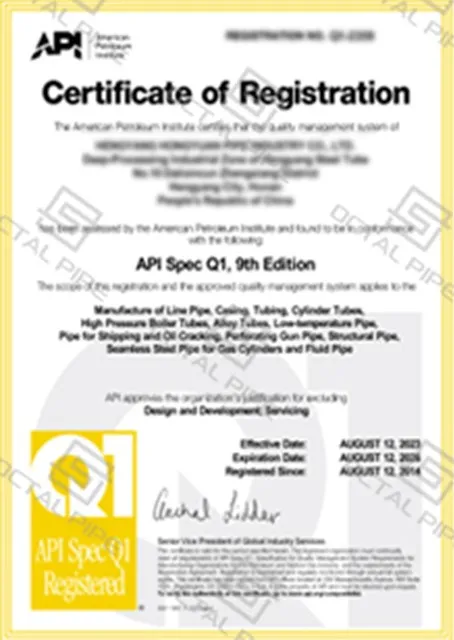
API Q1 Certificate
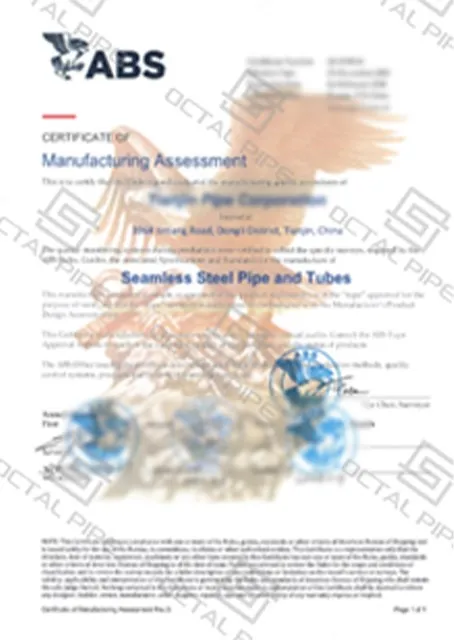
ABS Certificate
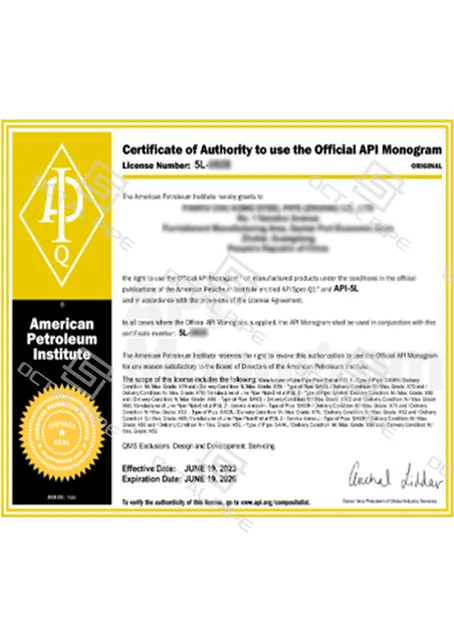
AP-5L Certificate
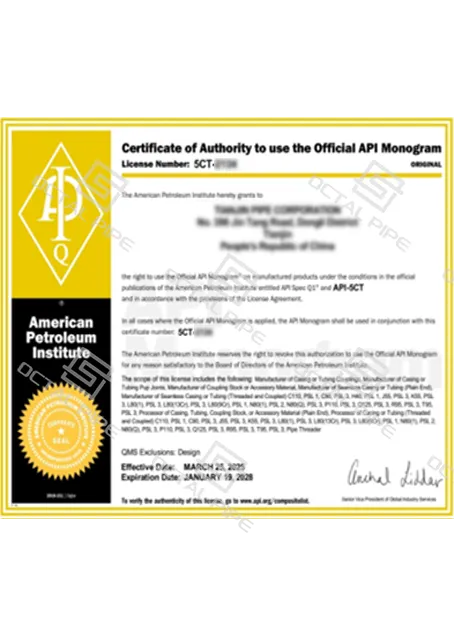
API-5CT Certificate
| Item | Parameter |
|---|---|
| Product type | CRA clad pipe / CRA lined pipe (carbon-steel carrier with CRA wetted layer/liner) (Octalsteel) |
| Applicable standard | API 5LD / API 5LC (Octalsteel) |
| Base pipe (carrier) | API 5L Grade B–X80 (PSL1/PSL2, sour options), ASTM A106 Gr.B, ASTM A333 Gr.6 (as specified) (Octalsteel) |
| CRA layer / liner materials | 304/304L, 316/316L, 317L, 321; Duplex/Super Duplex; Alloy 625, Alloy 825; Hastelloy C276/C22 (as specified) (Octalsteel) |
| OD range | Clad: 6"–60"; Lined: 1/2"–24" (Octalsteel) |
| Wall thickness range | Clad: up to 80 mm; Lined: 7–35 mm (Octalsteel) |
| Length | Up to 12.3 m (project-based) (Octalsteel) |
| End finish | Beveled ends / cut-to-length (as specified) (Octalsteel) |
| Typical QA focus | CRA continuity / bond integrity checks, hydrotest, PMI + dimensional checks, documentation pack for receiving (project-defined scope) (Octalsteel) |
Hot Tags: CRA Clad Pipe, China CRA Clad Pipe manufacturers, suppliers, factory, stainless steel hose pipe, galvanized electrical conduit, steel conduit pipe, welded elbow, flex steel hose, metric stainless steel tubing
Previous
Stainless Steel CoilNext
Chrome Moly PipeYou Might Also Like


Send Inquiry