




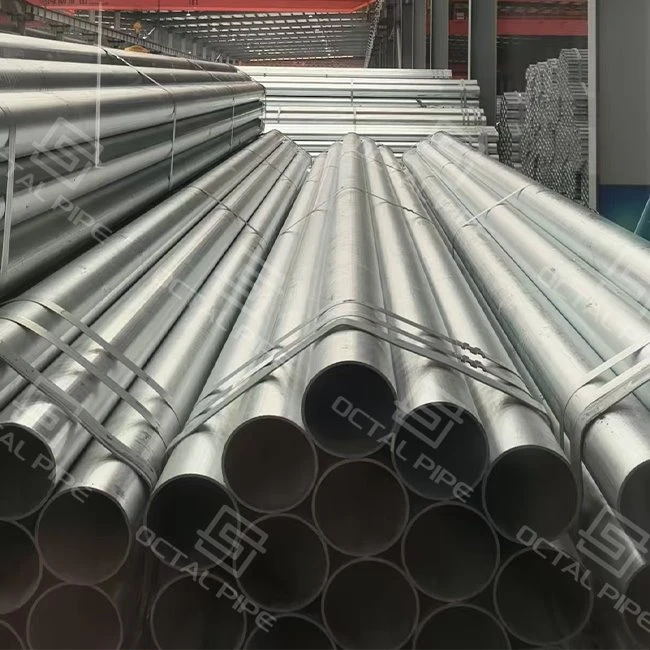

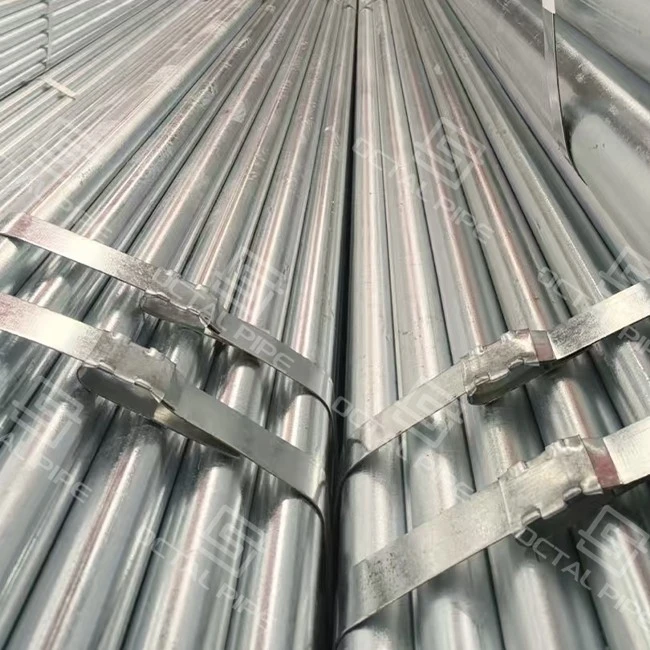

Hot-Dip Galvanizing
Zinc Coating: 35–650 μm, alloy + pure zinc layers
Standards: ASTM A123, ASTM A53, BS 1387, GB/T 3091
Sizes: ½″ – 20″ (DN15 – DN500), lengths 6 m / 12 m / custom
Steel Grades: Q195, Q235, Q345, ASTM A53 Gr.A/B
Key Advantages: Long service life, strong adhesion, low maintenance
Applications: Water, gas, construction, guardrails, petrochemical, agriculture
Galvanized steel pipe is carbon steel pipe protected by a zinc coating. The zinc layer does more than cover the surface. It acts as a barrier against moisture and air, and it also provides sacrificial protection if the coating is scratched. That is why galvanized pipe remains a practical option for outdoor service, wet environments, and utility work where bare or painted steel would need more frequent maintenance.
There are two common galvanizing routes:
- Electro-galvanizing: a thinner and smoother zinc coating, usually used where appearance is more important than long-term outdoor durability.
- Hot-dip galvanizing (HDG): the cleaned steel pipe is immersed in molten zinc at about 450°C, forming zinc-iron alloy layers that are metallurgically bonded to the steel, with an outer zinc layer on top.
Compared with electro-galvanizing, hot-dip galvanized steel pipe provides a heavier and more durable protective layer, especially in outdoor storage, transport, installation, and weather-exposed service. This is why it is commonly used for water supply lines, gas distribution, scaffolding, guardrails, irrigation systems, and general outdoor structures where corrosion protection and lower maintenance both matter.


Typical Specifications
| Parameter | Typical Value / Range |
|---|---|
| Product | Hot-dip galvanized steel pipe |
| Galvanizing Process | External and internal hot-dip zinc coating |
| Pipe Standard | ASTM A53 / A53M, BS 1387, GB/T 3091, or project requirement |
| Coating Basis | Coating mass or coating thickness as specified in the applicable standard or purchase order |
| Related Coating Reference | ASTM A123 / A123M or ISO 1461 for relevant fabricated galvanized items |
| Commercial Supply Size | 1/2" to 20" (DN15 to DN500) |
| ASTM A53 Size Scope | NPS 1/8 to NPS 26 (DN6 to DN650) |
| Steel Grades | Q195, Q215, Q235, Q345, ASTM A53 Gr.A / Gr.B |
| Length | 6 m, 12 m, or custom |
| End Type | Plain end, threaded end, or coupled end |
| Inspection Documents | MTC, dimensional inspection, coating inspection, packing list |
| Packing | Bundles, export packing, thread protection when required |
Relevant Standards & Specifications
Hot-dip galvanized pipe is usually purchased against a pipe standard plus a coating requirement. Those two parts should not be mixed together.
| Standard / Reference | What It Controls | Typical Use |
|---|---|---|
| ASTM A53 / A53M | Pipe scope, manufacturing type, testing, and galvanized pipe option | Seamless or welded galvanized pipe for mechanical, pressure, steam, water, gas, and air service |
| ASTM A123 / A123M | Hot-dip galvanized zinc coating requirements on fabricated iron and steel products | After-fabrication galvanizing, large tubes or welded fabrications |
| ISO 1461:2022 | General properties and test methods for hot dip galvanized coatings on fabricated iron and steel articles | International reference for fabricated galvanized articles |
| BS 1387 | Project-specific or legacy galvanized pipe reference | Water, gas, and general utility service in legacy/export specs |
| GB/T 3091 | Welded galvanized steel pipes for low-pressure fluid transport | Water, gas, and low-pressure fluid transport in Chinese-market or export orders |
For a broader selection guide covering pipe standards, coating weight, and QA points, see our How Do You Choose the Right Galvanized Steel Pipe for Your Project?
Manufacturing / Coating Process
The hot-dip galvanizing route for pipe is not a single "dip and cool" step. Coating quality depends on how clean the steel is before galvanizing, how the pipe enters and exits the bath, how excess zinc drains, and how the finished coating is inspected afterward. The basic HDG process is commonly summarized as surface preparation, galvanizing, and inspection.
| Step | What Happens in Production | Why It Matters |
|---|---|---|
| Surface preparation | Degreasing, rinsing, pickling, rinsing, and fluxing | Rust, oil, and mill scale have to be removed before zinc can bond properly |
| Hot-dip immersion | Pipe enters molten zinc at about 450°C | Iron in the steel reacts with zinc and forms alloy layers rather than just a paint-like film |
| Drainage and wiping | Excess zinc drains off as pipe exits the bath | Affects coating uniformity, thread condition, and internal flow passage |
| Cooling / passivation | Air cooling, water quench, or passivation depending on line practice | Stabilizes the coating and reduces white rust risk during storage |
| Inspection and repair | Coating mass / thickness check, visual finish, dimensional check, repair if permitted | Confirms the batch meets order requirements before packing |
In pipe production, surface preparation is where many coating problems start or are prevented. If oil, scale, or welding residues remain, zinc cannot bond uniformly and bare spots or rough high-build areas can appear. After cleaning and fluxing, the pipe is immersed in molten zinc. During immersion, iron from the steel reacts with zinc to form a series of zinc-iron alloy layers, then an outer zinc layer forms over them. This is why hot-dip galvanizing behaves differently from sprayed zinc or paint systems during handling and long-term exposure.
Steel chemistry also affects the final coating. Silicon and phosphorus in the base steel can change coating growth and appearance. More reactive steels can produce thicker, darker, matte-gray coatings made up largely of zinc-iron alloy, which are not necessarily lower in corrosion protection even if they look less bright than a decorative galvanized surface.

For a more detailed explanation of the process, coating layers, and standards, see What Is Hot Dip Galvanizing?
Protection Mechanism
The corrosion resistance of hot-dip galvanized steel pipe comes from more than one mechanism working together.
- Barrier protection keeps moisture and oxygen away from the steel surface.
- Cathodic or sacrificial protection means zinc corrodes preferentially if the coating is scratched.
- Alloy layer bonding gives the coating more resistance to peeling and handling damage than a simple deposited film.
- Zinc patina formation helps slow the corrosion rate in many atmospheric environments over time.
This matters in actual service. On a pipe rack, fence post, scaffold tube, or exposed water line, small scratches from loading, threading, slinging, or site handling do not immediately expose bare steel in the same way that a damaged paint film does. The zinc around the damaged spot continues to protect the steel locally, which is one reason hot-dip galvanized pipe remains popular for outdoor utility and construction service.
For a closer look at the zinc-iron alloy layers and how the coating protects steel in service, see our HDG Coating Anatomy & Corrosion Protection Guide.


Key Advantages
The main value of hot-dip galvanizing is not just that zinc is present on the surface, but that the coating is formed as part of a metallurgical process rather than applied as a simple top layer. That changes how the pipe performs in transport, installation, and atmospheric exposure.
- Stronger protection at weld zones, edges, and handling points
In outdoor pipe service, corrosion rarely starts at the middle of a clean barrel first. It usually starts where the steel is cut, threaded, handled, or repeatedly wet. A galvanized coating is more forgiving in those areas than paint-only protection because zinc continues to shield the steel even when the coating is locally damaged.
- Useful service life in atmospheric exposure
The actual life of a galvanized coating depends on humidity, rainfall, sulfur dioxide, airborne salinity, temperature, and coating thickness. In atmospheric service, hot-dip galvanized steel often delivers decades to first maintenance rather than just a few seasons, but the exact life depends strongly on the environment rather than on a single blanket number.
- Lower maintenance for hard-to-access outdoor work
This is why HDG is commonly chosen for guardrails, roadside posts, agricultural piping, rooftop frames, scaffold systems, and open-yard utility lines. If repainting is difficult or shutdown access is expensive, the coating value is not just corrosion resistance but reduced maintenance intervention over time.
- Easy inspection
Galvanized pipe is relatively straightforward to inspect. Buyers usually care about coating mass or thickness, finish continuity, drainage condition, threads, dimensional compliance, and document traceability. Those checks are easier to standardize than subjective claims like "high quality finish."
Applications
| Application Route | Typical On-Site Condition | Why Hot-Dip Galvanizing Fits |
|---|---|---|
| Municipal water / drainage | Above-ground water lines, bypass lines, exposed utility supports | Resists outdoor moisture and reduces maintenance frequency |
| Gas and utility service | Meter risers, utility sleeves, light gas runs, support frames | Suitable for weather exposure and routine handling damage |
| Construction and scaffolding | Scaffold tubes, handrails, temporary structures, edge protection | Handles repeated assembly, storage, and outdoor site use |
| Road and infrastructure | Guardrails, barrier posts, fence posts, sign supports | Performs well in long-term outdoor exposure with limited repaint access |
| Agriculture | Irrigation pipe, greenhouse frames, livestock water lines, fence systems | Suitable for wet/dry cycling and general outdoor service |
| General industrial outdoor service | Pipe bridges, cable supports, yard racks, perimeter structures | Provides practical atmospheric corrosion protection outdoors |
Hot-dip galvanized steel pipe is often chosen where the pipe or tubular structure sits outdoors, gets wet repeatedly, is handled roughly during installation, and cannot be repainted easily after commissioning. That is why it shows up on guardrail posts, irrigation lines, scaffold systems, open-yard supports, water utility runs, and light industrial external pipework far more often than on highly specialized high-temperature or internally aggressive process lines.
Why Choose Octal Pipe Hot-Dip Galvanizing
OCTAL supplies hot-dip galvanized steel pipe with a stronger focus on delivery consistency, clear documentation, and practical project matching. From size arrangement and end condition to packing, marking, and release documents, each lot is organized to be easier to inspect and easier to install.
This is especially useful for outdoor utility work, scaffolding, guardrails, irrigation lines, and general structural use, where clean delivery and reliable corrosion protection matter just as much as the pipe itself.
FAQ

01.Should hot-dip galvanized steel pipe be ordered to ASTM A53 or ASTM A123?
02.What coating requirement should be written into the purchase order?
03.What size range is commonly supplied for hot-dip galvanized steel pipe?
04.When is hot-dip galvanizing a better choice than electro-galvanizing?
Certifications
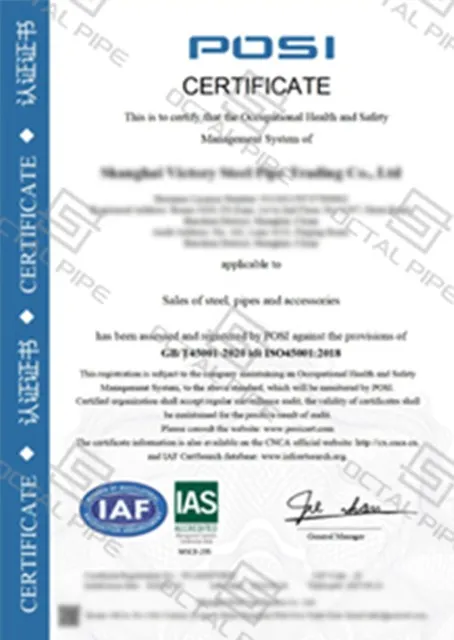
CE Certificate
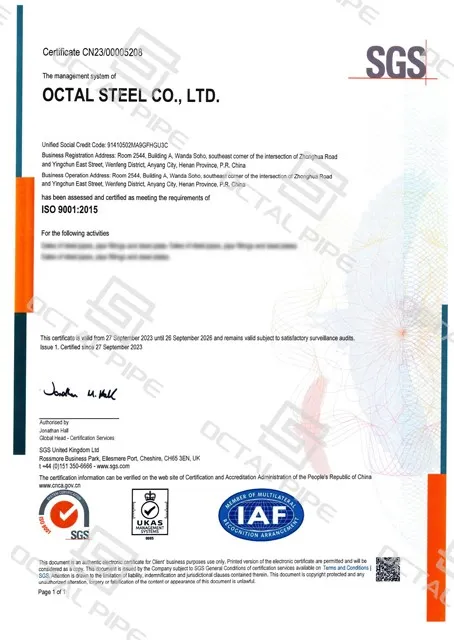
ISO 9001 Certificate
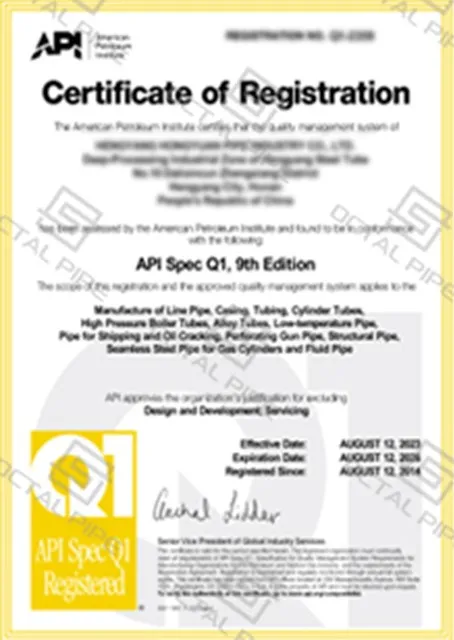
API Q1 Certificate
ABS Certificate
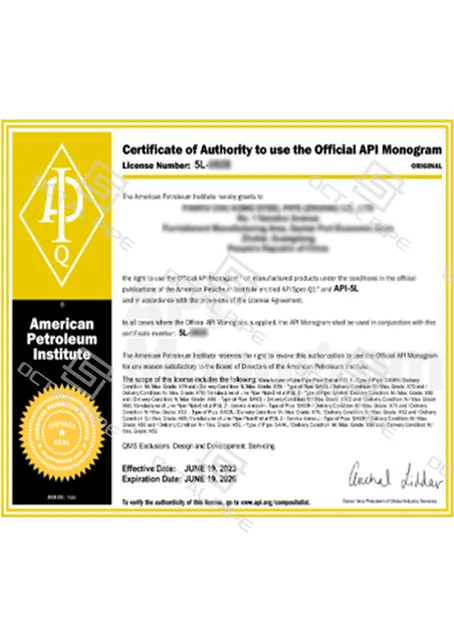
AP-5L Certificate
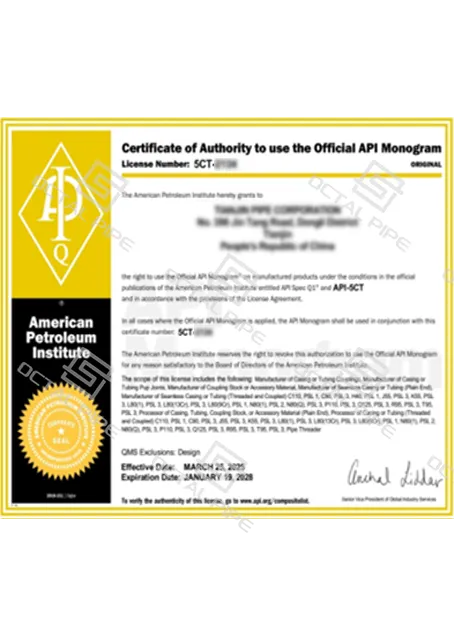
API-5CT Certificate
Hot Tags: hot-dip galvanizing, China hot-dip galvanizing manufacturers, suppliers, factory
Previous
No InformationNext
No InformationYou Might Also Like


Send Inquiry