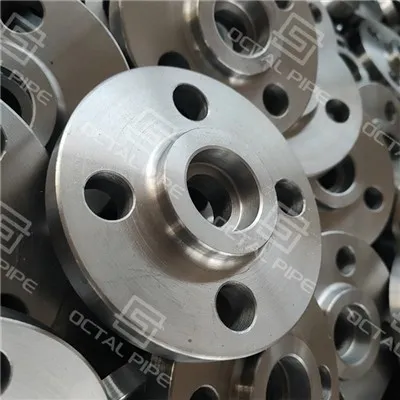
Standards: ASME B16.5 (½″–24″), ASME B16.47 (26″–60″)
Pressure Ratings: Class 150 – 2500
Size Range: NPS ½″ – 60″
Types: Standard, Long Weld Neck, Reducing WN, RF, RTJ, Flat Face
Materials: Carbon Steel (A105, A350 LF2), Alloy Steel (F11, F22, F91), Stainless Steel (304/304L, 316/316L), Duplex/Super Duplex
Key Features:
Tapered hub for stress distribution
Full penetration butt weld ensures leak-proof joint
Available with RF, RTJ, and FF facings
Applications: Oil & Gas, Petrochemical, Power Generation, Boilers, Pressure Vessels, Offshore Projects
Send Inquiry
Product Introduction
A weld neck flange is typically selected when the connection is expected to carry more than just pressure. In real projects, buyers choose it because the tapered hub + butt-welded neck give a smoother stress transition from flange to pipe, which helps in systems exposed to pressure cycling, thermal fluctuation, vibration, heavy-wall pipe, or stricter inspection requirements.
For procurement, this is not just a flange style choice. It is usually a decision about joint reliability, bore alignment, weld integrity, and long-term service stability. A weld neck flange that matches the correct standard, facing, bore, schedule, and material will usually create fewer fit-up problems than a flange selected only by nominal size and class.
Weld Neck Flange Standard and Specification
When buyers search weld neck flange specification or weld neck flange standard, they are usually not just looking to see whether the product is in stock. What they really need to confirm is whether the flange will line up with the project line class, pipe schedule, facing type, material grade, and inspection scope already defined in the drawing or PO. In real purchasing, most problems do not come from "no supply" - they come from details that were not locked in early, such as a wrong bore for the pipe wall, an incorrect facing, or missing document requirements that later slow down approval and installation.
A practical purchase description should define the flange through these checkpoints:
Item
What should be specified
Product type
Weld Neck Flange
Governing standard
ASME B16.5 / ASME B16.47 where applicable
Nominal size
NPS / DN
Pressure class
Class 150 / 300 / 600 / 900 / 1500 / 2500
Facing type
RF / RTJ / FF
Bore
Matched to pipe schedule or specified ID
Material grade
A105, LF2, F304/F316, F11/F22/F91, duplex grades, etc.
That is much safer than simply writing "4 inch weld neck flange," because it controls the points that usually cause receiving disputes: facing, bore match, material, and document scope.
What Industrial Scenarios Are Weld Neck Flanges Suitable For?
A weld neck flange is usually selected when the line is expected to handle higher pressure, elevated temperature, repeated thermal cycling, vibration, or heavier-wall pipe where joint reliability matters more than fabrication convenience. In actual projects, it is commonly used in oil and gas transmission lines, refinery and petrochemical piping, offshore modules, boiler systems, pressure-vessel connections, steam service, and other critical process or utility lines.
In these services, the flange is not just a connection point. It directly affects:
load transfer
weld integrity
long-term sealing stability
From a buyer's perspective, the value of a weld neck flange becomes much clearer when the cost of failure is high. A leak on a high-pressure branch, repeated rework caused by poor alignment, or extra weld correction during fit-up can easily cost more than the flange itself.
Its main advantages come from the tapered hub and butt-welded neck, which help create a smoother transition between flange and pipe. In practical terms, this means:
better bore alignment
less abrupt section change at the weld area
improved suitability for cyclic service and vibration-sensitive lines
better weld access for inspection
more reliable radiographic examination
stronger pipe-to-flange continuity
That is why engineers often prefer weld neck flanges for more demanding piping systems where long-term service reliability matters more than simple installation speed.
How To Select the Appropriate Material for Weld Neck Flanges?
Material selection should follow the service condition, not just stock or price. For weld neck flanges, the material needs to match the pipe grade, design temperature, corrosion environment, and the project's inspection/document requirements. A flange may be dimensionally correct, but if the material does not match the line class, it is still a rejected item.
In general, ASTM A105 is used for standard carbon steel piping under normal service conditions. ASTM A350 LF2 is preferred for low-temperature service where impact toughness matters. For higher-temperature alloy piping, buyers usually specify F11, F22, or F91 to stay aligned with the pipe material and operating condition. In corrosive service, F304 / F316 are common stainless options, while duplex / super duplex grades are more suitable when both chloride resistance and higher strength are required. At Octal Pipe, this kind of material matching is one of the basic control points in flange quotation and order review, because the material grade directly affects approval, welding compatibility, and final service reliability.
A simple example: for a steam line, flange selection is not just about size and class - the material also has to remain stable at temperature, so alloy grades like F11 or F22 may be needed instead of carbon steel. For a low-temperature line, using A105 instead of LF2 may create a toughness risk even though both are forged carbon steel grades. From a procurement standpoint, the wrong material grade usually causes bigger problems than the wrong flange type, because it affects approval, welding compatibility, and final project acceptance.
Weld Neck Flange Vs Slip-On
The comparison between weld neck flange and slip-on flange is one of the most common decisions in flange purchasing, because the two can look similar in basic function but are designed for different service priorities. A slip-on flange is usually chosen when fabrication is simpler and initial cost is lower, since the pipe slips into the flange before fillet welding. A weld neck flange, by contrast, is butt-welded to the pipe and has a tapered hub that provides a smoother transition between flange and pipe.
In practical terms, slip-on flanges are often used for more moderate-duty service, while weld neck flanges are preferred when the line needs better stress distribution, more accurate bore alignment, and stronger performance under pressure, temperature fluctuation, vibration, or cyclic loading. For buyers, the difference is not just fabrication style - it is really a choice between lower upfront cost and higher long-term joint reliability.
Comparison Point
Weld Neck Flange
Slip-On Flange
Pipe connection
Butt weld
Fillet weld
Stress distribution
Better through tapered hub
Less favorable under cyclic or severe loading
Bore alignment
More controlled
More dependent on fit-up
Best use
Higher pressure / temperature / critical service
Moderate-duty general piping
Inspection confidence
Stronger for critical piping
Simpler, but less preferred for severe service
Buyer priority
Reliability and long-term service
Lower initial fabrication cost
In short, buyers usually move to weld neck flange vs slip-on selection when the system becomes more demanding and the risk of leakage, fatigue, or repeated maintenance becomes harder to ignore.
Weld Neck Flange Symbol
The weld neck flange symbol is important on drawings, BOMs, and RFQs because many quotation errors start with vague or incomplete flange notation.
In project documents, the most common short forms are:
WN = Weld Neck
WNRF = Weld Neck Raised Face
WNRTJ = Weld Neck Ring Type Joint
LWN = Long Weld Neck
RWN or descriptive wording may be used for reducing weld neck configurations depending on drawing practice
The key point for buyers is that the symbol alone is not enough. "WN" identifies the flange type, but it does not define class, facing, bore, material, or standard. A drawing note that only says "WN flange" still leaves too much room for quotation error. The symbol should always be read together with the full callout.
Example drawing / BOM callout: WN, 6", Class 600, RF, ASTM A105, ASME B16.5, bore to Sch 80
Weld Neck Flange Weight
Buyers searching weld neck flange weight are usually trying to solve one of three problems: freight estimation, lifting/packing planning, or support-load calculation. The important thing is that weld neck flange weight is not controlled by size alone. It changes significantly with:
nominal size
pressure class
material density
hub geometry
facing type
bore size / schedule match
A Class 150 weld neck flange and a Class 1500 weld neck flange at the same NPS will obviously not behave like the same item in handling or shipment. The higher-class flange carries a heavier hub, thicker body, and different bolt circle geometry, so weight rises quickly with class.
Weld neck flange weight should be confirmed from the applicable standard table or production drawing, then checked again against the actual material and bore configuration before freight or support decisions are finalized.
Why Bore Match Matters More Than Many Buyers Expect
For a weld neck flange, acceptance is often decided less by outside diameter and more by whether the bore actually matches the pipe it will be welded to. The whole point of a weld neck design is to create a smooth transition from flange hub to pipe wall. If that bore is undersized, oversized, or simply matched to the wrong schedule, the welder is pushed into field correction work such as internal grinding, bore blending, hi-low adjustment, or weld profile compensation. That does not just slow fit-up - it can also affect weld consistency, radiographic acceptance, and the final flow path at the joint.
This becomes much more important on heavy-wall pipe, projects with multiple schedules, reducing transitions, high-pressure RTJ service, or long weld neck flanges connected to vessel or equipment nozzles. In those cases, a bore mismatch is not a minor workshop inconvenience. It can create an internal step at the weld, increase alignment correction time, and force extra machining or grinding that the buyer never planned for. That is why a serious RFQ should not stop at NPS + Class. It should also state the required bore to pipe schedule or give the target inside diameter, so the flange arrives ready for the actual pipe it must match, not just the nominal size on paper.
Inspection Priorities Before Shipment
For a serious weld neck flange order, buyers usually care more about measurable acceptance points than about general statements like "high precision."
The useful inspection focus normally includes:
flange standard and class confirmation
facing type check (RF / RTJ / FF)
bore and hub dimensions
bolt circle and bolt hole accuracy
serration finish or RTJ groove verification
marking confirmation
heat number traceability to MTR
PMI / UT / MT / PT where required
A weld neck flange that looks fine visually can still create site delays if the bore, facing, or documents do not line up with the project requirement.
01.How should a weld neck flange be specified in an RFQ or PO?
Include standard, size, class, facing, material, bore to pipe schedule, inspection/documents, and quantity. This helps avoid wrong bore, wrong facing, or material mismatch.
02.When is a weld neck flange better than a slip-on flange?
It is usually preferred for higher pressure, higher temperature, cyclic service, vibration, and heavier-wall pipe, where better stress transfer and bore alignment are required.
03.Why does bore match matter for a weld neck flange?
If the bore does not match the pipe schedule, fit-up may require grinding, mismatch correction, or weld adjustment, which slows installation and can affect inspection acceptance.
04.How should material be selected for weld neck flanges?
Material should follow the service condition. A105 is common for standard carbon steel service, LF2 for low temperature, F11/F22/F91 for higher temperature, and F304/F316 or duplex for corrosive environments.
05.What inspection points matter most before shipment?
Buyers usually check class, facing, bore, hub dimensions, marking, and heat traceability, plus MTR, PMI, or NDE if required.