




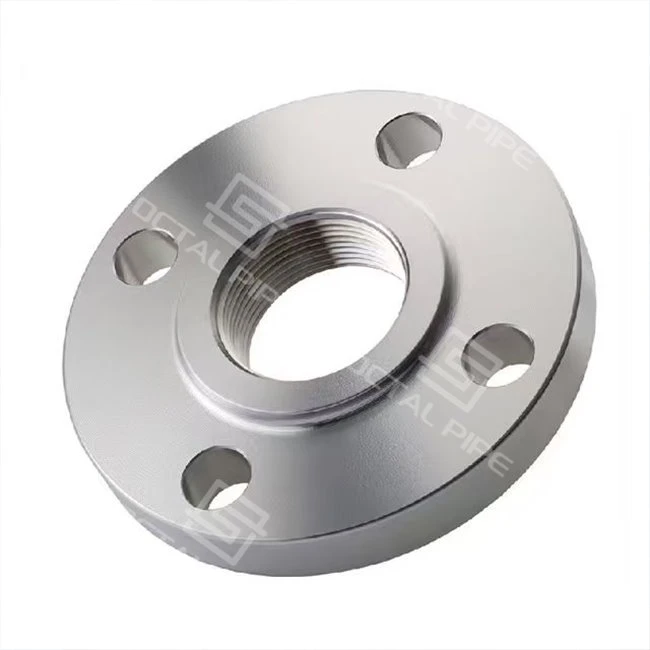


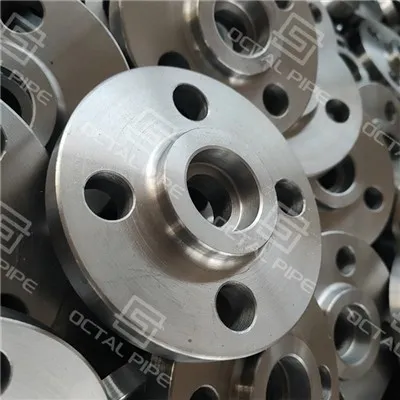
Threaded Flange
Thread Forms: NPT, BSPT, BSPP
Size Range: ½″ – 24″ (2″ & 4″ threaded flanges commonly stocked)
Pressure Classes: 150#, 300# (600# on request)
Facing Types: Raised Face (RF), Flat Face (FF), Ring Type Joint (RTJ)
Types: Standard Threaded, Threaded Reducing Flange, Tapped Blind Flange
Materials:Carbon Steel (A105, A350 LF2)
Stainless Steel (F304/F316, F321, F347)
Alloy & Duplex Steels
PVC threaded flange for special low-pressure applications
Advantages:
No welding required, safe for hazardous environments
Quick installation and easy maintenance
Cost-effective for small-bore piping
Compatible with NPT and BSP threaded systems
Applications: Oil & Gas, Utilities, Chemical, Water Treatment, Instrumentation
A threaded flange, also called a screwed flange, has an internally threaded bore that connects directly to externally threaded pipe or fittings. That basic threaded flange definition is straightforward, but in industrial purchasing the more useful definition is this: it is a removable flange connection used where welding at the joint is not preferred and where fit-up speed, future disassembly, and maintenance access matter.
This type of flange is most practical on smaller lines where site conditions make welding inconvenient or undesirable. A common example is a finished skid where the main structure has already been assembled, painted, and pressure-tested, but a small instrument branch still needs to be added. In that situation, a threaded connection can avoid local hot work, repainting, and repeated shutdown of nearby components.
It is also a practical choice on galvanized or coated piping where welding would burn away the protective layer at the joint. On maintenance work, it helps when the crew expects future disassembly, for example at drain points, vent points, temporary bypass connections, or instrument root locations where a welded joint would be slower to replace.
That said, threaded flanges should not be treated as a universal substitute for welded flanges. Where the service involves pulsation, sustained vibration, wide temperature swings, or more severe structural loading, the connection type should be checked against actual project conditions instead of being chosen only to save installation time.


Threaded Flange Dimensions and Basic Specification
The term threaded flange dimensions should be understood as more than outside diameter and bolt holes. In a real order, buyers need the complete connection package: nominal size, pressure class, thread type, facing type, material grade, and any special detail such as reducing bore or tapped blind configuration.
| Item | Typical Supply Scope |
|---|---|
| Product standard | ASME B16.5 |
| Size range | 1/2" to 24" |
| Common pressure classes | Class 150, Class 300 |
| Higher class | Class 600 on request / subject to application review |
| Facing types | RF, FF, RTJ |
| Thread forms | NPT, BSPT, BSPP |
| Main styles | Standard threaded flange, reducing threaded flange, tapped blind flange |
| Common materials | A105, A350 LF2, A182 F304/F304L, F316/F316L, F11, F22, F51, F53, F55 |
In many RFQs, the buyer starts with a short search phrase such as threaded flange 2, usually meaning a 2-inch threaded flange. In actual production release, however, "2 inch" is only the beginning. A usable line item still needs class, facing, thread form, material, and inspection scope. Without those details, quotation can be misleading and manufacturing can be released against the wrong connection basis.
For that reason, the dimensional side of a threaded flange should always be reviewed together with the connection side. The flange may be dimensionally correct under ASME B16.5, but the job can still stop if the ordered thread system does not match the mating pipe or fitting already installed on site.
Thread Standards and Connection Compatibility
For threaded items, thread compatibility is one of the first real field acceptance points. A flange may have the correct nominal size and pressure class, but if the thread system does not match the mating component, installation can fail immediately at fit-up.
| Thread Type | Form | Practical Note |
|---|---|---|
| NPT | Tapered | Widely used in North American piping practice |
| BSPT | Tapered | British standard tapered thread |
| BSPP | Parallel | Usually requires sealing arrangement suitable for parallel threads |
NPT and BSPT are both tapered, but they are not automatically interchangeable. BSPP is different again because it is a parallel thread and typically relies on a gasket, bonded seal, or another sealing method rather than taper interference alone. This is exactly why thread mistakes create so many avoidable site delays. The flange itself may look correct, the size may be correct, and the class may be correct, but the crew still cannot assemble the joint if one side is NPT and the mating item is BSPT or BSPP.
This happens more often than many buyers expect, especially on mixed projects where one package follows North American pipe thread practice and another follows British or European thread practice. On a short shutdown, that kind of mistake is expensive because it is normally discovered only when the mechanic is already at the line with the spool piece and sealant prepared.
A practical rule is simple: the purchase order should state the thread standard on every threaded flange item instead of assuming it from size, service, or project location. That one detail prevents a surprising amount of rework.


Material Selection
Material selection should follow service condition, not only availability in stock. A threaded flange is a relatively small component in the piping system, but the wrong material can still hold up inspection release, create compatibility issues with the mating line, or cause immediate rejection during receiving.
| Material Group | Typical Grades | Typical Use Logic |
|---|---|---|
| Carbon steel | ASTM A105 | General ambient-temperature utility and process service |
| Low-temperature carbon steel | ASTM A350 LF2 | Low-temperature service where impact performance is required |
| Stainless steel | ASTM A182 F304/F304L, F316/F316L | Corrosion-resistant service in water, chemical, and process lines |
| Alloy steel | F11, F22 | Elevated-temperature systems and alloy matching requirements |
| Duplex / super duplex | F51, F53, F55 | Chloride-bearing or more aggressive corrosive environments |
In real order review, material mistakes usually come from three places. First, general carbon steel is quoted where low-temperature impact grade was actually required. Second, 304 is offered where the service medium would more realistically call for 316 or duplex. Third, alloy grades are requested on one side of the connection, but the mating components are not reviewed together, leading to a mismatch within the same assembly package.
Some buyers also search for threaded flange pvc when comparing plastic piping accessories with metal flange systems. That search term is understandable, but it belongs to a different material and service category. PVC threaded flanges may appear in light-duty non-metallic systems, while a steel threaded flange is selected against different pressure, temperature, and mechanical service expectations. For a steel pressure-piping page, that distinction should stay clear.
Where a Threaded Flange Actually Works in Practice
A good threaded flange application is not just "oil and gas" or "chemical plant." It is a specific site condition where a removable non-welded connection solves a real problem better than a welded joint.
-
Instrument Root Valve and Small-Bore Take-Off on a Finished Skid
A skid has already been assembled, painted, and partially commissioned. A small instrument branch still needs to be connected, but the owner does not want additional hot work around completed tubing and painted supports. In that case, a threaded flange can make sense because it keeps the connection removable and avoids local weld repair and repainting after assembly.
-
Drain or Vent Point During Turnaround Work
A short plant shutdown is in progress, and the maintenance team needs to remove and reinstall a drain or vent assembly quickly. The line size is small, the work window is tight, and every extra permit adds delay. Here, the value of the threaded flange is practical rather than theoretical: the crew can dismantle and reinstall the connection without setting up local welding and post-weld cleanup.
-
Galvanized Utility Line on Water or Air Service
The piping is already galvanized. If the crew welds at the connection point, the protective layer is damaged locally and the joint area has to be repaired before handover. Where service conditions are suitable for threaded assembly, a threaded flange helps avoid that extra touch-up cycle.
-
Retrofit Branch on an Existing Pipe Rack
An old utility branch is being replaced on a congested rack. Access is limited, surrounding lines are live, and welding equipment is difficult to position. In that real-world scenario, a threaded connection can reduce site friction because the spool can be rotated into place more easily than a welded connection can be fitted, welded, cleaned, and rechecked.
-
Instrument Air, Nitrogen, and Utility Manifolds
This remains one of the most common threaded flange applications. On instrument air headers, nitrogen utility lines, and similar small-bore manifolds, the main concern is often controlled fit-up and later service access rather than high structural loading. That is where threaded flanges continue to be useful in practice.
Failure Risks Buyers Should Actually Control
Many product pages stay at the level of general claims, but threaded flange issues in the field usually come from a short list of repeat mistakes. In most cases, the problem is not the flange concept itself. The problem is that one key detail was left undefined before production release or before site fit-up.
| Common Risk | What Happens on Site | What Should Be Confirmed Before Release |
|---|---|---|
| Thread mismatch | Components cannot assemble correctly | Thread type stated clearly on each PO line |
| Wrong facing | Gasket and mating flange do not match | RF/FF/RTJ checked against mating side |
| Material mix-up | Wrong grade used in low-temp or corrosive service | Heat traceability and MTC by grade/lot |
| Marking confusion | Similar items mixed during receiving or installation | Clear marking of size, class, grade, heat |
| Incomplete documents | Goods arrive but cannot be released to site | MTC, inspection records, packing list, lot reference |
For threaded flange supply, the practical control points are clear: correct thread form, correct facing, correct material, readable marking, and documents that can be matched back to the physical lot. When these items are defined early, site installation is more straightforward and avoidable delays are easier to prevent.
Manufacturing and Quality Control
For threaded flanges, quality should be judged at the finished connection, not only at the raw material certificate. The main control points are machining accuracy, thread verification, facing condition, marking clarity, and whether the release documents correspond to the physical lot being shipped. At Octal Pipe, this part matters because threaded items are often small in size but sensitive in fit-up, and minor deviations usually appear during installation rather than on paper.
Typical Manufacturing Flow
- Approved forged or specification-compliant starting material
- Heat treatment according to material grade where required
- CNC machining of OD, thickness, bolt circle, flange face, and threaded bore
- Thread gauging to the specified standard
- Final dimensional and marking inspection
- Packing separation by size, class, grade, and lot
Typical QC Focus
| Control Item | Practical Acceptance Focus |
|---|---|
| Material identification | Grade and heat number match MTC |
| Thread verification | Thread checked against the ordered NPT/BSPT/BSPP standard |
| Facing condition | Facing type and finish match the order requirement |
| Dimensions | Bore, hole pattern, thickness, and main geometry checked against standard |
| Marking | Size, class, material, and heat/lot identification readable before packing |
| Extra testing | MT, PT, UT, PMI, impact, or third-party witness if required |
For RF flanges, buyers often pay attention to the facing condition because gasket complaints can arise even when the overall flange dimensions are otherwise correct. For threaded flanges, the other critical point is thread gauge discipline. If the thread is only approximately correct, the problem usually appears during fit-up, sealing, or final tightening on site.
When required by the project, release papers can include MTC / EN 10204 3.1, dimensional inspection records, thread verification records, heat treatment records where applicable, and third-party witness documents. The real trust point is the traceability chain from marking to heat number to certificate to inspection record.
Compliance and Standards
| Topic | Common Reference |
|---|---|
| Flange dimensional standard | ASME B16.5 |
| NPT thread reference | ASME B1.20.1 |
| BSPT thread reference | ISO 7-1 / EN 10226 |
| BSPP thread reference | ISO 228-1 |
| Material certificate option | EN 10204 3.1 when specified |
A standards list only becomes useful when it is tied back to inspection and release. In a real threaded flange order, the buyer is normally checking four things: the flange standard, the thread standard, the material standard, and the document standard. Anything beyond that is secondary unless the project specification adds extra testing or third-party witness requirements.
Ordering Notes
A threaded flange PO should not stop at size alone. It should include:
- nominal size
- pressure class
- facing type: RF, FF, or RTJ
- thread type: NPT, BSPT, or BSPP
- material grade
- quantity
- special detail if required, such as reducing bore or tapped blind
- inspection scope
- certificate requirement
- third-party witness requirement if applicable
- any project-specific packing or marking instruction
That one extra line of detail on the PO often saves more time than a long email chain later.


FAQ

01.What thread standard should be specified for a threaded flange order?
02.When is a threaded flange the right choice?
03.What details are needed to quote a 2-inch threaded flange?
04.What documents should be supplied with threaded flange orders?
05.How should threaded flange material be selected?
Certifications
CE Certificate
ISO 9001 Certificate
API Q1 Certificate
ABS Certificate
AP-5L Certificate

API-5CT Certificate
Hot Tags: threaded flange, China threaded flange manufacturers, suppliers, factory, tube flange, 4 pipe flange, decorative pipe flange, copper floor flange, 12 point screw, copper pipe flange
Previous
Socket Weld FlangeNext
No InformationYou Might Also Like



Send Inquiry