




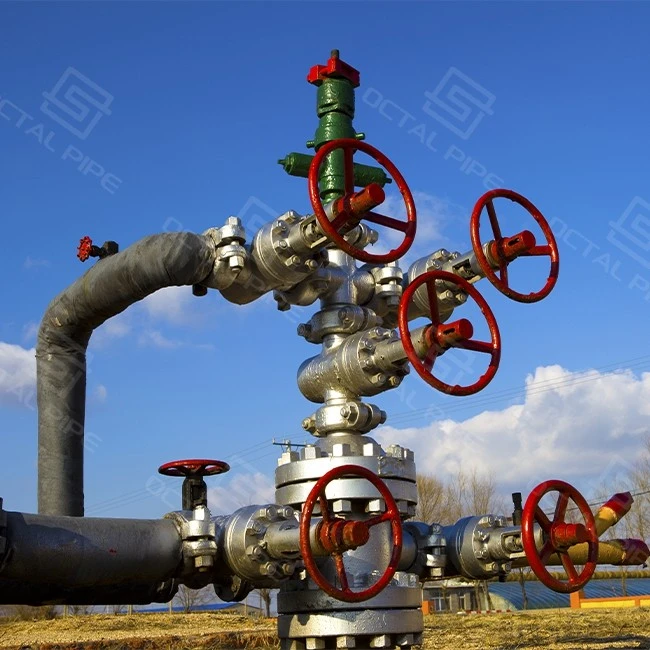
Wellhead and Christmas Tree
Components: Casing head, tubing head, master/wing valves, swab valve, choke assembly.
Specifications:
Pressure: 2,000 – 15,000 PSI
Bore Size: 2 1/16″ – 7 1/16″
Temp: API 6A K–U rating
PSL: Levels 1–4
Types: Vertical tree, horizontal tree, dual-completion, subsea Xmas tree.
Standards: API 6A, ISO 10423, NACE MR0175 – compliant with global requirements.
Applications: Oil & gas production wells, gas injection, offshore subsea, HPHT fields.
Supply Range: Complete assemblies, valves, chokes, custom-engineered designs.
A wellhead and Christmas tree assembly is used to support the casing and tubing strings at surface, contain well pressure, control production flow, and provide a safe shut-in route during operation, maintenance, and intervention. The wellhead forms the structural and pressure-containing interface, while the Christmas tree installed above it uses valves, spools, and chokes to regulate flow and provide access for well service. In oil and gas applications, the assembly needs to match the actual well condition and surface flow-control route, and the key API 6A specification details should be confirmed early, including working pressure, nominal bore, temperature class, material class, PSL, PR, and connection arrangement. A properly configured package helps keep installation, pressure control, and later field operations more stable and efficient.


Main Equipment Included in the Assembly
The supply scope can cover the main equipment used in API 6A wellhead and Christmas tree service, with package form arranged according to new-well supply, replacement work, repair orders, or partial upgrades.
| Equipment | Main Function |
|---|---|
| Casing Head | Supports and seals the casing string at surface and provides the base connection for the upper wellhead assembly |
| Tubing Head | Supports the tubing string and provides the interface between the wellhead and the Christmas tree |
| Casing Hanger | Suspends and seals the casing string within the casing head |
| Tubing Hanger | Suspends and seals the tubing string and directs production flow into the tree system |
| Lower and Upper Master Valves | Provide the main shut-in control in the vertical flow path of the tree |
| Production Wing Valve | Controls production flow from the tree to the outlet line |
| Kill Wing Valve | Provides access for kill fluid circulation, pressure balancing, or service operations |
| Swab Valve | Allows vertical access through the top of the tree for well intervention or service work |
| Choke | Regulates flow rate and helps control pressure drop in the production path |
| Cross-over Spool | Connects components with different sizes, outlets, or connection arrangements |
| Adaptors | Match connection interfaces between different wellhead or tree components |
| Connection Parts | Includes flanged, studded, and clamp-hub connection parts used in the assembly |
| Related Fittings and Accessories | Covers supporting pressure-control fittings and accessory parts required for the complete assembly |
A complete assembly is often preferred when the full pressure-control route needs to be matched from the beginning. Individual components are commonly supplied for replacement work, repair scope, or staged upgrades in existing installations.
Available API 6A Pressure, Bore, and Class Range
| Item | Typical Supply Range |
|---|---|
| Standard | API 6A |
| Working Pressure | 2,000 psi – 15,000 psi |
| Nominal Bore | 2 1/16" – 7 1/16" |
| Temperature Class | K, L, P, R, S, T, U |
| Material Class | AA – HH |
| PSL | PSL 1 – PSL 4 |
| PR | PR1, PR2 |
| Connection Type | Flanged, studded, clamp hub |
| Package Form | Complete assembly or individual components |
| Service Scope | Oil wells, gas wells, injection wells, offshore platform projects |
Surface Tree and Wellhead Assembly Configurations
A surface production tree is commonly used where the well needs a clear flow route from tubing to outlet line together with dependable shut-in control. This arrangement usually includes the master valve stack, production wing outlet, swab access, and choke path.
A wellhead package with tubing and casing support is often selected for new-well projects where the casing head, tubing head, hangers, and tree connections need to be aligned as one pressure-control system. This helps keep the interface between head, hanger, spool, and valve arrangement consistent from fabrication to installation.
A replacement or repair configuration is more common when only one pressure-containing part needs to be changed. In this situation, the key point is not only the component name, but whether the replacement item matches the existing pressure class, bore, connection geometry, and stack arrangement already installed at the wellsite.
Field Applications and Service Conditions
In onshore oil production wells, a surface tree is commonly used to control the flow route from the tubing to the gathering line while maintaining a reliable shut-in path at surface. A typical example is a conventional producing well tied into a field flowline, where the master valve, wing valve, and choke arrangement need to match the expected production rate, outlet direction, and routine maintenance procedure.
In gas wells, shut-in integrity and flow regulation usually receive closer review because the pressure-control path must remain stable during production, testing, and temporary shutdown. For example, a gas well connected to a separator or gas-gathering system may require the tree outlet connection, choke setup, and valve class to match the approved process route so the assembly can be installed without later field modification.
In water injection or gas injection service, the main requirement is reliable isolation and pressure containment during continuous operation and periodic shutdown. A typical case is an injection well where the surface assembly must isolate the well safely during pump maintenance, line inspection, or valve replacement while keeping the connection path aligned with the injection line.
During workover, recompletion, or well intervention, access through the upper part of the tree becomes especially important. In this condition, the swab valve arrangement, top connection, and valve stack sequence need to be defined clearly so intervention tools and field procedures can move forward without confusion at the wellsite.
For offshore platform wells, installation space is often tighter and approval routes are usually stricter. In practice, this means the pressure class, material class, connection arrangement, and release documents should all be confirmed together before manufacturing starts, especially where the assembly will tie into platform piping, choke manifolds, or compact production skids.


Materials, Classes, and Connection Options
For wellhead and tree equipment, pressure class, material class, PSL, and PR are critical operating definitions, and the applicable API 6A temperature class should also be confirmed according to actual service conditions. They determine whether the assembly is suitable for the actual well condition and whether it can move through technical review without repeated clarification.
The connection arrangement should also be confirmed early. Flanged, studded, and clamp-hub connections are all used in wellhead and tree service, but the correct choice depends on the existing stack design, outlet route, and installation method. In practice, the top connection, outlet connection, spool position, and choke location should be reviewed as one configuration set rather than as separate items.
For service involving corrosive conditions or sour environments, material review should be based on the actual operating medium, temperature, and service severity. For example, in a sour gas well producing wet gas with H2S and formation water, material selection cannot be based on pressure rating alone. The trim, sealing surfaces, and pressure-containing parts need to be checked against the real corrosive condition and the applicable sour-service requirement so the assembly can remain suitable for shut-in, flow control, and long-term field operation. This helps keep the material-class selection aligned with real well duty instead of relying on a broad description alone.
Quality Control and Documentation
For wellhead and tree equipment, quality control is not only about whether each part is manufactured correctly, but whether the full assembly is released on the right API 6A / ISO 10423 basis for the actual service condition. That is why the main approval items should be confirmed early, including working pressure, nominal bore, temperature class, material class, PSL, PR, connection details, service medium, and sour or non-sour condition. API 6A remains the main specification for wellhead and tree equipment, while ISO 10423 follows the same service-condition logic.
A sound quality-control route should also confirm whether the assembled configuration matches the intended service. For sour-service applications, material review is commonly checked against NACE MR0175 / ISO 15156 requirements rather than relying only on a general note, because H2S-related service can create additional material-selection risk.
The document package should be clear enough for inspection, shipment, and site handover. In many projects, the commonly requested documents include:
- API 6A / ISO 10423 compliance basis
- API Monogram license status, when monogrammed product is required
- ISO 9001 certificate
- EN 10204 3.1 material certificates
- Pressure test records
- Dimensional inspection reports
- Traceability records
- Marking details
- Packing list
- Project-specific release documents, when required
API describes the Monogram as a voluntary licensing program for products manufactured to applicable API specifications, while ISO 9001 is the widely used framework for quality management systems. EN 10204 3.1 is also commonly used for traceable material certification in project supply.
For assemblies with multiple pressure-containing components, the traceability route should remain clear from material certificate to component marking and final release records, so the package can move through inspection and acceptance with fewer delays.
Why Octal for API 6A Wellhead and Tree Supply
Octal supplies wellhead and Christmas tree equipment with a focus on clear configuration matching, practical project support, and reliable document preparation. The scope can cover complete assemblies, tree valves, chokes, spools, and related pressure-control components for new wells, replacement work, and repair projects.
With the right specification confirmed early, it becomes easier to keep the pressure class, bore, connection details, and component arrangement aligned from quotation to shipment. This helps reduce interface mismatch, simplifies inspection, and supports smoother installation at site.
For projects involving sour service, higher-pressure duty, or more demanding service conditions, Octal can support specification review and component matching based on the actual operating requirement. The goal is to provide not only the equipment itself, but a supply package that is easier to approve, easier to inspect, and easier to put into service.
FAQ

01.What information should be confirmed before requesting a quotation for API 6A wellhead and Christmas tree equipment?
02.Can API 6A wellhead and Christmas tree equipment be supplied as both complete assemblies and replacement components?
03.How do PSL and PR affect API 6A equipment selection?
04.How should sour-service conditions be specified for a wellhead and Christmas tree assembly?
05.How should the API 6A temperature class be selected for a wellhead and Christmas tree assembly?
Certifications
CE Certificate
ISO 9001 Certificate
API Q1 Certificate
ABS Certificate
AP-5L Certificate
API-5CT Certificate
Hot Tags: wellhead and christmas tree, China wellhead and christmas tree manufacturers, suppliers, factory
Previous
API 6D Valve and Pipeline ValveNext
No InformationYou Might Also Like




Send Inquiry