




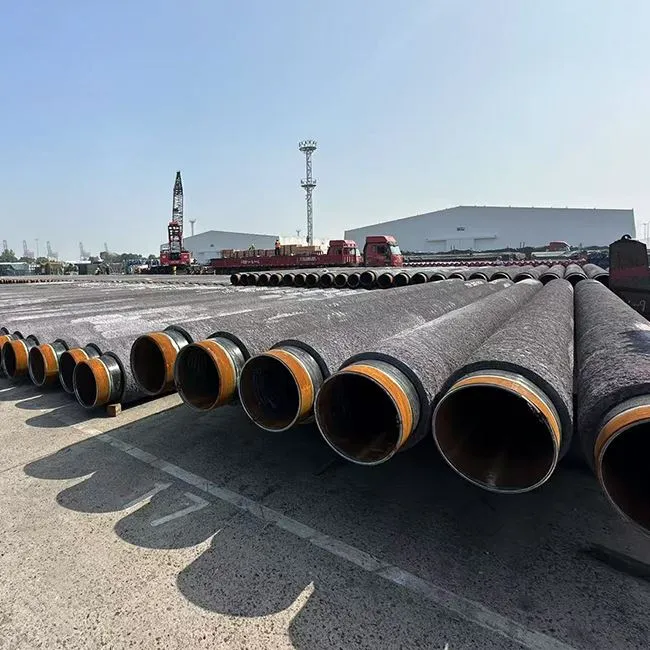

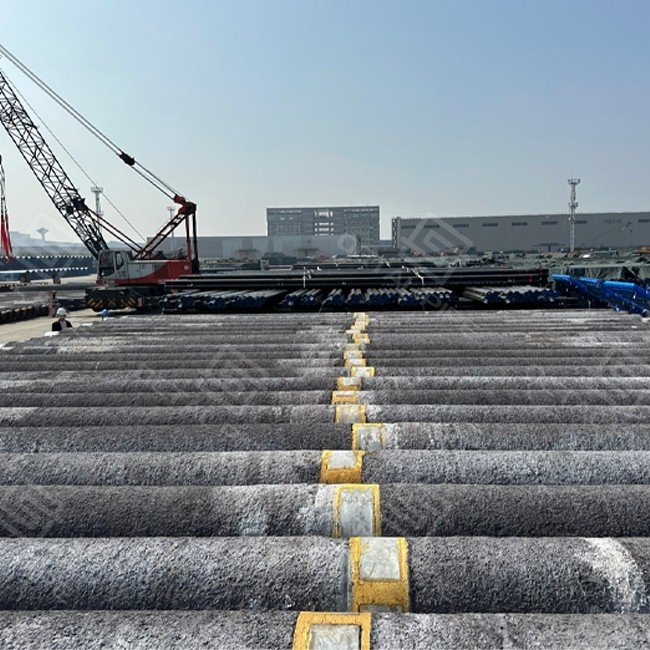

CWC Pipe(Concrete Weight Coating)
Pipe Range: 6″ – 48″ (custom up to 60″)
Coating Thickness: 25 – 150 mm
Concrete Density: 3040 – 3500 kg/m³
Reinforcement: Steel mesh, polypropylene fibers, additives
Coating Types: Heavy Concrete Weight Coating, Impingement CWC
Anode Installation: Optional sacrificial or ICCP anodes integrated for cathodic protection
Mechanical Benefits: Negative buoyancy, abrasion resistance, impact protection, long-term durability
Applications: Offshore pipelines, submarine flowlines, swamp & river crossings, landfall approaches
Key Advantages: Custom density solutions, field-welding compatibility, proven offshore performance
cWC Pipe Meaning
CWC Pipe(Concrete Weight Coating)is a specialized external coating applied to steel pipelines to provide negative buoyancy, mechanical protection, and long-term stability in offshore and swamp environments. Unlike simple corrosion coatings, CWC adds a dense concrete layer over anti-corrosion systems ,ensuring pipelines remain secure and stable even under strong hydrodynamic forces or buoyant soils.
CWC Pipe is essential for:
- Submarine pipelines in shallow and deepwater projects
- River and swamp crossings where uplift resistance is critical
- Landfall approaches exposed to waves, tides, and currents
When an offshore pipeline must stay on the seabed and on route, buyers choose Concrete Weight Coating (CWC) for three practical reasons: it adds negative buoyancy to prevent uplift, improves seabed stability against currents and wave action, and provides mechanical protection during handling, installation and long-term seabed contact. Octal Pipe supplies CWC as a coordinated package-base pipe + anti-corrosion coating (3LPE/FBE/3LPP) + concrete weight coating-so the line meets stability calculations and construction requirements without extra rework between vendors.
CWC Pipes Standards & Specifications
Octal Pipe manufactures CWC Pipe in accordance with international offshore pipeline standards:
- ISO 21809-5 – Concrete Weight Coatings for Pipeline Transportation Systems
- DNV-RP-F110 & DNV-OS-F101 – Offshore pipeline stability guidelines
- Pipe Size Range: 4″ – 48″ (custom up to 60″)
- Coating Thickness: 25 mm – 150 mm
- Concrete Density: 3040 – 3500 kg/m³ (adjustable per project)
- Pipe Lengths: 8 – 18 m standard, custom lengths available
cwc pipe coating Manufacturing process
(1) Surface Preparation
Application of 3LPE anti-corrosion coating (FBE primer + adhesive + polyethylene topcoat)
Surface roughening to ensure proper adhesion of concrete
(2) Reinforcement Placement
Steel mesh or wire cages installed around the pipe
Polypropylene fibers added for enhanced crack resistance
(3) Concrete Application
Heavy Concrete Weight Coating: Dense concrete applied with controlled aggregates
Impingement Concrete Weight Coating (ICWC): Concrete applied by impingement, achieving high bonding strength and density
(4) Anode Installation
To ensure full corrosion protection, sacrificial anodes or impressed current anodes are often integrated into CWC-coated pipelines:
Anode Types: Aluminum, zinc, or MMO (Mixed Metal Oxide) anodes
Installation: Embedded in the CWC layer and electrically bonded to the pipe
Function: Provides cathodic protection in seawater and swamp conditions, extending pipeline life by 20–40 years
(5) Curing & Finishing
Controlled curing of concrete to achieve mechanical strength
Chamfering or beveling of pipe ends for easier field welding.
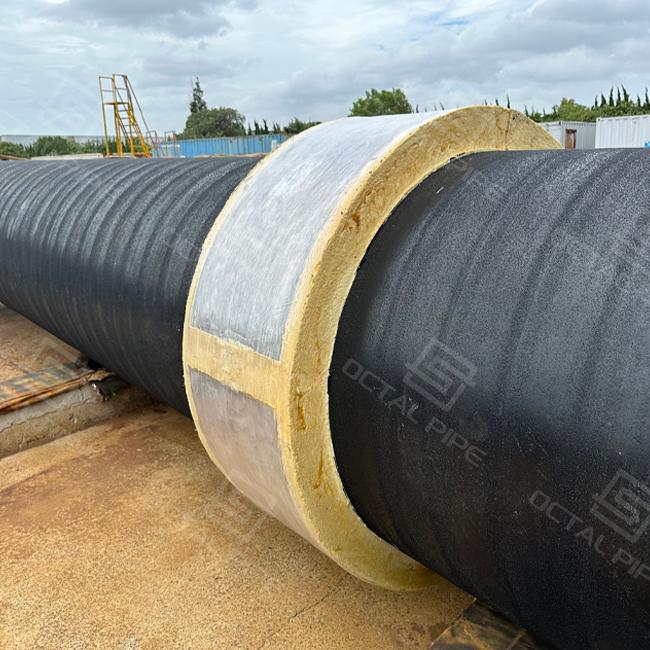
The CWC pipe coating process is not only "adding concrete." The quality outcome is decided by reinforcement fit-up, curing control, and end finishing-because most field issues show up as edge damage, cracking, or poor transition at the concrete-free ends.
- Surface prep & base coating confirmation: anti-corrosion layer verified before concrete application.
- Reinforcement installation: mesh/cage positioning checked so concrete doesn't delaminate under handling loads.
- Concrete application: build-up to specified thickness with controlled compaction.
- Controlled curing: prevents brittle edges and early cracking during transport.
- End finishing: concrete-free ends and clean transitions for welding access (when required).
Mechanical & Protective Properties
- Negative Buoyancy: Ensures pipelines stay submerged and stable in water or swamp settings, effectively countering uplift from buoyant forces.
- Mechanical Protection: Safeguards against external threats like anchor drags, trawling gear, and direct impacts during installation or operation.
- Abrasion Resistance: Endures wear from seabed shifts, ocean currents, and contact with rocky or abrasive surfaces.
- Crack Resistance: Reinforced concrete withstands bending, handling stresses, and operational loads without fracturing.
- Optional Thermal Insulation: Integrates additional layers to preserve fluid temperatures in deepwater flowlines and subsea environments.

concrete weight coating plant
The mechanical benefits above only hold if the concrete weight coating plant controls the variables that typically fail in real logistics-segregation, edge spalling, early cracking, and inconsistent weight per meter. From a buyer's point of view, this is where "CWC pipe" turns from a spec line into a receiving risk. Octal Pipe runs CWC supply with plant-level controls so your coating build-up is consistent across the lot and survives transport, lifting, and pull-in handling.
- Mix control (density consistency): We control cement/aggregate/water ratio and batching discipline to hit the specified density and reduce segregation that can create weak zones and variable submerged weight.
- Reinforcement fit-up (spalling prevention): Mesh/cage positioning is checked before concrete placement to prevent local thin areas that chip during lifting or impact at the yard.
- Curing management (crack control): Time/temperature curing is managed to reduce shrinkage cracking that often shows up after shipment or after the first few handling cycles.
- Handling rules (edge and end damage): Lifting points, edge protection, and end protection are applied to reduce chipping at the coating ends-where damage most often leads to site repair delays.
Field Joint & Welding Compatibility – Built for Offshore Construction
On an offshore spread, CWC pipe is only "good" if it doesn't slow down welding and field joint coating. The concrete protects the pipe on the seabed, but if the ends are not prepared correctly, crews waste hours chipping concrete, repairing edge damage, and reworking the field joint-exactly where schedule risk and rejection risk are highest.
How Octal Pipe makes Concrete Weight Coating practical for offshore construction?
Concrete-free ends that match real welding practice
- Concrete cutback (CWC-free length): We keep a fixed concrete-free distance from the pipe end to the start of concrete, typically 200–400 mm per end (or as your project specifies). This gives enough room for line-up clamps, internal/external welding stations and handling tools without chipping concrete during fit-up.
- Anti-corrosion coating cutback (3LPE/FBE/3LPP): Inside the concrete-free zone, the corrosion coating is also controlled with a separate cutback for field joint work. For most offshore programs, Octal holds the 3LPE (or 3LPP/FBE) cutback at the bevel end typically around 150–250 mm (or per your field joint coating system), leaving a consistent bare-steel band for welding and then a clean transition for field-joint coating.
- Controlled transitions (no "ragged edge"): The concrete termination is shaped and protected so the edge is stable through lifting, loading and firing-line handling. The corrosion coating edge is also kept clean and measurable, so the field joint crew can prep, heat and apply sleeves / liquid epoxy systems without chasing irregular edges or reworking damaged areas.
End profile built to protect the coating edge
- The most common damage point is the concrete edge during loading, pipe handling and stringing. Octal uses a controlled end chamfer / taper profile and edge protection so the concrete termination is less likely to crack or spall. That means fewer repairs on deck and less risk of exposing the corrosion coating at the cutback.
Compatibility with field joint coating systems
- Different projects use different field joint methods (heat-shrink sleeves, liquid epoxy/PU systems, or 3LPP/3LPE compatible solutions). Octal coordinates the CWC pipe cutback, surface preparation and transition profile so your field joint coating system can be applied without fighting the concrete. If needed, we can supply drawings showing cutback length, coating build-up and the joint transition zone-so the welding contractor and coating crew work from the same reference.
Designed around handling, not just lab performance
- Offshore pipe moves through multiple lifts-mill yard, port, vessel loading, firing line, stinger. Octal focuses on the "in-between" stages: stable concrete edges, clear markings, protected bevels and packaging that reduces end damage. The goal is simple: less touch-up work on the vessel, smoother lay rate, and fewer NCRs caused by chipped CWC pipe or damaged cutbacks.
One accountable package: base pipe + corrosion coating + CWC
- CWC pipes performance depends on what's underneath it. Octal supplies the package as one coordinated scope-base pipe + 3LPE + CWC + cutback/end preparation-so bonding, compatibility and inspection are managed under one responsibility instead of split between multiple vendors.


Buoyancy & Stability Inputs – What We Need From Your Project
Buoyancy & Stability Inputs – What We Need From Your Project
Concrete weight coating is rarely "one thickness fits all". The right CWC coated pipe design depends on seabed soil, currents, lay method and the anti-corrosion coating system under the concrete
To quote and engineer Octal pipeline concrete weight coating (CWC) correctly, we typically confirm the items below:
| Buyer / EPC input | Why it matters for CWC | What Octal returns |
|---|---|---|
| Pipe OD / WT / length & steel grade | Determines submerged weight and handling stress | CWC thickness & density proposal (within project range) |
| Anti-corrosion system (FBE / 3LPE / 3LPP) | Concrete bonding and long-term delamination risk | Surface prep + bonding plan and test scope |
| Water depth / current / seabed condition | Drives uplift risk and required negative buoyancy | Buoyancy / stability check sheet (project-specific) |
| Installation method (S-lay / J-lay / shore pull / swamp crossing) | Controls impact, bending and abrasion exposure | Reinforcement option (mesh / fiber) & durability targets |
| Field joint plan (weld procedure, coating method on joints) | Prevents "weak points" at girth welds | Concrete-free ends + bevel/chamfer solution |
| CP design (sacrificial / ICCP) & anode type | Integrates anodes into coating without rework | Anode embedding & electrical bonding plan |
Concrete weight coating density is one of the few parameters that directly changes on-bottom stability calculations. Buyers should lock density and thickness together on the RFQ so the delivered submerged weight matches the installation design intent.
| What the buyer specifies | What it controls on site |
|---|---|
| Concrete weight coating density (kg/m³) | Submerged weight per meter (stability) |
| Coating thickness (mm) | Total weight + mechanical protection level |
| Tolerance / acceptance basis (if required) | Whether "close enough" is acceptable at receiving |
Click to watch Octal Pipe's CWC Pipes shipping video↓
CWC Pipe Quality Control & Testing
Octal Pipe implements rigorous QA/QC protocols to guarantee the integrity and performance of CWC Pipe coating applications:
- Density and Compression Tests: Confirm concrete density and compressive strength meet specified thresholds for buoyancy and load-bearing.
- Bonding Tests: Validate strong adhesion between the concrete layer and underlying anti-corrosion coating to prevent delamination.
- Dimensional Checks: Ensure uniform coating thickness and overall geometry align with project tolerances.
- Holiday Detection: Identify and rectify any defects or voids in the anti-corrosion base layer for complete protection.
- Buoyancy Simulation: Simulate real-world conditions to verify resistance to uplift and stability in submerged environments.


Engineering Applications(Concrete Weight Coating Pipeline / Pipe)
| Application section | Real job-site conditions | Why concrete weight coating is specified | Octal Pipe supply focus |
|---|---|---|---|
| Submarine pipelines | Currents and wave action can cause uplift and lateral movement during lay; seabed contact/drag during positioning | Concrete weight coating for pipeline adds negative buoyancy and an outer shell that protects the anti-corrosion layer | Consistent build-up and clean end transitions; concrete-free ends for welding access (when specified) |
| Nearshore & landfall approaches | Pull-in over rollers/winches, tidal zone abrasion, coastal erosion and impact risk | Concrete weight coating pipe sections resist pull-in abrasion and stay seated through tide/wave cycles | Cutback length + end protection aligned to pull-in/welding station practice (when specified) |
| Swamp / marsh crossings | Buoyant soils and soft ground can lift the line after backfill; exposure risk increases with water table changes | Concrete weight coating for pipeline increases submerged weight to prevent floatation and movement | Density/thickness targets matched to stability intent; reinforcement control to reduce cracking/spalling |
| River crossings | Seasonal floods, high velocity flow, scour can expose pipe and shift alignment | Concrete weight coating pipeline sections counter uplift and provide mechanical protection when cover is lost | Repeatable end finishing for fast field welding + field joint coating; handling rules to avoid edge damage |
| Deepwater installations | Long lay spreads, repeated handling, deepwater stability requirements | Concrete weight coating helps maintain on-bottom stability and protects coating over long installation cycles | Uniformity + handling discipline to reduce chipping in lifting/transport; inspection scope per PO/ITP when required |
Key Advantages of Octal Pipe CWC coated pipe
Octal Pipe's CWC advantage comes from what is controlled on the shop floor-the steps that prevent the typical offshore CWC problems (weight variance, edge spalling, cracking after shipment, and end-transition damage that slows welding).
Weight build-up controlled as a system (density + thickness + reinforcement): In the plant, batching and placement are managed so density and thickness stay aligned to the stability intent, and reinforcement is positioned to avoid local weak zones. This is how Octal Pipe reduces "same spec, different weight per meter" variation that forces re-checks during installation. (Density/thickness records can be supplied when specified in PO/ITP.)
Interface discipline before concrete is applied: Many failures start at the interface, not in the concrete itself. Octal Pipe runs base-coating confirmation and surface condition control before concrete placement, so the concrete layer bonds properly instead of lifting later as spalls or hollow spots under handling loads.
End transitions built for welding reality (not just factory appearance): The highest-cost delays usually happen at the ends-ragged edges, chipped transitions, or cutbacks that don't match the welding station. Octal Pipe controls concrete-free end length and the transition profile so fit-up, clamps, and field joint coating work can proceed without breaking concrete at the edge. (End cutback and profile per PO/ITP.)
Curing and handling controls designed around transport damage: CWC often looks fine at dispatch and fails during yard moves, trucking, or port lifting. Octal Pipe manages curing conditions and applies handling discipline (lifting points, stacking rules, edge/end protection) to reduce micro-cracking and edge spalling that would otherwise create site repairs and acceptance delays.


FAQ

Q1 - Why use concrete weight coating on offshore pipelines?
Q2 - How do you choose CWC thickness and density?
Q3: Can CWC be applied over 3LPE/FBE and still allow welding on site?
Certifications
CE Certificate
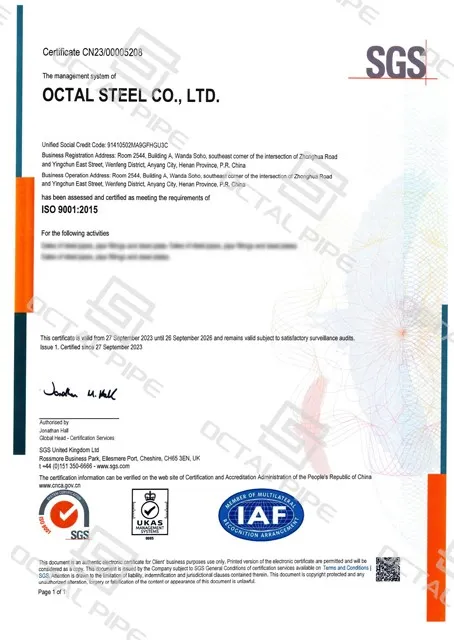
ISO 9001 Certificate
API Q1 Certificate
ABS Certificate
AP-5L Certificate
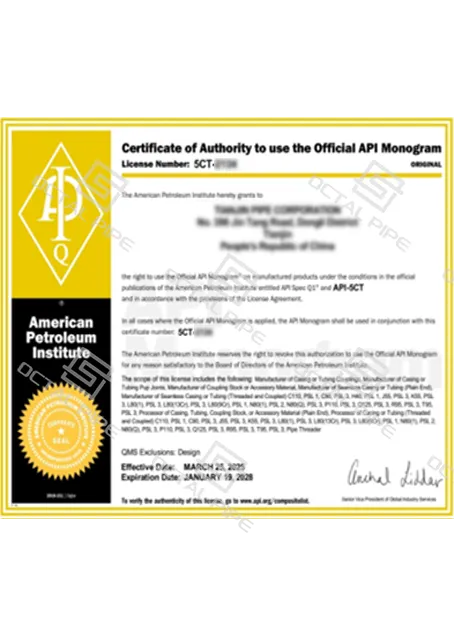
API-5CT Certificate
Quick Specification Snapshot
Standard: ISO 21809-5
Pipe Range: 6″ – 48″ (up to 60″ optional)
Coating Thickness: 25 – 150 mm
Concrete Density: 3040 – 3500 kg/m³
Reinforcement: Steel mesh, fibers, additives
Applications: Offshore pipelines, submarine flowlines, swamps, rivers
Hot Tags: CWC Pipe(Concrete Weight Coating), China CWC Pipe(Concrete Weight Coating) manufacturers, suppliers, factory
Previous
No InformationYou Might Also Like




Send Inquiry