




A645 Nickel Alloy Steel Plate
Grade: Gr.A / Gr.B
Typical Material: 5% Ni nickel alloy steel plate
Delivery Condition: Quenched & Tempered
Thickness Range: 6 ~ 60mm(customized)
Width Range: Up to 5000mm
Length Range: Up to 18000mm
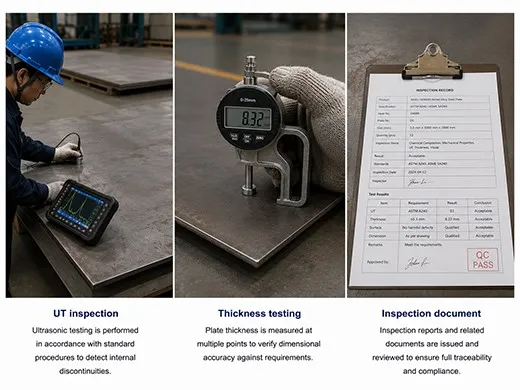
Inspection: UT, impact test, hardness test, dimensional inspection
Documents: EN 10204 3.1 / 3.2, MTC, UT report, heat treatment record
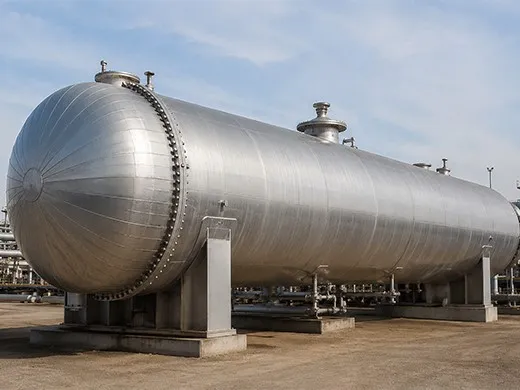
Applications: LNG storage tanks, cryogenic pressure vessels, LEG/LPG storage systems
A645 Nickel Alloy Steel Plate is a 5% nickel, quenched and tempered pressure-vessel plate used where the steel must keep impact toughness at cryogenic temperature. In LNG tanks, LEG/LPG storage vessels, and low-temperature pressure equipment, buyers normally check ASTM A645 together with Q&T condition, impact-test temperature, UT acceptance level, heat-treatment record, and MTC traceability before fabrication approval.
Unlike nickel-plated steel, ASTM A645 is not a surface-coated material. Nickel is added during steelmaking and works through the full plate thickness after rolling and heat treatment. This is why the material is selected for shell plates, bottom plates, and other cryogenic storage sections where welding reliability and low-temperature fracture resistance must be confirmed before use.


How ASTM A645 Plate Is Reviewed Before Project Approval
In LNG and low-temperature storage projects, ASTM A645 plate is reviewed around one main risk: brittle fracture after repeated cooling and warming cycles. The plate must keep stable impact toughness after rolling, Q&T heat treatment, cutting, forming, and welding.
For LNG tank and cryogenic vessel procurement, grade name alone is not enough for approval. Buyers usually check impact-test temperature, UT acceptance level, heat-treatment traceability, WPS/PQR compatibility, and third-party inspection hold points before fabrication starts.
For thicker shell or bottom plate sections, the review is stricter because weld repair, impact retesting, and plate replacement become difficult after cutting, forming, and multi-pass welding.


Order Details Usually Checked Before Production
Before issuing a purchase order, most LNG and cryogenic projects first confirm the plate standard, grade, Q&T condition, impact-test requirement, UT level, and documentation package. These items decide whether the material can enter the fabrication approval stage.
| Item | Description
|
|---|---|
| Standard | ASTM A645 / ASME SA645 |
| Grade | Gr.A / Gr.B |
| Typical Material | 5% Ni steel |
| Delivery Condition | Quenched & Tempered |
| Nickel Content |
|
| Thickness Range | 6–60 mm, customized |
| Width Range | Up to 5000 mm |
| Length Range | Up to 18000 mm |
| UT Inspection | ASTM A578 or project requirement |
| Documents | EN 10204 3.1 / 3.2, MTC, UT report, heat treatment record |
| Third-Party Inspection | SGS, BV, DNV, LR, ABS, TÜV, or project-specified agency |
Chemistry Control For Low-Temperature Service
For LNG and cryogenic service, chemistry is reviewed together with toughness and welding approval. Nickel content supports low-temperature impact performance, while phosphorus and sulfur are kept low to reduce inclusion risk, brittle-fracture sensitivity, and weld-defect risk.
| Element | Typical Control Range (%) |
|---|---|
| C | 0.045–0.060 |
| Si | 0.15–0.23 |
| Mn |
|
| P | ≤0.007 |
| S | ≤0.0025 |
| Ni | 4.75–5.00 |
Actual chemical values should follow the final MTC, ASTM / ASME requirement, and approved project specification.
Mechanical Properties Reviewed For Cryogenic Service
For A645 nickel alloy steel plate, buyers normally care more about low-temperature toughness stability than only room-temperature strength. In LNG fabrication, the plate must keep reliable performance after rolling, quenching, tempering, cutting, forming, and welding.
| Property | Typical Data From 5Ni Steel Production |
| Yield Strength | Mainly 581–630 MPa |
| Tensile Strength | Mainly 621–660 MPa |
| Impact Value | Above 100 J |
| NDTT | Below -120°C |
| Z-Direction Reduction | Above 60% |
For A645 nickel alloy steel plate, mechanical review focuses on cryogenic toughness, tensile properties, NDTT, and Z-direction performance. In LNG fabrication, these values are checked together with rolling, Q&T heat treatment, cutting, forming, and welding records.
Heat Treatment And Production Control
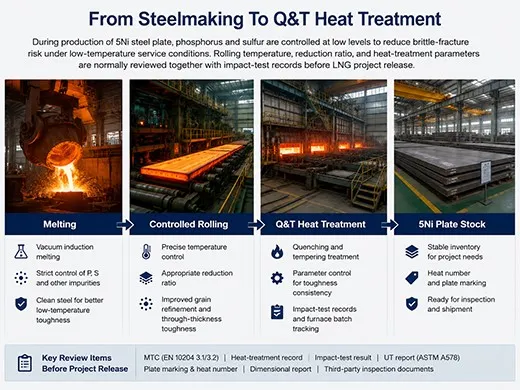
For ASTM A645 plate, heat treatment has a direct influence on final cryogenic performance. After controlled rolling, the plate normally goes through quenching and tempering to stabilize microstructure and improve toughness consistency across the plate thickness.
During production, the key control points include nickel content, impurity control, rolling reduction, quenching temperature, tempering process, and cooling condition. For LNG tank plate, buyers often review heat-treatment batch records together with MTC, UT report, and impact-test data.
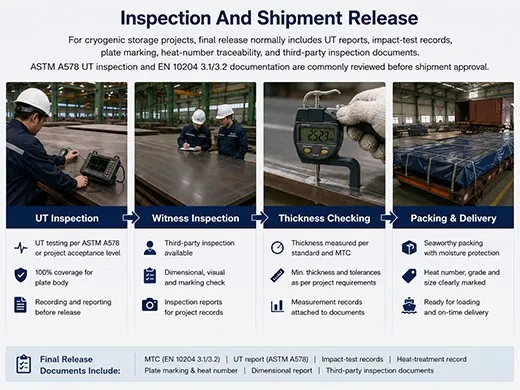
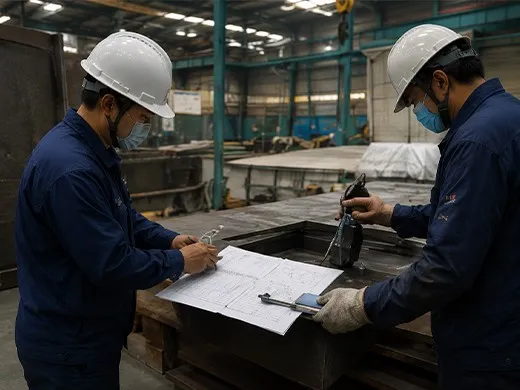
Before shipment, plate surface, dimensions, marking, heat number, and traceability records should be checked to confirm that the delivered plate matches approved project documents.

How The Plate Is Released For LNG Projects
For ASTM A645 / 5Ni nickel alloy steel plate, buyers usually check the full production route before LNG or cryogenic project approval. The key review points are not limited to grade name, but also include Q&T condition, impact-test result, UT acceptance, plate marking, and heat-number traceability.
The normal route covers steelmaking, slab conditioning, controlled rolling, quenching and tempering, cutting and sampling, mechanical testing, UT inspection, dimensional checking, and packing release.
During steelmaking, phosphorus and sulfur are controlled to reduce inclusion risk. During rolling and Q&T treatment, temperature control and reduction ratio affect grain refinement and through-thickness toughness consistency.
Before shipment, the MTC, UT report, heat-treatment record, impact-test result, plate marking, and third-party inspection documents should match the approved LNG or cryogenic project requirements.
Microstructure, Inclusion And NDTT Review
For cryogenic nickel alloy steel, microstructure stability is closely related to impact toughness and brittle-fracture resistance. Finished 5Ni steel plate normally shows tempered martensite with a small amount of reverted austenite after Q&T treatment.
In LNG storage projects, unstable microstructure, center segregation, or poor inclusion control may reduce crack resistance under repeated cooling conditions. That is why metallographic review, inclusion rating, UT inspection, NDTT result, and impact-test data are usually checked together during material approval.
For 25 mm and 50 mm 5Ni steel plates, NDTT below -120°C and inclusion control at D1 / DS0.5 levels can support fracture safety review in LNG and cryogenic storage projects.
Welding Performance Of A645 Nickel Alloy Steel Plate
Welding performance is one of the main review points for ASTM A645 plate used in LNG tanks and cryogenic pressure vessels. The base plate may meet ASTM A645, but the welded joint must also maintain low-temperature toughness after fabrication.
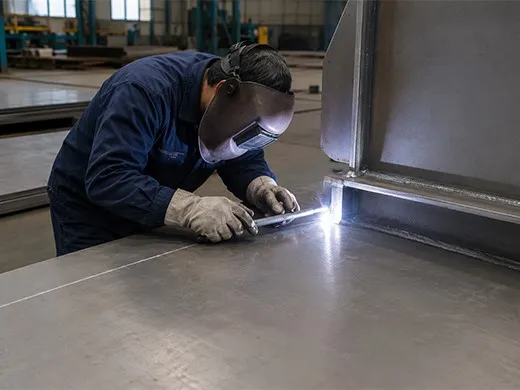
In actual fabrication projects, engineers usually review heat input control, preheating condition, HAZ hardness, hydrogen cracking prevention, PWHT influence, and WPS/PQR records. For thick SA645 plate, third-party witnessed welding qualification may be requested before fabrication starts.
Y-groove crack testing for 5Ni steel at room temperature and 50°C preheating condition showed 0% surface crack rate, 0% root crack rate, and 0% section crack rate in tested samples, supporting welding crack-resistance evaluation for cryogenic fabrication.
Remaining Magnetism Control During Fabrication
For field welding of cryogenic steel plate, remaining magnetism may be checked before fabrication because excessive magnetism can affect arc stability and weld bead control.
In LNG tank fabrication, finished 5Ni steel plate is normally checked at the plate surface, plate corners, and weld preparation areas. Remaining magnetism is generally required below 50 GS. Finished plate can be controlled within 30 GS, with plate corners within 20 GS and most other positions within 10 GS.
Proper handling after heat treatment, reduced exposure to strong magnetic sources, and measurement before fabrication help control welding interference risk.
Project Applications And Supply Experience
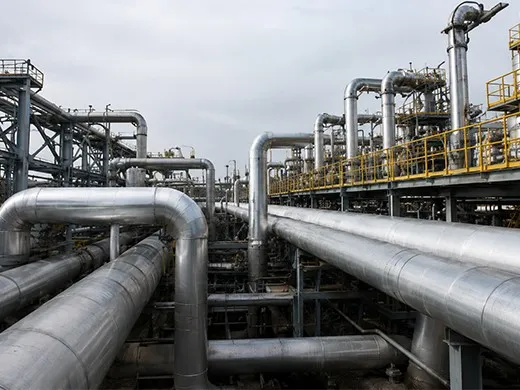
A645 nickel alloy steel plate is mainly used in LEG storage tanks, LPG storage tanks, VLEC tanks, LNG fuel tanks, cryogenic pressure vessels, and low-temperature hydrocarbon equipment.
Actual 5Ni / 5.5Ni project records include A645 Gr.B plate for LEG storage tank applications, SA-645 Gr.A plate for a 30000 m³ LPG storage tank, and 5.0Ni steel plate for a 100000 CBM VLEC project. These reference cases can support buyer evaluation for cryogenic storage applications.
For LNG and cryogenic projects, related inspection or approval may involve SGS, BV, DNV, LR, ABS, CCS, TÜV, or other project-specified agencies.


Nickel Alloy Steel Vs Nickel-Plated Steel
ASTM A645 is nickel alloy steel, not nickel-plated steel. The nickel is part of the steel chemistry and works through the full plate thickness after rolling and heat treatment.
Nickel-plated steel only has a nickel layer on the surface. It may improve appearance or surface corrosion resistance, but it cannot provide the same through-thickness cryogenic toughness required for LNG tanks, cryogenic pressure vessels, or refrigerated hydrocarbon systems.
FAQ

Q1: Is ASTM A645 plate normally supplied in Q&T condition?
A1: Yes. For LNG and cryogenic service, ASTM A645 plate is normally supplied in quenched and tempered condition to achieve stable low-temperature toughness.
Q2: Why is 5% nickel important in A645 steel plate?
Q3: What documents are usually required for A645 plate approval?
Q4: Can ASTM A645 plate be supplied with third-party inspection?
Certifications

CE Certificate

ISO 9001 Certificate

API Q1 Certificate

ABS Certificate

AP-5L Certificate

API-5CT Certificate
Hot Tags: a645 nickel alloy steel plate, China a645 nickel alloy steel plate manufacturers, suppliers, factory, 1 2 round bar, 52100 round bar, aluminium 6061 round bar, mild steel chequered plate, mild steel coils, stainless tread plate
Previous
No InformationNext
China Steel SiloYou Might Also Like


Send Inquiry