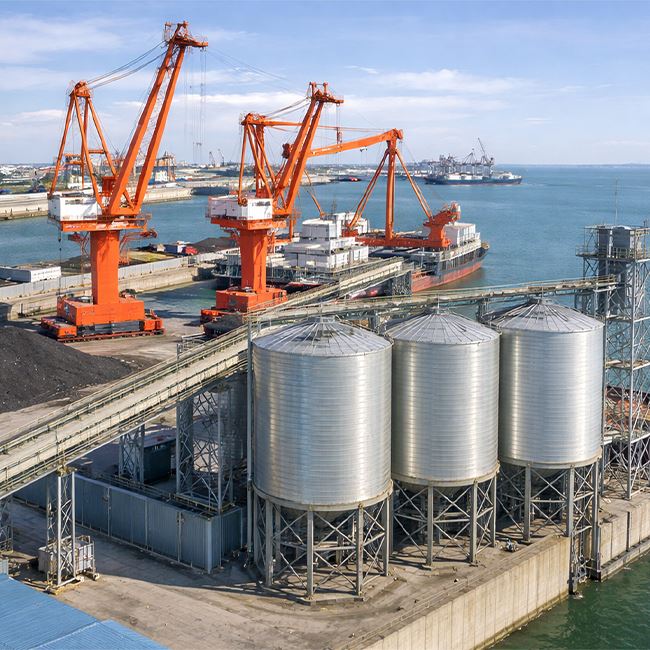
Scope: China steel silo package = steel silo + discharge + transfer/dust interfaces (optional modules/tanks); 100–20,000 m³, φ3–35 m.
Directories: Steel silo types + supporting equipment + liquid tanks.
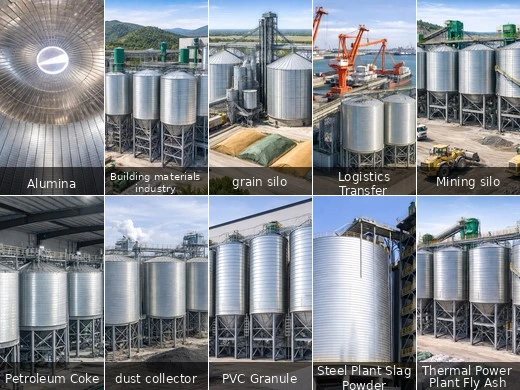
Reference Map: 10 system scenarios for fast selection.
Delivery: Structure-only or integrated package (transfer, dust, discharge, packaging).
Send Inquiry
Product Introduction
China steel silo is a prefabricated Steel silo storage structure engineered for silo storage of bulk powders or granules, with designed-in discharge control and ready interfaces for transfer and dust management; for buyers, China steel silo purchase is not "one item"-scope, interfaces, and documentation move together as one acceptance package. It is a controlled boundary for bulk solids: the Steel silo structure, the discharge zone that makes silo storage predictable, and the interfaces that keep dust and losses under control. If any of these are under-scoped, a storage silo becomes a maintenance problem instead of a production buffer. In most project RFQs, the discharge and emission boundary is defined upfront, including dust collection, aeration, and the downstream transfer method.
This China steel silo page is built around four categories so buyers can lock scope quickly:
Steel Silo Directory with three primary construction families and material-specific variants
Silo Supporting Equipment Directory that turns a Steel silo into a complete silo storage line
Liquid Tank Directory for projects that combine solids and utility liquids
System Scenarios Overview with ten common applications referenced for quick mapping
Steel Silo Directory
A Steel silo must be specified by duty first, then by form. In practice, Steel silo selection starts with material behavior and ends with a testable interface list. For procurement, the "duty" definition prevents change orders later: material behavior, expected cycles, discharge method, and environmental constraints. In China steel silo RFQ, these inputs should be written as acceptance criteria, not marketing descriptions. When those inputs are clear, the storage silo type becomes a logical selection, and the Steel silo scope can be frozen with measurable acceptance points.
Engineering Envelope Used for Quoting
For most export projects, our standard China steel silo engineering envelope covers:
Typical capacity band: 100–20,000 m³ per storage silo system scope
Typical diameter band: Ø3–35 m for Steel silo shells
Service modes: buffer silo storage, day-bin dosing, or long-term storage silo holding
Construction Types
Spiral Steel Silo
A Spiral Steel Silo is commonly selected for repeatable geometry and efficient erection on multi-silo yards. For China steel silo projects handling cement, fly ash, and mineral powder, a Spiral Steel Silo supports sealed silo storage when roof penetrations and venting interfaces are defined early. A Spiral Steel Silo is often chosen when the owner wants a consistent Steel silo footprint across multiple phases.
Acceptance controls buyers can verify:
Shell geometry and alignment targets that protect roof fit-up and discharge centerline
Roof sealing details around manholes and instrument nozzles to prevent the silo leakage
Discharge-zone definition: cone angle, aeration zoning, and anti-bridging interface list
Piece marking and packing list mapping for fast receiving release of the China steel silo lots
Bolted Steel Plate Silo
A bolted Steel silo suits modular shipping and controlled site assembly. In China steel silo work, bolting reduces hot-work exposure and makes inspection more auditable through bolt mapping, gasket selection, and torque control. This approach is common for export projects where panels travel in containers and are erected with a defined sequence. It is also common for a grain storage silo when aeration and access interfaces are specified together.
Acceptance controls buyers can verify:
Panel tolerance plan, hole alignment, bolt list, and torque procedure
Seal and gasket specification matched to temperature swing and moisture
Interface list frozen at RFQ: vents, filters, access ladder, platforms, and level devices
Weather sealing around roof-to-shell joints that often become dust leaks in silo storage yards
Welded Steel Silo
A welded Steel silo is chosen when stiffness, custom geometry, or high duty cycle dominates. In China steel silo procurement, welded scope must be paired with inspection evidence and a coating plan, because lifecycle is defined by weld integrity and surface protection as much as by thickness. A welded Steel silo is typically specified when the duty pushes the limits of fatigue, impact loading, or high-temperature variations.
Acceptance controls buyers can verify:
Welding procedure and inspection scope aligned to the project ITP
Distortion control to protect nozzle orientation and discharge geometry
Coating records and repair procedure for transport and erection
Weld mapping and traceable reports so the China steel silo can be released without re-inspection
Material-specific Steel silos
Material behavior changes what "good silo storage" means. China steel silo directory should separate these variants so a storage silo order is based on failure modes, not only capacity.
Insulated Steel Silo
An insulated Steel silo targets condensation control and temperature stability. In China steel silo projects for hygroscopic powders, insulation reduces caking risk and protects silo storage discharge stability across seasons.
Grain Steel Silo
A grain storage silo is engineered around preservation and safe handling. For China steel silo grain duty, the storage silo scope should include aeration readiness, ventilation tie-ins, and monitoring ports so the Steel silo supports long-term silo storage without quality loss.
Practical RFQ inputs for a grain storage silo:
Grain type, moisture band, target storage duration, and turnover rate
Aeration and ventilation expectations plus local compliance
Discharge method and cleaning access requirements
Cement Steel Silo
Cement silo storage is dust-first. A Steel silo must stay sealed during filling and unloading, and the discharge zone must resist arching. In China steel silo purchasing, include the dust collector interface and flow aid option so a storage silo can meet throughput without emergency rework.
Mineral Powder Steel Silo
Mineral powder silo storage is sensitive to moisture and compaction. Specify hopper geometry, aeration layout, and dust boundary so the Steel silo delivers stable discharge and reduced housekeeping at the storage silo yard.
Biomass Pellet and Wood Chip Steel Silos
Biomass silo storage must manage dust explosivity and moisture cycling. In China steel silo biomass duty, define isolation interfaces and dust control at transfer points so the storage silo remains safe and clean.
Sulfur Steel Silos
Sulfur storage silo duty emphasizes sealing, corrosion control, and ventilation boundary. China steel silo for sulfur should lock temperature range and dust control scope early.
Urea Steel Silos
Urea silo storage is driven by hygroscopic caking risk. China steel silo order should define humidity control approach, lining options if required, and discharge assistance so the Steel silo does not plug during unloading.
Melamine Steel Silos
Melamine storage silo duty requires contamination control and reliable dust handling. Specify sealed filling, dedusting, and cleanout access so the Steel silo can be released quickly at receiving and run stable silo storage.
Alumina Steel Silos
Alumina silo storage focuses on wear, dust load, and moisture protection. China steel silo package often combines multiple Steel silo units with shared dust control and conveying, so interface mapping prevents commissioning delays at the storage silo array.
Prebaked Anode and Calcined Coke Steel Silos
Calcined coke silo storage is abrasive and dusty. Specify wear protection at impact points and define the dedusting interface so the Steel silo discharge remains stable and silo storage losses are controlled.
Steel Silo Roof
The Steel silo roof carries vents, filters, and access. In China steel silo procurement, define roof penetrations, venting, and safety access so the storage silo can be accepted without on-site redesign.
Buyer selection matrix
Selection item
Procurement input to lock
What it protects in silo storage
Flow risk
bridging/ratholing tendency, discharge method, flow aid scope
stable discharge for the storage silo
Dust boundary
dedusting interface, venting, sealed filling and load-out
compliant and clean silo storage
Site constraint
transport limits, welding restrictions, erection window
schedule and assembly risk
Transfer route
Air Chute, Silo Pump, conveyor, elevator
throughput and uptime
Protection
coating/galvanizing, packing, opening protection
corrosion and damage risk
Silo Supporting Equipment Directory
China steel silo is only as reliable as its interfaces. Supporting equipment turns a Steel silo into a complete silo storage line from receiving to load-out. Procurement should treat each module as an interface package with a testable acceptance point. A storage silo scope is incomplete without defined dust control, isolation, and transfer, especially when the China steel silo is intended for continuous production.
Receiving and loading modules
Bulk Processing Equipment
Bulk Processing Equipment connects trucks or hoppers to a Steel silo filling interface.
Powdered material bulk loader F series, suitable for fine powders ≤0.5 mm
Granular material bulk loader K series, suitable for 0–30 mm materials
For China steel silo receiving, the acceptance focus is sealed filling: dust control, stable loading, and controlled spillage so the silo storage yard stays clean.
Dedusting and emission control
Silo Dust Collector
A dust collector stabilizes the air balance of the silo and protects the China steel silo yard. Define dust temperature and humidity to avoid filter blinding, and confirm the connection flange and maintenance access on the roof. Dust control is often the easiest visible win for silo storage housekeeping and compliance.
Conveying and elevation
Mining Belt Conveyor
A belt conveyor supports long-distance, continuous transfer between the silo and downstream use. Enclosure strategy reduces dust around silo storage areas and supports safer operation in China steel silo yard.
Silo Bucket Elevator
A bucket elevator supports vertical lift into top feed. It is common in grain storage silo lines and also in mineral powder silo storage layouts. Define lift height, capacity, and dust sealing so the top remains clean.
Air Chute
An Air Chute fluidizes powder for transfer at low pressure. Typical references include 0.03–0.05 MPa compressed air, dust emission <5 mg/m³, and conveying capacity up to about 200 t/h at trough width around 400 mm, with installation angles commonly around 4–10°. In China steel silo line, an Air Chute is selected for gentle conveying that reduces wear while keeping silo storage enclosed.
Flow aid and discharge control
Inflation Equipment
Inflation equipment improves discharge stability at the bottom. Typical components include gasification plates, blower, control system, and ring-pipe distribution. Reference ranges include pressure 0.03–0.1 MPa, gasification plate permeability 1–2 m³/m²·min, and branch line pressure rating up to 0.6 MPa. In China steel silo powder duty, this is often the key to stable silo storage discharge.
Valves for the Building Materials Industry
Valves define isolation and control around the storage silo. Define valve type, wear class, and maintenance access so the China steel silo line can run without frequent shutdown. Correct isolation reduces unplanned leakage and material loss in silo storage.
Pneumatic transfer
Silo Pump
A Silo Pump supports dense-phase transfer to remote points. Typical references include working pressure 0.3–0.6 MPa, conveying distance up to about 1500 m, throughput 50–200 t/h per pump depending on material, and solid-to-gas ratio around 30:1. Wear-resistant ceramic lining is used for abrasive duty. In China steel silo projects, a Silo Pump is chosen when sealed transfer protects silo storage cleanliness and long-distance routing is required.
Packaging and dispatch
Ton Bag Packaging Machine
Ton bagging turns storage silo inventory into dispatch-ready product. Typical references include 0.5–2 t bags, 20–40 bags/hour at 1 t/bag, weighing accuracy around ±0.2%, dust emission <5 mg/m³ with enclosed dust removal, optional explosion-proof configuration Ex d IIB T4, optional RFID/labeling, and contact parts 304 stainless steel for clean handling. For China steel silo export operations, this module defines how silo storage becomes saleable shipments.
Liquid Tank Directory
Many China steel silo projects include utility or process liquids. Keeping the tank scope visible helps EPC coordination, because civil, erection, and commissioning resources overlap with the Steel silo package. This section lists common tank options used alongside silo storage yards.
Galvanised Steel Storage Tank
Often used for utility water near silo storage lines where corrosion resistance and fast erection are required.
Stainless Steel Storage Tank
Used where hygiene or corrosion control is required. It is common near grain storage silo facilities and chemical powder storage silo lines.
Composite Elevated Storage Tank
Used where elevated water storage is required and corrosion resistance is needed without full stainless cost.
Carbon Steel Storage Tank
Used where coatings and inspection manage corrosion. Often applied for industrial circulating water on China steel silo sites.
System Scenarios Overview
For fast scoping, the ten scenarios below map typical material behavior to a recommended Steel silo family and the minimum interfaces required to keep silo storage stable. Each scenario can be expanded into a dedicated system article, while this China steel silo page stays as the master directory for storage silo selection. The ten system scenarios are: 1) Petroleum coke; 2) Lithium-ion battery production line; 3) Logistics transfer; 4) Alumina; 5) PVC granule; 6) Building materials industry; 7) Thermal power plant fly ash; 8) Steel plant slag powder; 9) Grain; 10) Mining.
System scenario
Typical risk focus in silo storage
storage
Recommended Steel silo directory item
directory item
Typical supporting equipment to lock
Petroleum coke
Abrasion, heavy dust load, transfer wear
Prebaked Anode and Calcined Coke Steel Silos
Silo Dust Collector, Mining Belt Conveyor, wear-class Valves
Lithium ion battery production line
Fine dust containment, cleanliness, sealed transfer
Welded Steel Silo or Bolted Steel Plate Silo
Silo Dust Collector, Valves, Ton Bag Packaging Machine
China steel silo RFQ becomes accurate only when inputs are written as acceptance criteria. This checklist prevents scope gaps for a Steel silo and protects silo storage commissioning.
Material data
Bulk density range, particle size distribution, moisture band
Flow risk: bridging, ratholing, caking tendency
Temperature range and abrasiveness level
Dust hazard requirements and housekeeping target for silo storage
Duty and throughput
Storage capacity and refill frequency for each storage silo
Peak in/out rate and steady-state discharge rate
Transfer route selection to complete silo storage: conveyor, elevator, Air Chute, or Silo Pump
Site constraints
Headroom, transport limits, crane access, erection window
Wind/snow/seismic basis for the China steel silo location
Corrosion environment and cleaning approach for the storage silo yard
Interfaces to lock before production
Filling interface and venting interface
Dedusting interface and access path
Discharge method and flow aid scope
Load-out method: truck loading, bulk loading, or ton bag
Documentation package for release
Drawings and interface list for each Steel silo
Material certificates and coating records
Weld and NDT evidence for welded scope
Pre-shipment inspection record and commissioning checklist
Why Source Steel Plate Silos from China with Octal
Steel plate silos land as projects, not standalone items. What protects schedule and performance is a controllable manufacturing base, repeatable project execution, and after-sales that stays accountable to the same scope boundary-structure, discharge, dust, and transfer interfaces.
China manufacturing base with controllable QA: Plate sourcing by heat/lot, traceable fabrication records, and factory inspection points tied to an agreed ITP-so quality is evidenced, not assumed.
Project delivery, not "equipment supply": One package scope that includes steel plate silo body, discharge zone, dust boundary, and interface definition to conveying/packaging-reducing split responsibility and site change orders.
One-stop integration across categories: Steel silo + supporting equipment + related liquid tanks coordinated under one GA/interface matrix-fewer vendors, fewer mismatched flanges, elevations, and control signals.
Execution experience built into the handover: Standard deliverables for civil/MEP coordination (anchor plan, loads, nozzle schedule, installation sequence, lifting points), aligned to common EPC workflows.
After-sales tied to commissioning reality: Start-up support, commissioning checklist, operating parameters for stable discharge, spares list, and remote troubleshooting-focused on downtime prevention rather than generic "service."
Accountable documentation chain: Marking → lot mapping → MTC → inspection/NDT records → packing list-supports audit, acceptance, and warranty discussions with evidence.
FAQ
Q1: What capacity range does China steel silo typically cover, and what diameter range is common?
A1: Typical engineering coverage for China steel silo in this entry is 100–20,000 m³ with common diameters from φ3 m to φ35 m, with final sizing driven by material bulk density, buffer time, throughput, and site wind/seismic basis.
Q2: How do I choose between spiral, welded, and bolt assembly in China steel silo scope?
A2: Selection is usually anchored on installation constraints and the quality plan: spiral is used where efficient site assembly and repeatable geometry support schedule control, welded is used where weld procedure and inspection scope are part of acceptance, and bolt assembly is used where transport limits or phased erection favor segmented delivery with sealing and bolt management defined.
Q3: What should be included in a silo system solution beyond the steel silo structure?
A3: A complete scope typically includes dust control (silo dust collector), conveying/lifting (mining belt conveyor or silo bucket elevator), discharge and pneumatic transfer (air chute, silo pump, inflation equipment as applicable), control/sealing interfaces (valves), and packaging/export modules such as a ton bag packaging machine or bulk loading interface.
Q4: Which system scenarios are most common for steel silo projects, and what are the key control points?
A4: Common scenarios include petroleum coke, fly ash, slag powder, alumina, PVC granule, building materials, grain, mining, logistics transfer, and lithium ion battery production lines; key control points typically focus on enclosed dust control, discharge stability, interface sealing, automation scope, and documentation/traceability for receiving release and commissioning.