




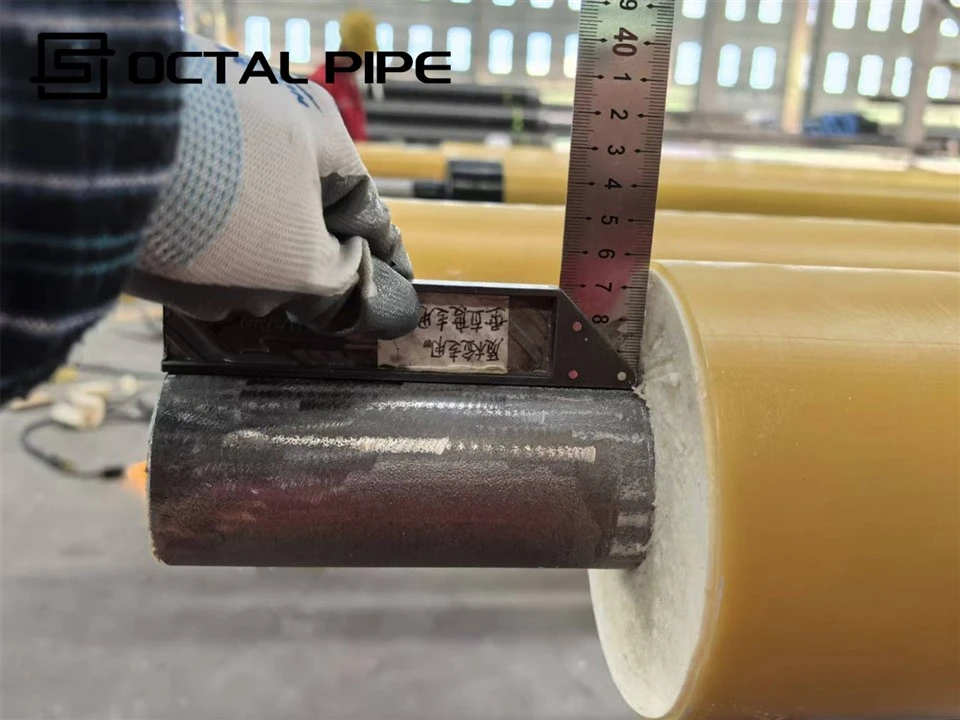


Polyurethane Pipe Insulation
Carrier Pipe Options: Carbon steel, stainless steel, ductile iron
Thermal Conductivity: ≤ 0.030 W/m·K
Foam Density: 60–80 kg/m³
Operating Temperature: -50°C to +140°C, short-term up to 150°C
Commercial Size Range: DN25 to DN1200 (1" to 48")
Application Routes: District heating and cooling, industrial process piping, cold-climate water distribution, HVAC and refrigeration systems
Installation Type: Direct-buried, above-ground, and underwater pipeline systems
Supply Form: Factory-made pre-insulated pipe system, straight lengths, custom jacket and cutback available
Polyurethane pipe insulation is supplied as a factory-built pipe system rather than as loose foam alone. The usual structure is a carrier pipe, a rigid polyurethane foam insulation layer, and an outer protective jacket. On OCTAL's current supply route, that system is offered as steel carrier pipe + rigid PU foam insulation + HDPE / steel / FRP outer jacket, with a commercial size range of DN25–DN1200, thermal conductivity of ≤ 0.030 W/m·K, foam density of 60–80 kg/m³, and an operating range of -50°C to +140°C, with short-term exposure up to 150°C.
For buried district-heating service, the standard bonded system is more specific. EN 253 covers straight factory-made insulated pipe assemblies for directly buried hot-water networks using a steel service pipe from DN 15 to DN 1200, rigid polyurethane foam insulation, and an outer polyethylene casing. It is written for continuous operation up to 120°C and occasional peak temperatures up to 140°C.
In practical project language, polyurethane insulation pipe, polyurethane pipe insulation, and polyurethane foam pipe insulation usually refer to the same supply concept: a pre-insulated pipe system built to control heat loss, keep process temperature more stable, and reduce the installation variability that often comes with field-wrapped insulation.
Typical Specifications
| Parameter | Typical Value / Range |
|---|---|
| Product | Polyurethane pipe insulation / pre-insulated pipe |
| System structure | Carrier pipe + rigid PU foam insulation + outer jacket |
| Carrier pipe | Carbon steel, stainless steel, or ductile iron |
| Insulation layer | Rigid closed-cell polyurethane foam |
| Outer jacket | HDPE, steel, or FRP |
| Thermal conductivity | ≤ 0.030 W/m·K |
| Foam density | 60–80 kg/m³ |
| Operating temperature | -50°C to +140°C, short-term up to 150°C |
| Commercial size range | DN25–DN1200 (1"–48") |
| Typical service life | ≥ 30 years under normal conditions |
| Common service routes | District heating / cooling, industrial process, cold-climate water, HVAC / refrigeration |
| Documents | MTC, thermal data, dimensional inspection, packing list, lot traceability |
For more detailed structure data, technical references, and application guidance, download our Polyurethane Insulation Pipe Technical Data & Application Guide.
These figures describe the normal commercial route. For directly buried district-heating systems built to EN 253, the bonded system scope is DN15–DN1200, and the temperature profile is more conservative than the broader industrial range.
Structure of a Polyurethane Insulation Pipe
A polyurethane insulation pipe works as a three-layer system, and each layer solves a different problem in service:
- The carrier pipe carries pressure and the medium itself.
- The polyurethane foam insulation controls heat transfer.
- The outer jacket protects the insulation from groundwater, soil contact, impact, UV exposure, and handling damage.
In actual projects, the carrier pipe is usually carbon steel, but stainless steel or ductile iron can also be selected where the medium, corrosion condition, or piping standard requires it. The jacket choice then follows the installation route. HDPE is common for buried systems because it gives a strong moisture barrier. Steel jackets are more suitable where above-ground protection and mechanical strength are more important. FRP is often considered where corrosion resistance and lower shell weight are part of the job.
This layered structure is the reason this product behaves differently from loose pipe insulation applied on site. A field-wrapped system depends heavily on site workmanship, weather, and sealing quality. A bonded pre-insulated system arrives with a more consistent insulation thickness, more stable concentricity, and fewer weak points before installation even begins. That becomes especially useful on long buried runs, plant utility corridors, and chilled-water lines where site rework is slow and expensive.


Polyurethane Foam Pipe Insulation in Real Service
The thermal value of polyurethane foam pipe insulation comes from its low conductivity and closed-cell structure, but the finished pipeline performance depends on more than one lab number. It depends on:
- foam density
- bonding quality
- jacket sealing
- cutback accuracy
- field-joint workmanship
- installation environment
The standard supply range gives 60–80 kg/m³ for foam density and ≤ 0.030 W/m·K for thermal conductivity, which is a practical industrial range for pre-insulated steel pipe supply.
In buried hot-water networks, problems rarely start because the insulation looked good on paper but the actual line was poorly designed. They usually show up because of water ingress at field joints, damaged outer casing during handling or backfilling, off-center carrier pipe, or uneven foam fill. In chilled-water service, the same logic applies in reverse: temperature gain and condensation control depend on the whole assembly staying dry and sealed, not on foam data alone. This is why polyurethane pipe insulation is usually chosen where long runs, buried installation, or exposed outdoor routing make consistent factory insulation more valuable than site-applied wrapping.
Among common types of insulation used on pipe systems, polyurethane is typically selected when the project needs a compact, factory-made insulation system rather than a loose material package installed layer by layer on site. In that sense, polyurethane pipe insulation is less about selling foam by itself and more about supplying a ready-to-install thermal pipe system.
For a closer review of polyurethane insulated pipe advantages and limitations, including field joint sealing, moisture ingress risk, temperature limits, and repair difficulty after burial, see our detailed guide.

Manufacturing and Bonding Quality
The manufacturing route of polyurethane pipe insulation is one of the main reasons it performs well when supplied correctly. The carrier pipe is prepared first by cleaning, blasting, or priming as required. The outer jacket is then positioned concentrically with spacers, and the polyol / isocyanate mix is injected into the annular gap. As the foam expands and cures, it fills the void and bonds firmly to both the carrier pipe and the jacket.
A typical production route includes:
- carrier pipe surface preparation
- jacket positioning and centering
- PU foam injection into the annular space
- expansion and curing
- end cutback finishing
- dimensional and visual inspection
That bond is not a decorative detail. It affects how the system behaves when the steel pipe expands and contracts, when the line is lowered into a trench, and when supports or backfill loads act on the outer jacket. Poor bonding, uneven fill, or inconsistent cutback dimensions usually do not stay "factory problems." They become installation problems later, especially on long district-heating runs or plant utility lines where jointing and alignment need to stay consistent from piece to piece.
This is one of the practical differences between ordinary insulation supply and a good pre-insulated pipe package. The work is not just making foam. It is keeping the carrier pipe, insulation layer, jacket, and end dimensions under control in the same production run.


Applications
Polyurethane pipe insulation is best selected by actual operating condition rather than by a broad industry label.
| Application Route | Typical Working Condition | Why This Product Fits |
|---|---|---|
| District heating | Direct-buried hot-water mains and branch lines | Controls heat loss and supports bonded buried pipe design |
| District cooling / chilled water | Buried or exposed cooling lines where temperature gain must be limited | Helps maintain fluid temperature and reduce condensation risk when the system stays sealed |
| Industrial process piping | Outdoor utility lines carrying temperature-sensitive media | Keeps process temperature more stable over long runs |
| Cold-climate water distribution | Surface or shallow-buried lines in low ambient temperatures | Helps reduce heat loss and protect delivery temperature |
| Plant utility interconnections | Pipe bridges and transfer lines between units | Gives a cleaner factory-insulated route than field-wrapped insulation |
In real projects, a buried district-heating line and an above-ground process utility line do not ask for exactly the same product. The first may follow an EN 253-type bonded buried route with PE casing. The second may need a steel or FRP outer jacket because of UV exposure, plant traffic, or above-ground mechanical risk. That is why the jacket choice matters just as much as the foam itself. OCTAL's supply structure supports that difference by offering HDPE / steel / FRP jacket routes rather than limiting the product to one casing material only.
Material Standard Context
For users comparing this product with loose insulation materials, one important boundary is that ASTM C591 is a material specification for unfaced rigid cellular polyurethane-modified polyisocyanurate thermal insulation on surfaces. It covers service temperatures from -183°C to 149°C, but it also states that actual temperature limits for specific applications should be agreed between manufacturer and purchaser. That makes it useful as a reference for insulation material behavior, but it is not a substitute for a complete pre-insulated pipe system specification.
That distinction helps avoid a common mistake. A project may see a foam material temperature limit and assume the whole insulated pipe system can be used the same way. In reality, the assembled product still has to be checked against:
- carrier pipe standard
- operating temperature profile
- outer jacket material
- field-joint method
- installation route
For buried district heating, EN 253 is the better system-level reference. For broader industrial insulation work, the material data and the assembled system data still need to be reviewed together.
If the project still needs a quick engineering screen, download our Polyurethane Insulation Pipe Selection Checklist for temperature, joint, casing, and burial review points.
Why Choose OCTAL
OCTAL supplies polyurethane pipe insulation as a complete product, not as loose components that have to be sorted out later. That matters on real jobs where the order may include different diameters, multiple jacket types, mixed installation routes, and tight installation schedules. The useful difference is not just that the product is insulated. It is that the carrier pipe, foam layer, outer jacket, cutback dimensions, and release documents stay organized in one supply chain.
For buyers comparing polyurethane pipe insulation manufacturers, that is usually where the real separation happens. The problem on site is rarely "can someone make PU foam." The real question is whether the finished insulated pipe arrives concentric, traceable, properly cut back, clearly packed, and matched to the service route it was ordered for. OCTAL's standard commercial range of DN25–DN1200, with HDPE / steel / FRP jacket options and a bonded three-layer structure, makes it suitable for district heating, district cooling, industrial process, refrigeration, and other thermal utility lines that need more than a generic insulation material.
FAQ

01.What should be confirmed before ordering polyurethane pipe insulation?
02.What is the difference between polyurethane pipe insulation and site-applied pipe insulation?
03.What operating temperature can a polyurethane insulation pipe handle?
04.When should HDPE, steel, or FRP outer jackets be used?
Certifications

CE Certificate

ISO 9001 Certificate

API Q1 Certificate

ABS Certificate

AP-5L Certificate

API-5CT Certificate
Hot Tags: polyurethane pipe insulation, polyurethane insulation pipe, polyurethane foam pipe insulation, pipe insulation polyurethane, polyurethane pipe insulation manufacturers, pipe insulation, types of insulation, stainless steel hose pipe, galvanized electrical conduit, steel conduit pipe, welded elbow, flex steel hose, metric stainless steel tubing
Previous
Seamless Steel PipeYou Might Also Like


Send Inquiry