




Mobile Station For Medium And Fine Crushing And Screening
Production Capacity Range: 85 ~ 625 t/h
Crushing Stage: Medium crushing, fine crushing, screening
Main Models: Z-PF1214, Z-PF1315, Z-CS110, Z-CS160, Z-CH430, Z-CH440, Z-HP300, Z-HP400
Crushing Types: Impact crushing, cone crushing
Applicable Materials: Limestone, granite, basalt, river stone, iron ore, concrete waste
Main Components: Feed hopper, crusher, vibrating screen, conveyor, mobile chassis, hydraulic system
Product Control: Closed-circuit crushing and screening, multiple aggregate size production
Application Fields: Quarry, mining, aggregate production, road construction, construction waste recycling
Produce controlled aggregate sizes with a mobile crushing plant designed for medium crushing, fine reduction, and screening after primary crushing. Unlike coarse-crushing stations that focus on handling large run-of-mine feed, medium and fine crushing stations receive pre-crushed material and further reduce it into more consistent sizes for aggregate production, mining operations, and construction applications. Depending on configuration, these mobile systems cover feed sizes from ≤90 mm to ≤350 mm and production capacities from 85 t/h to 625 t/h.
Select the correct crushing configuration according to material hardness, required product size, production target, and screening requirements. A mobile impact crusher is commonly selected when the project requires efficient reduction and improved particle shape, while cone-based configurations are preferred for hard and abrasive materials such as granite and basalt. Combining crushing and screening equipment allows a mobile crusher system to produce more stable final products without requiring a permanent processing plant.
In a complete mineral processing workflow, medium and fine crushing connects the primary reduction stage with final screening and classification. Octal Pipe supports quarry, mining, and industrial projects where processing equipment operates together with steel structures, tubular products, and fabricated components. For these projects, equipment selection should consider the entire material flow, including crushing capacity, screening efficiency, conveyor arrangement, and final product requirements.
What Medium and Fine Crushing Does
Medium and fine crushing is the stage between primary crushing and final product classification.
After large rocks are reduced by a primary crusher, the material still contains different particle sizes. Secondary and fine crushing further reduces the material and improves size consistency before screening.
The typical process route is:
Primary Crushing → Medium Crushing → Fine Crushing → Screening → Final Product
The main objectives include:
| Objective | Engineering Purpose |
|---|---|
| Further size reduction | Produce material suitable for final processing |
| Size control | Maintain stable product gradation |
| Product improvement | Meet aggregate and construction requirements |
| Process flexibility | Adapt to different project conditions |
A mobile crushing system integrates crushing, conveying, and screening equipment into one transportable unit, making it suitable for quarry expansion, temporary projects, and operations requiring frequent relocation.

Main Technical Parameters
The available medium and fine crushing stations include impact and cone crushing configurations for different material conditions.
| Model | Feed Size | Production Capacity |
|---|---|---|
| Z-PF1214 | ≤300 mm | 90–180 t/h |
| Z-PF1315 | ≤350 mm | 120–250 t/h |
| Z-CS110 | ≤156 mm | 100–200 t/h |
| Z-CS160 | ≤188 mm | 132–253 t/h |
| Z-CH430 | ≤90 mm | 115–320 t/h |
| Z-CH440 | ≤110 mm | 240–550 t/h |
| Z-HP300 | ≤150 mm | 85–440 t/h |
| Z-HP400 | ≤196 mm | 135–625 t/h |
The parameter range shows that different models serve different crushing conditions. Feed size, production requirement, material hardness, and final product specification should be considered together.
The published production capacity represents the operating range of each configuration under suitable conditions. Actual output depends on feed characteristics, crusher settings, material properties, and the capacity balance of the complete crushing and screening system.
Mobile Impact Crushing for Aggregate Production
A mobile impact crusher is commonly used when the project requires efficient reduction and improved particle shape.
Impact crushing uses high-speed impact force to break material against impact plates and wear components. This crushing method is suitable for materials where product shape and reduction efficiency are important.
The Z-PF series provides medium crushing capability for controlled feed materials.
| Model | Maximum Feed Size | Production Capacity | Typical Application |
|---|---|---|---|
| Z-PF1214 | ≤300 mm | 90–180 t/h | Aggregate production |
| Z-PF1315 | ≤350 mm | 120–250 t/h | Higher feed requirement projects |
Typical applications include:
| Material | Reason for Selection |
|---|---|
| Limestone | Efficient reduction and good particle shape |
| Concrete waste | Recycling applications |
| Medium-hard rock | Effective impact breakage |
| Aggregate production | Improved product appearance |
For highly abrasive materials, wear consumption should be evaluated carefully because impact crushing components experience higher stress under severe rock conditions.
Mobile Cone Crushing for Hard Rock
A mobile cone crusher is commonly selected for secondary and fine crushing applications involving harder and more abrasive materials.
Cone crushing reduces material through compression between the mantle and concave. This operating principle provides stable size reduction and is widely used in hard-rock aggregate and mining applications.
| Model | Feed Size | Production Capacity |
|---|---|---|
| Z-CS110 | ≤156 mm | 100–200 t/h |
| Z-CS160 | ≤188 mm | 132–253 t/h |
| Z-CH430 | ≤90 mm | 115–320 t/h |
| Z-CH440 | ≤110 mm | 240–550 t/h |
| Z-HP300 | ≤150 mm | 85–440 t/h |
| Z-HP400 | ≤196 mm | 135–625 t/h |
Cone crushing is commonly applied to:
| Material | Main Requirement |
|---|---|
| Granite | High abrasion resistance |
| Basalt | Stable hard-rock reduction |
| River stone | Controlled particle-size production |
| Iron ore | Dense material processing |
For hard-rock aggregate production, a common processing route is:
Jaw Crushing → Mobile Cone Crushing → Screening
The cone stage receives controlled feed from the primary crusher and prepares material for final classification.
Screening and Final Product Control
Crushing alone does not determine the final aggregate quality. Screening separates different product sizes and controls the final material specification.
A mobile screening plant can operate independently or together with crushing equipment to create a complete closed-circuit system.
| Screening Function | Purpose |
|---|---|
| Size separation | Produces different aggregate fractions |
| Oversize return | Sends larger particles back for further crushing |
| Product control | Maintains consistent gradation |
| Process optimization | Reduces unnecessary over-crushing |
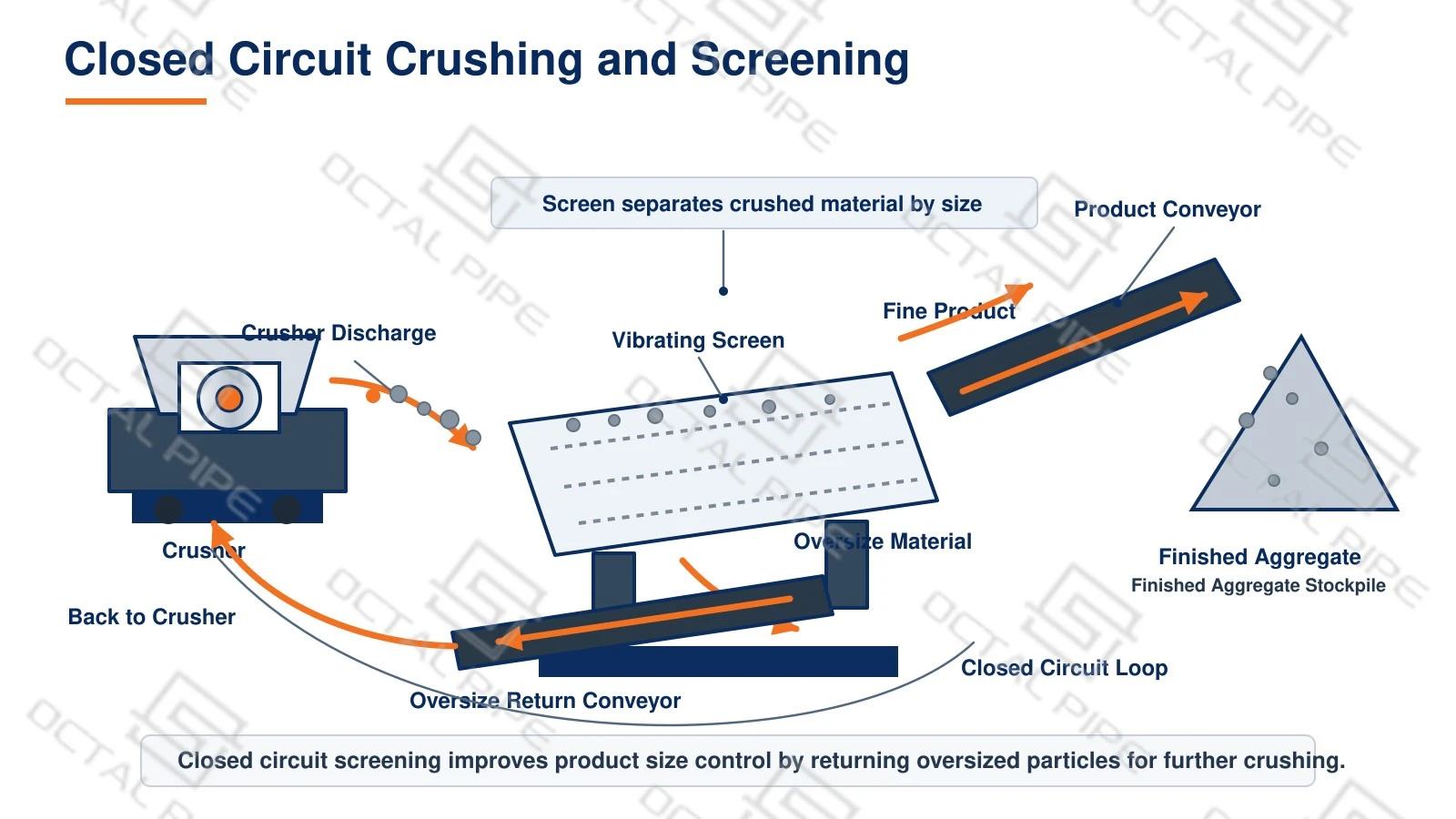
A typical closed-circuit process is:
Crusher Discharge → Vibrating Screen → Finished Product → Oversize Return
This arrangement improves material utilization and helps maintain stable final output.
Closed-Circuit Crushing and Screening
Medium and fine crushing stations are often designed around closed-circuit operation.
Compared with open-circuit crushing, closed-circuit systems return oversized material to the crusher until it reaches the required size range.
| Open Circuit | Closed Circuit |
|---|---|
| Single crushing pass | Repeated size control |
| Simpler arrangement | More consistent product |
| Suitable for rough reduction | Suitable for specification aggregate |
Closed-circuit operation is especially useful when customers require controlled aggregate sizes rather than general material reduction.
How to Select the Right Configuration
The correct mobile station depends on the relationship between material characteristics, crusher type, and final product requirements.
| Selection Factor | Influence on Equipment Choice |
|---|---|
| Feed size | Determines suitable crusher inlet |
| Material hardness | Influences impact or cone selection |
| Abrasiveness | Determines wear requirement |
| Product size | Defines crushing and screening stages |
| Production target | Determines suitable capacity range |
| Particle shape requirement | Influences impact crushing suitability |
| Screening requirement | Determines final plant arrangement |
For softer materials such as limestone and recycled concrete, impact crushing may provide advantages in shaping and reduction efficiency.
For harder materials such as granite and basalt, cone crushing is often selected because of its compression-based crushing principle and wear performance.
Application Areas
Medium and fine crushing and screening stations are commonly used in:
| Application | Typical Process |
|---|---|
| Quarry aggregate production | Crushing → Screening → Stockpiling |
| Mining operations | Crushing → Classification → Processing |
| Road construction | Reduction → Screening → Aggregate production |
| Construction waste recycling | Crushing → Separation → Reuse |
These systems are suitable for projects requiring flexible installation, reduced site preparation, and easier relocation compared with fixed processing plants.
Octal Pipe can support related steel pipe, tubular products, structural steel, and fabricated components for larger quarry, mining, and industrial projects where processing equipment forms part of a wider construction package.
FAQ

01.What is a mobile station for medium and fine crushing and screening?
02. When should a mobile impact crusher be selected?
03.When is a mobile cone crusher more suitable?
04.Why is screening important in a mobile crushing plant?
Hot Tags: mobile station for medium and fine crushing and screening, China mobile station for medium and fine crushing and screening manufacturers, suppliers, factory
Previous
No InformationYou Might Also Like


Send Inquiry