




Vacuum Insulated Tubing
Product: Double-wall vacuum insulated tubing for steam, heavy-oil and geothermal wells
Temperature: Up to 400 °C service with low k-value insulation to cut wellbore heat loss
Material & Grade: API 5CT seamless tubing in grades N80–Q125
Size Range: 2-7/8"×1.9" to 7"×5-1/2", R2/R3, insulated pup joints available
Quality: Each joint vacuum-tested, NDT + thermal tested with full traceable certificates
Every steam-injection or geothermal project spends a lot of money turning fuel into high-quality steam at surface. In a conventional tubing string, a big part of that energy is lost on the way down: steam quality drops, oil stays viscous, wax and scale build up, casing runs hot and, in permafrost, the ground around the well can start to thaw. When operators reach this point, the question is no longer "more steam?" but "how do we keep the heat where it matters?"
Octal Pipe's insulated tubing, also known as vacuum insulated tubing (VIT), is designed for exactly these wells. Each joint is a double-wall assembly with an inner production tube and an outer carrier tube. The annulus is filled with high-performance insulation and evacuated to a high vacuum, with reflective layers and getters to block conduction, convection and radiation at the same time. Compared with bare tubing, our VIT string delivers significantly higher bottom-hole steam quality, lower annulus temperatures and much smaller heat loss per metre.
Built on API 5CT tubing grades such as N80, L80 and P110 with BTC or premium gas-tight connections, Octal pre-insulated tubing can be run with standard OCTG handling equipment, but gives you the thermal performance required for heavy-oil steam injection, offshore heavy-oil developments, permafrost wells and high-enthalpy geothermal projects.

How Octal Insulated Tubing Works
Octal insulated tubing is built as a double-wall concentric pipe string. Each joint consists of a smaller inner tube that carries the well fluids and a larger outer tube that protects the assembly. The two tubes are welded together at both ends, creating a sealed annular insulation space between them. Joints are connected in the well with API BTC or premium threaded couplings, so the complete string runs much like standard tubing.
The thermal design is based on cutting all three basic heat-transfer mechanisms – conduction, convection and radiation – in the annulus:
- Aluminium foil for radiation blocking
Reflective aluminium foil is wrapped in the annulus to reflect infrared radiation back towards the hot inner tube. This greatly reduces radiant heat loss at high steam temperatures.
- Insulation material for conduction control
The space between inner and outer pipe is filled with low-conductivity insulation (such as perlite powder or ultra-fine glass wool). This increases the thermal resistance of the annulus and limits conductive heat flow.
- Vacuum and getters to suppress convection
After assembly, the annulus is evacuated to a high vacuum and fitted with getters that continuously absorb residual gases. With almost no gas left to move, convective heat transfer in the annulus is effectively eliminated.
- Pre-stress treatment of the inner tube for safety
The inner pipe is given controlled pre-stress before final welding, so that thermal expansion and contraction during welding and field operation do not create harmful residual stresses. This helps keep the weld zone and the whole joint mechanically safe over many heating and cooling cycles.
By combining this double-pipe structure with radiation shielding, solid insulation, high vacuum and inner-tube pre-stress, Octal insulated tubing minimizes heat loss along the wellbore while still behaving mechanically like a familiar OCTG tubing string.
A key engineering point is that thermal performance is not determined by insulation material alone. In field service, heat loss is strongly affected by annulus stability, end-weld integrity and joint-area thermal control after repeated temperature cycling. That is why pre-stressed insulated tubing is especially relevant in cyclic steam service rather than only in steady-temperature service.


Key Applications – Where Octal Insulated Tubing Is Used
| Application scenario | Operating challenge | How Octal insulated tubing helps |
|---|---|---|
| Deep-water / offshore heavy-oil wells | Heat from hot fluids migrates into casing annuli, building trapped annulus pressure and cooling heavy oil on the way up. | Vacuum insulated tubing cuts heat leak into the annulus, stabilises annulus pressure and keeps produced fluids hotter, improving heavy-oil mobility without extra surface heating. |
| Hydrate-sensitive gas wells & hydrate formations | During shut-in or low-rate flow, temperature drops can trigger methane-hydrate formation in the wellbore or near hydrate-bearing layers. | A more stable temperature profile delays hydrate formation, extends the safe shut-in window and helps protect hydrate-bearing formations around the well path. |
| Steam injection for heavy oil (SAGD / CSS) | Steam loses quality in conventional tubing, while casing and cement see high thermal cycling and risk of steam channeling. | Vacuum insulated tubing (VIT) delivers hotter steam to the reservoir, reduces heat into casing/cement and lowers the risk of thermal fatigue and steam channeling along the annulus. |
| Onshore wax-prone crude & flow assurance | Crude cools in the tubing string, causing wax, scale or asphaltene deposits that cut production and require frequent clean-outs. | Insulated tubing slows cooling, keeps fluid above wax appearance temperature for longer and extends clean-out intervals, helping production stay closer to design rates. |
| Geothermal and hot-water wells | Heat is lost from deep hot formations to shallow aquifers and wellbore, reducing outlet temperature and plant efficiency. | Insulation reduces "short-circuit" heat loss in the wellbore, so more heat reaches surface equipment, improving district-heating or power-generation efficiency. |
| Permafrost and Arctic wells | Hot injection or production strings can thaw permafrost around the well, threatening pad stability and surface facilities. | Octal insulated tubing creates a thermal barrier between hot inner flow and outer casing, helping preserve permafrost integrity and protect foundations throughout the well life. |
The product family can be understood more clearly through five direct-use directions: heavy-oil thermal recovery, prevention of permafrost thaw in oil and gas fields, anti-wax wellbores, geothermal heating and power generation, and hot-spring wells. This helps show that the range is not limited to steam injection alone; it can also be selected according to heat-preservation duty in hot-water and geothermal service.


Hot-spring wells
For hot-spring development, the value of insulated tubing or insulation pipe is not only to reduce heat loss, but also to keep more useful heat available from depth to outlet. In such projects, higher outlet temperature and more stable heat preservation can improve the commercial value of the well and reduce temperature loss during delivery.
Size Range and Basic Specifications
To make model screening easier, the size information in this section is arranged in separate table groups. The first table covers the standard vacuum insulated tubing size family mainly used for steam injection, heavy-oil production and other oilfield thermal service. The second table group adds prestressed insulated tubing sizes and insulation grades for cyclic thermal duty. The third table shows common Octal insulation pipe models used more directly in geothermal heat-exchange and hot-spring heat-preservation service. Keeping these size families separate makes RFQ review easier and helps distinguish conventional oilfield thermal strings from geothermal insulation-pipe configurations.
Octal vacuum insulated tubing is available in the following representative size family for oilfield and steam-service applications.
| Size code | Outer pipe (inch / mm) | Inner pipe (inch / mm) | Approx. flow ID (mm) | Typical connection OD (mm) | Unit weight (kg/m) |
|---|---|---|---|---|---|
| 73 × 40 | 2-7/8" × 5.51 mm wall (73.02 mm OD) | 1.9" × 3.68 mm wall (48.26 mm OD) | ≈ 40.9 | ≈ 88.9 (BTC / premium) | ≈ 13.5 |
| 89 × 50 | 3-1/2" × 6.45 mm wall (88.9 mm OD) | 2-3/8" × 4.83 mm wall (60.32 mm OD) | ≈ 50.7 | ≈ 108 | ≈ 20.5 |
| 114 × 76 | 4-1/2" × 6.88 mm wall (114.3 mm OD) | 3-1/2" × 6.45 mm wall (88.9 mm OD) | ≈ 76.0 | ≈ 132.1 (BTC) | ≈ 32 |
| 140 × 101 | 5-1/2" × 7.72 mm wall (139.7 mm OD) | 4-1/2" × 6.35 mm wall (114.3 mm OD) | ≈ 101.6 | ≈ 160 (BTC) | ≈ 43 |
| 178 × 124 | 7" × 9.19 mm wall (177.8 mm OD) | 5-1/2" × 7.72 mm wall (139.7 mm OD) | ≈ 124.3 | ≈ 200 (BTC) | ≈ 65 |
For projects with repeated thermal cycling, a prestressed insulated tubing size family together with insulation-grade classification is also available. These values are best shown below the standard VIT table as a supplemental reference for thermal-service selection, especially where buyers need to compare size, connection envelope, unit weight and insulation performance in the same review step.
| Size code |
Outer pipe (inch / mm) | Inner pipe (inch / mm) | Flow ID / annulus gap (mm) |
Connection type / OD (mm) |
Unit weight (kg/m) |
|---|---|---|---|---|---|
| 73 × 40 | 2-7/8" × 5.51 mm wall (73.02 mm OD) | 1.9" × 3.68 mm wall (48.26 mm OD) | 40.9 / 6.87 | USS / 88.9 | 13.5 |
| 89 × 50 | 3-1/2" × 6.45 mm wall (88.9 mm OD) | 2-3/8" × 4.83 mm wall (60.32 mm OD) | 50.66 / 7.84 | USS / 108 | 20.5 |
| 114 × 76 | 4-1/2" × 6.88 mm wall (114.3 mm OD) | 3-1/2" × 6.45 mm wall (88.9 mm OD) | 76 / 5.82 | BTC / 132.1 | 32 |
| 140 × 101 | 5-1/2" × 7.72 mm wall (139.7 mm OD) | 4-1/2" × 6.35 mm wall (114.3 mm OD) | 101.6 / 4.98 | BTC / 160 | 43 |
| 178 × 124 | 7" × 9.19 mm wall (177.8 mm OD) | 5-1/2" × 7.72 mm wall (139.7 mm OD) | 124.26 / 9.86 | BTC / 200 | 65 |
For geothermal heating, geothermal power generation and hot-spring wells, the product family further includes a separate Octal insulation pipe model family. Showing these models in an independent table makes geothermal and hot-water applications easier to compare without mixing them with steam-service tubing sizes, and gives buyers a clearer starting point for heat-preservation channel design and model selection.
| Size code |
Outer pipe (OD / WT, mm) | Inner pipe (OD / WT, mm) | Bore ID / annulus gap (mm) |
Connection type / OD (mm) |
Unit weight (kg/m) |
|---|---|---|---|---|---|
| 89 × 62 | 89 × 4 | 70 × 4 | 62 / 5.5 | NU / 108 | 15.2 |
| 95 × 62 | 95 × 4.5 | 73.02 × 5.51 | 62 / 6.49 | EU / 108 | 20 |
| 114 × 81 | 114.3 × 5 | 89 × 4 | 81 / 7.65 | BTC / 127 | 22.6 |
| 140 × 100 | 139.7 × 6 | 108 × 4 | 100 / 8.87 | BTC / 154 | 31 |
| 219 × 182 | 219 × 7 | 194 × 6 | 182 / 5.5 | SC / 234 | 66 |


Thermal Performance Grades
To make engineering selection easier, Octal insulated tubing is offered in several thermal grades:
- Grade B – λ ≈ 0.06–0.04 W/(m·°C)
- Grade C – λ ≈ 0.04–0.02 W/(m·°C)
- Grade D – λ ≈ 0.02–0.006 W/(m·°°C)
- Grade E – λ ≈ 0.006–0.002 W/(m·°C)
The higher the grade, the lower the heat loss per metre and the better the bottom-hole steam quality for a given surface condition. Our engineering team can model heat loss versus depth so you can see the difference between ordinary tubing, basic pre-insulated tubing and high-grade Octal VIT along your specific well profile.
| Insulation grade | B | C | D | E |
| Thermal conductivity λ W / (m·℃) |
0.06 > λ >= 0.04 | 0.04 > λ >= 0.02 | 0.02 > λ >= 0.006 | 0.006 > λ >= 0.002 |
For practical selection, thermal grade should be read together with service duty. In steam-injection and heavy-oil projects, lower thermal conductivity means higher steam quality at reservoir depth and less unwanted heat transfer into the annulus. In geothermal and hot-spring projects, lower thermal conductivity means higher outlet temperature and more usable heat at surface. That is why insulation grade should be tied to project energy balance, not treated as an isolated catalog number.


Thermal Design & k-Value Performance for Octal Insulated Tubing
For insulated tubing buyers, the key questions are not only "what sizes do you have?", but:
- How much heat loss can I actually save in my well?
- Is the design optimized for deep-water, steam injection or onshore conditions?
- Can I see the k-value and temperature profile before I order?
To answer these, Octal treats insulated tubing as an engineered system, not a one-type-fits-all product.
In practical design work, insulated tubing is selected by service objective, heat duty and well condition, not by OD alone. The review normally starts with the operating target: preserving steam quality to reservoir depth in CSS or SAGD wells, limiting heat leak to the annulus in deep-water production, reducing temperature drop in wax-prone onshore wells, protecting frozen formations in permafrost areas, or preserving usable heat in geothermal and hot-water service. From there, the tubing string is defined by insulation grade, annulus vacuum target, support layout, connection thermal control and service-life requirement under repeated thermal cycling.
This approach gives buyers a more usable basis for comparison at project stage. Instead of comparing tubing only by size and thread type, the selection can be checked against expected heat loss, bottom-hole or outlet temperature, annulus temperature, well-depth suitability and whether the construction is intended for steam injection, deep-water flow assurance, onshore thermal duty or geothermal heat-preservation channels. That is also the logic of the sections below: configuration first, then heat-transfer control in the annulus, then k-value and temperature modeling, and finally service life and length range.
1. Configurations tuned to field conditions
Instead of a single construction, Octal offers several insulation configurations built on the same seamless inner / outer pipe concept. For deep-water production we focus on long-term stability and very low k-values to control annulus temperature and hydrate risk; for steam projects (CSS / SAGD) we emphasize high-temperature capability and resistance to thermal cycling; for onshore wells and permafrost protection we balance insulation strength with cost and mechanical loads. Each configuration is defined by its insulation grade, vacuum level and internal support layout, so you can match the VIT string to your field rather than adapting the field to the tubing.
2. Control of convection, conduction and radiation in the annulus
Our designs combine three mechanisms to reduce heat transfer between inner and outer pipe:
- Convection control – the annulus is evacuated to a defined vacuum level, or filled with inert gas where appropriate, so there is minimal fluid left to carry heat by convection. Getters in the annulus help maintain this condition over the life of the well.
- Conduction control – carefully spaced supports keep inner and outer pipes aligned while minimising the metal contact area, maintaining the insulation gap even under load and temperature changes.
- Radiation control – multi-layer insulation with reflective and non-conductive layers (similar in principle to MLI systems) reduces radiant heat transfer at high steam temperatures.
Where required, additional insulation is applied around the joint area so that connections do not become "hot spots" in the string.
3. k-value based performance and thermal modeling
Thermal performance is expressed as a k-value (heat loss in BTU/hr·ft·°F or W/m·°C). Octal insulated tubing is available in several k-value bands, from deep-water levels designed for very low heat leak, to higher-k but more economical grades for moderate-temperature onshore service.
For project work, our engineering team can:
- calculate k-values for the selected insulated tubing configuration,
- run temperature-versus-depth profiles for your specific well geometry, and
- compare scenarios such as "conventional tubing vs insulated tubing" or "mid-grade vs high-grade VIT".
This gives you a clear view of bottom-hole steam quality, casing/annulus temperature and surface outlet temperature before you commit to a string design.
A simplified comparison table below shows how lower thermal conductivity is associated with higher heat-extraction power under different bottom-hole temperature conditions.
| Thermal conductivity [W/(m·K)] |
Approx. heat-extraction power at 55 °C (kW) |
Approx. heat-extraction power at 60 °C (kW) |
Approx. heat-extraction power at 65 °C (kW) |
Approx. heat-extraction power at 70 °C (kW) |
|---|---|---|---|---|
| 0.02 | ≈ 520 | ≈ 565 | ≈ 610 | ≈ 650 |
| 0.05 | ≈ 455 | ≈ 495 | ≈ 535 | ≈ 575 |
| 0.10 | ≈ 405 | ≈ 440 | ≈ 475 | ≈ 505 |
| 0.20 | ≈ 350 | ≈ 380 | ≈ 410 | ≈ 440 |
| 0.40 | ≈ 300 | ≈ 325 | ≈ 350 | ≈ 375 |

The same engineering logic also extends into geothermal and hot-water applications. Three downhole thermal-channel concepts are defined as Scheme A, B and C. Scheme A represents a wellbore without effective insulated treatment, where more heat is absorbed and lost in the heat-storage section. Scheme B applies insulation over part of the section to improve geothermal utilization efficiency. Scheme C builds a more complete downhole heat-preservation channel so that geothermal utilization can be pushed further, especially in higher-heat wells. This matters because it connects pipe selection to system heat-preservation performance rather than to tubing size alone.

Another application path is the coaxial heat-exchange route using casing and center-pipe arrangements, where insulation pipe is used to preserve more useful geothermal energy along the wellbore. For geothermal heating and power-generation projects, selection is usually driven by outlet temperature, circulation rate, single-well heat extraction and annual heat output, not just OD and thread type.

A representative PERT II case is listed below to show how outlet temperature and single-well power are evaluated under a defined geothermal operating condition.
| Parameter | PERT II performance at 2500 m well depth |
|---|---|
| Application route | PERT II |
| Well depth | 2500 m |
| Bottom-hole temperature | 85 °C |
| Flow rate | 30 m³/h |
| Operating condition | Steady-state condition |
| Return-water temperature | 20 °C |
| Bottom water temperature | 41 °C |
| Outlet-water temperature | 29.7 °C |
| Single-well power | about 338 kW |
Typical geothermal configurations include a 273.05 × 11.43 mm casing with 178 × 135 / 194 / 154 mm matching insulated channel dimensions for about 4000–4500 m wells and around 3750–4500 kW output, a 244.5 × 10.03 mm casing with 140 × 100 / 154 mm class arrangement for about 3100 m wells and roughly 1250–1500 kW, a 219.1 × 10.16 mm casing with 140 × 100 / 154 mm class arrangement for about 3000 m wells and roughly 1000–1250 kW, a 177.8 × 9.19 mm casing with 114 × 81 / 127 mm class arrangement for about 2500–3000 m wells and roughly 750–1000 kW, and a 139.7 × 7.72 mm casing with 89 × 62 / 99 mm class arrangement for about 2500–3000 m wells and roughly 400–600 kW.
For easier project matching, the geothermal route is further grouped into H2000, H3000 and H4000 series. In practical terms, these represent progressively deeper and higher-output geothermal solutions, helping buyers align well depth and heat-extraction target with the correct insulation-pipe route.
A direct performance comparison also helps clarify where the insulation-pipe route adds value versus PERT II. The thermal conductivity of PERT II is about 0.42 W/(m·K), versus less than 0.02 W/(m·K) for Octal insulation pipe. In a 70 °C downhole-temperature comparison, heat-extraction power is about 375 kW for PERT II and about 650 kW for Octal insulation pipe, an increase of about 275 kW, or roughly 73%. In another comparison for a 2500 m well with about 60 °C bottom-hole temperature, 30 m³/h flow rate and 20 °C return-water condition, PERT II reaches about 26 °C outlet temperature and 210 kW single-well power, while Octal insulation pipe reaches about 33 °C and 453 kW, improving single-well heat-extraction power by about 243 kW, or roughly 116%.
The comparison table below summarizes the same test basis and the performance difference between PERT II and Octal insulation pipe.
| Scenario / Metric | PERT II | Octal insulation pipe | Improvement |
|---|---|---|---|
| Well depth (m) | 2500 | 2500 | Same test basis |
| Bottom-hole temperature (°C) | 60 | 60 | Same test basis |
| Flow rate (m³/h) | ≈ 30 | ≈ 30 | Same test basis |
| Return-water temperature (°C) | 20 | 20 | Same test basis |
| Thermal conductivity [W/(m·K)] | 0.42 | < 0.02 | Lower heat conductivity |
| Outlet-water temperature (°C) | 26 | 33 | +7 °C |
| Single-well power (kW) | ≈ 210 | ≈ 453 | +243 kW / about 116% |


4. Designed service life and length options
Octal insulated tubing is manufactured in Range 2 and Range 3 lengths with a design life aligned to long-term deep-water, steam-injection or geothermal service. Vacuum integrity, insulation performance and welds are all qualified to withstand many years of thermal cycling, so the k-value you see in the design model is the k-value you can expect in the field.


Materials, Grades and Connections
Octal insulated tubing is built on familiar API 5CT tubing grades:
- N80, L80-1, L80-1Cr, L80-3Cr, L80-9Cr
- Q125, S135 and other high-strength grades for HPHT wells
- Standard connection is API BTC, and we can also supply:
- gas-tight special connections (e.g. metal-to-metal premium threads similar in performance to high-end gas-well tubing).
- integral and semi-flush options for clearance-critical liners.
- matching insulated pup joints, crossovers and accessories.
This means you get the thermal advantages of vacuum insulated tubing, but your rig crew still runs it with familiar OCTG handling practices.
Representative connection-level data can help buyers screen candidate products before RFQ finalization. Typical insulation-pipe models include:
· 140 × 100 - 5-1/2" BTC, connection OD about 154 mm, unit weight about 31 kg/m, reference length about 1429 cm, outer-pipe class N80 139.7 × 6, outer-pipe pressure strength about ≥23 MPa, inner-pipe class N80 108 × 4, inner-pipe pressure strength about ≥36 MPa, thermal conductivity at 100 °C duty λ < 0.02 W/(m·K)
· 189 × 62 - 3-1/2" NU, connection OD about 108 mm, unit weight about 15.2 kg/m, reference length about 39 ft, outer pipe N80 89 × 4, outer-pipe pressure strength about ≥25.8 MPa, inner pipe J55 70 × 4, inner-pipe pressure strength about ≥38 MPa, thermal conductivity at 100 °C duty λ < 0.02 W/(m·K)
· 1219 × 182 - 8-5/8" SC, connection OD about 233 mm, unit weight about 65.7 kg/m, reference length about 70 ft, outer pipe 20# 219 × 7, outer-pipe pressure strength about ≥9 MPa, inner pipe 20# 196 × 6, inner-pipe pressure strength about ≥13 MPa, thermal conductivity at 100 °C duty λ < 0.02 W/(m·K)
· 1114 × 81 - 4-1/2" BTC, connection OD about 127 mm, unit weight about 22.6 kg/m, reference length about 96 ft, outer pipe N80 114 × 5, outer-pipe pressure strength about ≥24.3 MPa, inner pipe N80 89 × 4, inner-pipe pressure strength about ≥43 MPa, thermal conductivity at 100 °C duty λ < 0.02 W/(m·K)
These details matter because insulated-pipe procurement is rarely decided by thermal performance alone. Connection type and coupling OD affect running clearance, compatibility with existing well structure and the practicality of field installation. Adding these model-level details to the page makes the discussion more useful for both engineering review and purchasing comparison.
Manufacturing & Quality Assurance
Our insulated tubing manufacturing route is designed around reliability of the vacuum annulus as well as mechanical performance:
- Seamless pipe preparation – outer and inner tubes are produced from hot-rolled seamless pipe, cut to length, heat-treated and 100 % NDT-checked. Surfaces are shot-blasted to ensure good bonding and cleanliness.
- Insulation assembly – the inner pipe is wrapped or packed with perlite / glass wool, reflective foil and spacers according to the selected thermal grade, then inserted into the outer pipe.
- Pre-stretch and welding – controlled pre-stretch is applied to the inner tube, then both ends are welded to close the annulus while maintaining alignment.
- Vacuum processing – the annulus is evacuated to the specified vacuum level; getters are activated to maintain low pressure over the life of the string.
- Leak and vacuum integrity tests – welds and vacuum ports are tested (NDT and leak tests) to confirm annulus tightness.
- Thermal conductivity test – sample joints from each batch undergo λ testing to verify the insulation grade.
- Threading and finishing – connections are machined, gauged to API 5B or premium drawings, threads are phosphated and protected, and joints are marked and packed for transport.
8.The complete chain of tests – mechanical, NDT, vacuum, thermal and thread inspection – is tied to heat number and joint number, and documented in EN 10204 3.1 / 3.2 packages for project approval.

The production route can be described more explicitly as pipe-end preparation and upsetting, heat treatment, inspection, fixed-length cutting and internal/external surface cleaning; wrapping of aluminium foil and insulation materials; assembly of outer and inner tubes; pre-stretching and welding; vacuum extraction with leak checking and X-ray inspection; annulus-vacuum stabilization; thermal-conductivity testing; and final operations such as threading, hydrotest and export packing. This extra process description is worth adding because it gives buyers a clearer acceptance path from raw tube to finished insulated joint.
From a procurement standpoint, the commercial issue is not only whether the product starts with low heat loss, but whether the annulus remains sealed, whether the weld area stays stable after thermal cycling and whether the finished joints can be released with repeatable threading and traceable inspection records. This is why the QA section should stay tied to thermal test, vacuum integrity, NDT, connection inspection and documentation together rather than treating them as separate claims.


How Our Product Differs from Other "Insulated Tubing" You May See Online
Many search results for insulated tubing actually refer to surface products such as pre insulated PEX tubing for district-heating loops, pre insulated copper tubing for HVAC, insulated heat shrink tubing for electrical cables, or branded items like dekron insulated tubing used in industrial instrumentation. These products are useful in their fields, but they are not designed for down-hole 350–400 °C service, high collapse loads or API 5CT requirements.
Octal supplies a different category: steel vacuum insulated tubing for oil, gas and geothermal wells. Our product:
- uses API 5CT-grade steel tubes rather than plastic or copper.
- is engineered to carry steam and produced fluids under high pressure at depth.
- integrates with OCTG casing strings, wellhead equipment and down-hole tools.
- and goes through the same level of OCTG testing as production tubing, on top of vacuum and thermal tests.
So if your project needs pre insulated PEX tubing or pre insulated copper tubing for surface lines, those are separate products; when you need insulated steel tubing that can survive in the well itself, Octal vacuum insulated tubing is the appropriate solution.
Octal supplies a different category: steel vacuum insulated tubing and insulation pipe for oil, gas, geothermal and hot-water wells. The product is built on steel tubulars rather than plastic or copper, is designed to carry steam or hot fluid under well conditions, integrates with OCTG strings and downhole equipment, and goes through mechanical, thermal, vacuum and connection-related quality control.
One more distinction is that this product family should not be understood only as steam-injection tubing for oil wells. It also includes an insulation-pipe route for geothermal heating, geothermal power generation and hot-spring wells, where value is measured by higher outlet temperature, better heat preservation and stronger single-well heat-extraction efficiency.


FAQ

FAQ 1 – When should I use insulated tubing instead of regular tubing?
FAQ 2 – What sizes and grades are available for insulated tubing?
FAQ 3 – What temperature and k-values can Octal insulated tubing handle?
Certifications
CE Certificate
ISO 9001 Certificate
API Q1 Certificate
ABS Certificate
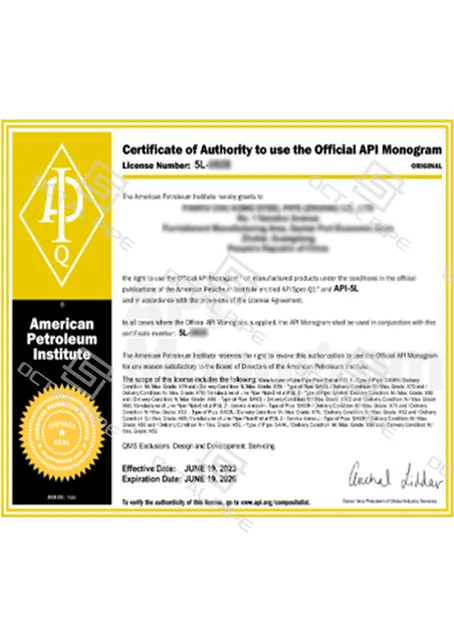
AP-5L Certificate
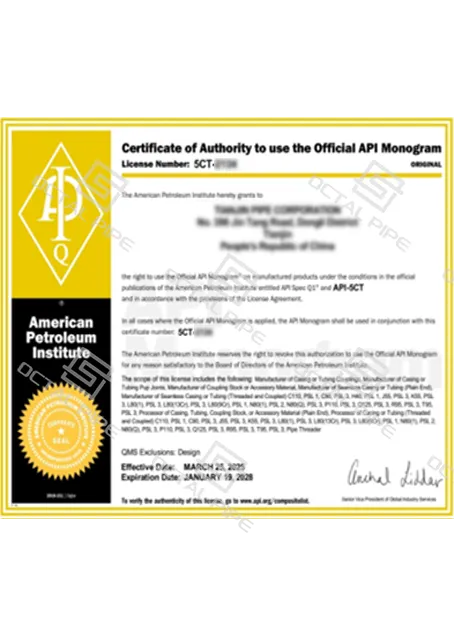
API-5CT Certificate
Service type: steam injection (CSS / SAGD), heavy-oil production, deep-water, geothermal, permafrost wells
Structure: concentric double-wall seamless steel pipe, evacuated annulus with multilayer insulation
Size range (outer × inner):
73 × 40 mm (2-7/8" × 1.9")
89 × 50 mm (3-1/2" × 2-3/8")
114 × 76 mm (4-1/2" × 3-1/2")
140 × 101 mm (5-1/2" × 4-1/2")
178 × 124 mm (7" × 5-1/2")
Length: Range 2 (R2) and Range 3 (R3), insulated pup joints available
Steel grades: N80, L80-1 / 1Cr / 3Cr / 9Cr, Q125, S135 and other API 5CT grades
Connections: API BTC as standard, optional gas-tight premium connections
Thermal grades (k-value): multiple insulation levels, k down to approx. 0.002–0.006 W/(m·°C) depending on grade
Max. operating temperature: up to about 400 °C (application-dependent)
Hot Tags: Vacuum Vacuum Insulated Tubing, China Vacuum Vacuum Insulated Tubing manufacturers, suppliers, factory, well casing pipe steel, glow tubing, apollo casing pipe, submersible casing pipe, 2 well casing, copper pipe with insulation
Previous
High Collapse(HC) CasingNext
TubingYou Might Also Like


Send Inquiry