
A sucker rod is used to transmit motion and load from the surface drive to the downhole pump in a rod-lift system. In a beam-pumped well, the rod string moves up and down inside the tubing and drives the pump plunger, which lifts produced fluid to surface. In that sense, the rod is not just a steel bar in the wellbore; it is the working mechanical link between the surface pumping unit and the pump below. SLB describes the rod string as the connection between the surface system and the downhole pump, and notes that rod-pump systems remain one of the most common artificial-lift methods in oil wells.
In practical oilfield use, sucker rod selection is based on the actual rod-string duty. Key variables include pump setting depth, tubing size, pump size, fluid load, polished rod load, stroke length, strokes per minute, and target production rate. The design also has to consider well deviation, tubing contact, gas-liquid ratio, sand, paraffin, scale, and corrosive media such as CO2 and H2S. These factors determine whether the rod string should be single-diameter or tapered, which rod grade and diameter should be used, whether a higher-strength rod is required, and how couplings and pony rods should be matched.
What a sucker rod does in a rod-lift system
In reciprocating rod lift, the sucker rod string converts surface reciprocating motion into downhole pump movement. The beam unit lifts and lowers the string; the pump plunger follows that motion and moves fluid through the tubing. In PCP service, the rod string is also a torque-transmission member, so it is not working only in axial tension. That is why rod selection cannot be separated from pumping mode, well geometry, and load cycle.
A complete rod string is not limited to full-length rods. API 11B covers steel sucker rods and pony rods together with polished rods, couplings, sinker bars, polished rod clamps, stuffing boxes, and pumping tees. In field operation, these items work as one rod-lift system rather than as isolated components, because string load, connection performance, pump landing, tubing contact, and run life all depend on the combined behavior of the rods, short sections, couplings, and associated accessories.
API 11B product family and common rod-string components
The product family can be read more clearly through the components below:
| Product | Function in the rod-lift system |
|---|---|
| Sucker rod | The main full-length load-carrying section of the rod string. It transmits reciprocating motion in beam pumping or torque in PCP service from the surface drive to the downhole pump, while also carrying string weight and cyclic operating load inside the tubing. |
| Pony rod | A shorter rod section used to fine-adjust the total rod-string length so the pump can be landed at the required depth and the stroke geometry can be set correctly. It is used for string tally correction rather than as the main working length of the rod string. |
| Polished rod | The top rod section that passes through the stuffing box at surface. It connects the rod string to the surface drive, transfers polished-rod load, and provides the smooth sealing surface required for the stuffing-box packing during continuous reciprocating motion. |
| Coupling / subcoupling | The threaded connector used to join adjacent rod sections and transmit tensile load through the string. In operation, the coupling also influences connection integrity, fatigue performance, and tubing-contact behavior, especially in deviated wells where coupling OD may contact the tubing wall. |
| Sinker bar / stabilizer bar | A heavier lower-string component used in selected rod-string designs to maintain tension near the pump, improve string stability, and reduce buckling, tubing contact, or rod whip. It is especially useful where the lower rod string is prone to compression-related instability or wear. |
A rod string should be evaluated as an integrated working system rather than as an isolated rod body. Correct selection of rod grade and diameter does not, by itself, ensure satisfactory field performance. Premature wear, fatigue, landing error, and tubing-contact damage can still occur when the pony-rod tally, coupling design, polished-rod section, or lower-string support is inconsistent with the actual well profile, string load, and operating mode.
Sucker rod sizes, lengths, and pony rods
Current API-aligned manufacturer data is fairly consistent on the standard-length side, as shown in this [Sucker rod sizes, lengths, and pony rods] reference.Tenaris lists nominal sucker-rod lengths of 25 ft and 30 ft, while pony rods are listed at 2, 4, 6, 8, 10, and 12 ft. SLB's product page also identifies 25- and 30-ft rods and pony rods in 2-, 4-, 6-, 8-, and 10-ft lengths. Commercial catalogs commonly list rod body diameters from 5/8 in through 1-1/8 in, and some catalogs extend further to 1-1/4 in or 1-1/2 in depending on the product series and manufacturer. Octal's current product pages list 5/8 in to 1-3/4 in across its sucker-rod family, while its high-strength page lists 5/8 in to 1-1/8 in for that route.
| Item | Common commercial range | Practical meaning |
|---|---|---|
| Rod body diameters | 5/8 in, 3/4 in, 7/8 in, 1 in, 1-1/8 in; some catalogs also list 1-1/4 in and 1-1/2 in | Diameter affects load capacity, rod-string weight, and coupling/tubing fit |
| Standard sucker-rod lengths | 25 ft, 30 ft | Main full-length rod sections used to build the string |
| Pony-rod lengths | 2 ft, 4 ft, 6 ft, 8 ft, 10 ft, 12 ft | Used to adjust final rod-string tally and set the pump correctly |
| Typical use of pony rods | String-length correction | Not a different rod function; a shorter section for landing accuracy |
Download:Sucker Rod Size and Length Reference
A pony rod vs sucker rod comparison is therefore mainly a difference in length and rod-string function, not a difference in basic purpose. Pony rods are used to finish the string to the required landed depth without forcing the pump to sit too high or too low.


Sucker rod grades and product series
The standard API 11B sucker rod grade set is built around C, K, and D. Public product literature consistently ties those grades to increasing load and corrosion demands: Grade C for lighter service, Grade K where corrosion resistance is more important, and Grade D for higher-load service than C or K. Public commercial summaries repeat the same tensile range logic: C and K are commonly shown at 90,000–115,000 psi tensile strength, while D is commonly shown at 115,000–140,000 psi. Premium and manufacturer-specific routes then extend above the basic API grades into grades such as KD, DXS, HA, HS, HL, and HY, depending on the supplier system.
| Grade / series | Classification | Typical service logic |
|---|---|---|
| C | API grade | Light-load wells under controlled corrosion conditions |
| K | API grade | Similar tensile range to C, but used where corrosion resistance is more important |
| D | API grade | Medium- to heavier-load service where higher strength is needed |
| KD / DS / DXS | Premium / supplier-specific route | Moderate corrosion, fatigue-sensitive duty, and some PCP or slim-hole applications |
| HA / HS / HL / HY | High-strength / premium route | Deep wells, high cyclic load, heavy polished loads, PCP torque, and more demanding fatigue duty |
Download:Sucker Rod Grades and Product Series Reference
The key point is that sucker rod grade selection is a string-design and well-duty decision, not a simple catalog choice. The selected grade has to match the actual polished rod load, pump setting depth, stress cycle severity, corrosion environment, and operating mode of the well. In practical terms, lighter-duty reciprocating wells may remain within the API C / K / D range, while deeper wells, higher cyclic loading, greater deviation, PCP torque, or more aggressive corrosion conditions can push the design toward premium or high-strength rod series. For that reason, grade should be read together with rod diameter, string taper, coupling class, and expected fatigue life, because the rod string succeeds or fails as a matched mechanical system rather than as an isolated grade label.
Standard sucker rod vs high strength sucker rod
A standard sucker rod is generally used where the rod string can be designed within the normal API 11B grade range and the well does not impose unusually high tensile load, torque, or fatigue demand. In practical terms, standard rods are commonly matched to conventional beam-pumping wells, moderate depths, and service conditions where the rod load, deviation, and corrosion level remain within the limits of the selected API grade.
A [high strength sucker rod vs standard sucker rod] comparison becomes important when the well condition moves beyond the practical range of standard API rod selection.This usually includes deep wells, heavier rod loads, high-flow wells, PCP service, or operating conditions where fatigue performance becomes a more critical design factor. Octal's high-strength page places its H/HY route in deep, heavy-load, and corrosive wells, while Lufkin's comparison guide places premium grades such as KD, DXS, HA, and HS in wells with higher fatigue, corrosive fluids, and PCP/slim-hole demands.
| Item | Standard sucker rod | High strength sucker rod |
|---|---|---|
| Typical design basis | Basic API 11B grade selection | More demanding rod-string duty |
| Common service | Conventional beam pumping | Deep wells, heavy loads, PCP, higher fatigue duty |
| Main concern | Load and corrosion matching | Higher cyclic load, torque, fatigue, and run-life demand |
| Common grade direction | C / K / D | KD / DXS / HA / HS / HL / HY and similar premium routes |
| Why it is selected | Standard reciprocating service envelope | When standard API grades are no longer enough |
Download:Standard vs High Strength Sucker Rod Reference
The distinction is not just that one rod is "stronger." The more useful distinction is functional: standard rods are often enough in conventional reciprocating service, while high-strength rods are chosen when the string must survive higher load, more severe fatigue, added torque, or more demanding well geometry.
Where sucker rods are actually used
Sucker rod service should be understood through actual well duty rather than through broad industry labels. In field operation, the rod string is selected against the specific pumping method, well depth, fluid load, well trajectory, and corrosion profile of the well. The engineering question is not simply whether the well is producing oil, but whether the rod string is working under reciprocating load, torsional load, side loading from deviation, high fluid-column weight, or a chemically aggressive produced-fluid system. Those conditions determine whether the string should remain within a conventional API grade envelope or move toward a different rod diameter, string taper, coupling class, or high-strength rod series.
Sucker rods are commonly used in the following well conditions:
- conventional beam-pumped wells where the rod string drives a reciprocating downhole pump and the main design focus is cyclic axial load, pump setting depth, and polished rod load;
- PCP wells where the rod string must transmit continuous rotational torque to the downhole rotor while also carrying string weight and operating load inside the tubing;
- deep rod-lift wells where the upper string carries higher repeated tensile load over a longer string length, making taper design, fatigue resistance, and connection performance more critical;
- deviated or dogleg wells where the rod string is exposed to tubing contact, coupling wear, and compression-related buckling risk, especially in the lower section of the string;
- corrosive wells where the produced fluid contains significant water, CO2, H2S, or other corrosive components, so grade selection must consider not only strength but also corrosion resistance and inhibitor reliability;
- heavy fluid-column service where higher liquid density, greater pump fillage, or higher production targets increase the load carried by the rod string and push the design toward larger diameters, stronger grades, or a more carefully balanced taper.
A few field examples make the service logic clearer:
- In a deep reciprocating well, the upper rod sections see repeated high tensile load on every stroke. In this condition, the design concern is not only nominal rod strength, but also fatigue life at the upset and threaded connection, coupling integrity, and whether the string taper keeps upper-string stress within an acceptable range.
- In a deviated well, the string may not remain centered in the tubing. Coupling OD can contact the tubing wall, and the lower rod string may move into compression on part of the stroke. Under those conditions, sinker bars, stabilizer bars, rod guides, and coupling selection become part of the wear-control strategy rather than optional accessories.
- In a PCP well, the rod string is not working under axial load alone. It must transmit surface drive torque to the downhole rotor while also carrying string weight in the wellbore. As a result, the rod system is subjected to combined torsional stress, axial tension, cyclic loading, and, in deviated wells, additional tubing contact and wear. In this service, rod grade, diameter, connection system, and coupling selection have to be read together.
- In a corrosive well, the design question is not only whether the string can carry the load. It is also whether the selected rod grade can maintain run life in the presence of produced water, CO2, H2S, and the actual inhibitor program. In these wells, rod-string design has to consider corrosion risk, fatigue interaction, and whether the chosen grade remains suitable over the full service interval.
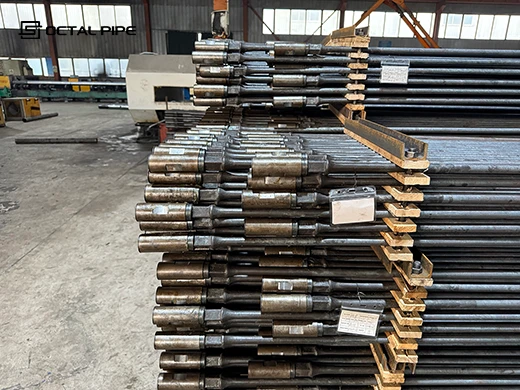
Couplings and why they matter
Rods are connected by couplings, and the selected coupling class affects both rod-string integrity and tubing wear. Public API-oriented literature identifies Class T and Class SM as the common API coupling classes, while some product systems also include high-strength coupling routes for more demanding service. Because the coupling outside diameter is larger than the rod body, the coupling is often the first part of the string to contact the tubing wall in deviated wells. For that reason, coupling selection should be evaluated together with rod grade, string load, well deviation, and expected wear conditions, rather than treated as a separate accessory choice.
| Coupling class | What it means | Where it matters |
|---|---|---|
| Class T | Through-hardened coupling | General load-carrying connection service |
| Class SM | Spray-metal coupling | Used where surface condition and tubing-contact behavior matter more |
| High-strength / UHS | Premium coupling route | Used with higher-load or premium rod-string designs |
The practical point is simple: rod grade, rod diameter, and coupling class should be read as one working system. A high-strength rod with the wrong coupling strategy can still run into wear, fatigue, or tubing-contact problems in service.
What is the difference between a sucker rod and a pony rod?
A sucker rod is the standard full-length rod section used to build most of the rod string. A pony rod is the shorter rod section used to adjust total string length. Current API-aligned literature lists standard rods at 25 ft and 30 ft, while pony rods are commonly listed at 2, 4, 6, 8, 10, and 12 ft.
That difference is operational, not just dimensional. Pony rods are used when the final rod tally has to be adjusted so the pump lands correctly and the stroke geometry works as intended.
FAQ

01.Can the same sucker rod string be used for both beam pumping and PCP service?
02.When is a pony rod required in a sucker rod string?
03.Does a higher rod grade always mean a better rod string?
04.Why does coupling selection matter if the rod grade is already correct?
Certifications
CE Certificate

ISO 9001 Certificate

API Q1 Certificate
ABS Certificate
AP-5L Certificate
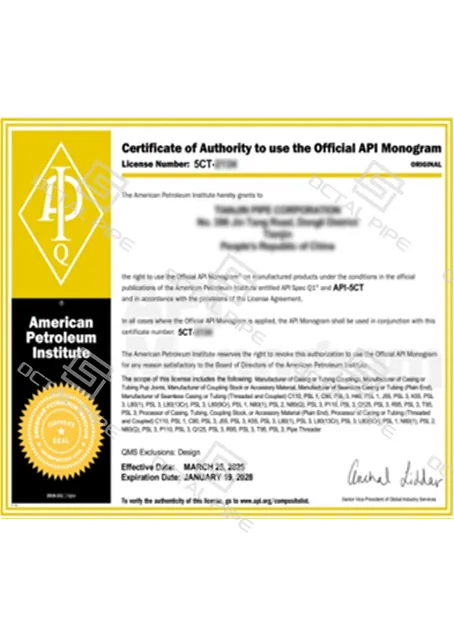
API-5CT Certificate