In instrumentation lines, clean media systems, and assemblies with tight dimensional tolerances, precision stainless steel tubes – especially in 304/304L and 316/316L – are defined not only by outside diameter and wall thickness, but also by geometry, material standard, surface class, and traceability.
Surface class (AP / BA / MP / EP), together with roughness and inspection records, determines whether a tube is suitable for industrial, sanitary, or high-purity service and how easily it can pass project acceptance.
Specification Framework for Precision Stainless Steel Tubes
| Dimension | Key Points | Typical Appearance in Project Specifications |
|---|---|---|
| Dimensions & Tolerances | Outside diameter (OD), wall thickness (WT), tolerance range; internal diameter or flow cross-section where required | Listed in "Dimensions & Tolerances" or data tables; directly affects fitting compatibility, weld fit-up, and connection to equipment nozzles |
| Geometrical Accuracy | Ovality, straightness, concentricity | Added as geometric tolerances; used to control long tube runs, support spacing, orbital welding alignment, and fatigue behaviour of thin-wall small-diameter tubes |
| Tube Ends | Deburring, squareness and perpendicularity, chamfer form, bevel preparation where required | Defined in "Ends / End Preparation"; reduces on-site grinding and rework, improves assembly efficiency and sealing reliability |
| Standards | ASTM A269 / A270 / A213 / A249 / A554, and revision level | Listed in "Standards / Applicable Codes & Standards"; fixes mechanical property scope, test items, and documentation content |
| Grades | 304/304L, 316/316L, 321/347, 2205 and other stainless steels | Listed in "Materials"; selected based on medium, temperature, cleaning method, and design life. Precision 304 stainless steel tubes and 316L precision stainless steel tubes are most common in clean and high-purity systems |
| Manufacturing Route | Precision seamless; welded + cold worked | Listed in "Manufacturing Process" or supplementary requirements; defines acceptable production routes and their implications on tolerances, surface condition, and delivery flexibility |
| Traceability & Quality | Heat number, cast number, production batch, surface treatment batch, inspection records | Implemented through tube markings, labels, EN 10204 3.1/3.2 MTCs, and inspection reports; forms the traceability chain needed for acceptance and later audits |
Once these dimensions are defined, the surface class (AP / BA / MP / EP) and associated roughness values govern media compatibility, cleanability, and documentation requirements.
Surface Classes for Precision Stainless Steel Tubes: AP / BA / MP / EP


In engineering practice, four delivery surface classes are commonly used for precision stainless steel tubes:
- AP – Annealed & Pickled
- BA – Bright Annealed
- MP – Mechanical Polished
- EP – Electropolished
Specifications and purchase orders typically combine these as:
Surface class + scope (ID / OD / ID+OD) + target internal Ra value.
1. AP – Annealed & Pickled
AP focuses on removing scale and weld heat tint to obtain a clean, weldable, and corrosion-resistant base surface. Typical uses:
- General industrial process lines
- Instrument and control lines
- Utility headers and some heat-exchanger services
For 304 and 316 precision stainless steel tubes, AP surfaces are widely used for industrial water, steam, compressed air, inert gases, and many standard chemical services.
Surface Characteristics
- Uniform matte or dull finish, without heavy scale or pronounced heat tint.
- Internal roughness at a medium level, suitable for most industrial media and standard cleaning methods.
- Where pressure drop or residue control is more critical, an internal Ra range can be added on top of AP to further define the surface.
2. BA – Bright Annealed
BA surfaces are obtained through bright annealing under protective atmosphere and emphasise clean, bright, and scale-free tube surfaces. Typical uses:
- Process lines with visual and basic cleanliness requirements
- Equipment connection piping and visible areas in plants
- Base surface for later MP or EP when tighter roughness control is needed
In precision 304/304L and 316/316L stainless steel tubes, BA is common in food, personal care, and certain process water applications.
Surface Characteristics
- Uniform metallic bright finish with limited scale; weld seam colour close to parent material.
- With stable atmosphere and temperature control, internal and external surfaces show very little oxidation.
- Under the same dimensional tolerances, BA is favourable for achieving uniform final appearance and roughness after MP or EP.
3. MP – Mechanical Polished
MP reduces roughness by mechanical grinding and polishing while also controlling visual appearance. Typical uses:
- Hygienic piping in food, beverage, and pharmaceutical plants
- Systems with defined residue control and CIP / SIP cycles
- Exposed pipework and equipment areas where a consistent finish is required
For 316L precision stainless steel tubes, MP internal surfaces combined with suitable Ra limits are a typical configuration for sanitary and high-value media services.
Surface and Roughness Characteristics
- Surface can be configured as fine-ground, brushed, or mirror-like, balancing cleanability and appearance.
- Typical internal roughness targets for precision tubes:
Industrial mechanical polish: internal Ra ≈ 0.6–0.8 µm
Sanitary mechanical polish: internal Ra ≈ 0.4–0.6 µm
These values vary with standards, industry practice, and plant capability, and are usually written as "MP internal surface, Ra ≤ X µm" with a defined measuring method and location.
Mechanical polishing inevitably removes some material. For thin-wall and tight-tolerance tubes, OD, WT, and ovality allowances need to be planned in advance so that finished precision tubes remain within the specified tolerances.
4. EP – Electropolished
EP uses electrochemical dissolution of micro-peaks to produce a smoother, denser internal surface, improving cleanability and residue control. Typical uses:
- High-purity and ultra-pure water systems
- Semiconductor and electronic-grade chemical piping
- High-end pharmaceutical and bioprocess piping
- Lines with strict limits on particles, extractables, and cleaning validation results
In high-purity systems, 316L EP precision stainless steel tubes are a standard combination: the grade supports corrosion resistance and cleaning chemistry, while EP internal surfaces support stringent cleanliness targets.
Surface and Roughness Characteristics
- Internal surface becomes smoother at the micro-scale, with fewer stagnation points and micro-pits.
- Typical internal roughness targets:
High-purity / sanitary EP: internal Ra ≈ 0.3–0.4 µm
Higher cleanliness (e.g. UHP): internal Ra down to ≈ 0.25 µm or below, subject to process capability and standard requirements
EP is usually defined together with cleaning, drying, clean packaging, and documentation; it is part of a complete high-cleanliness control scheme rather than a cosmetic finish only.
Application Scenarios and Typical Choices
1. AP – Conventional Industrial and Instrumentation Systems
Media: industrial water, steam, inert gases, standard chemicals
Systems: utilities, instrument impulse lines, control signal piping
Characteristics: focus on corrosion resistance and weldability; no extreme limits on internal residue.
Octal Pipe supplies AP internal 304 and 316 precision stainless steel tubes for many utility and instrumentation circuits, combining standardised pickling / passivation with dimensional inspection to cover most industrial operating conditions.
2. BA – Clean Process and Appearance-Sensitive Lines
Media: process water, some food / personal care media, inert or protective gases
Systems: equipment hookups, skid piping, visible pipe runs around machines and modules
Characteristics: cleaner and more uniform appearance than AP, reduced colour variation and surface defects, while preserving headroom for later polishing or electropolishing if required.
In Octal Pipe deliveries, BA 304L and 316L precision tubes are often selected for clean plant piping and equipment connection lines where surface cleanliness, appearance, and future modification flexibility are all relevant.
3. MP – Hygienic and Easy-to-Clean Systems
Media: food and beverage products, pharmaceutical process liquids, high-value fine chemicals
Systems: hygienic piping, CIP / SIP loops, production lines with frequent cleaning cycles
Characteristics: defined internal Ra limits, reduced residue retention, and smoother weld transitions to support cleaning and validation.
For sanitary 316L precision stainless steel tubes, Octal Pipe commonly combines MP internal surfaces with relevant sanitary standards such as ASTM A270 and provides Ra test results and surface treatment records to support customer validation in pharmaceutical and food projects.
4. EP – High-Purity and High-Cleanliness Systems
Media: high-purity and ultra-pure water, electronic-grade chemicals, biologics, high-purity gases
Systems: semiconductor process lines, electronic-grade chemical distribution, high-end pharmaceutical and bioprocess platforms
Characteristics: strict limits on particles, extractables, and bioburden; often a "MP + EP" combination with tight Ra and cleanliness documentation.
In high-purity and UHP projects, Octal Pipe typically delivers EP precision tubes in 316L with a process chain of bright annealing, mechanical pre-polish, and electropolishing, supported by batch-level Ra reports and cleaning records to meet semiconductor and bioprocess customer requirements.


Traceability and Quality Control – From Raw Materials to Finished Tubes
| Stage | Key Control Points | Typical Tests / Records | Role in the Project |
|---|---|---|---|
| Raw Material (billets / hollows / coils / bars) | Grade confirmation (304/304L, 316/316L, etc.); chemical composition; cleanness and inclusion control | Heat number; EN 10204 3.1/3.2 MTC; chemical analysis report | Ensures that precision 304 and 316 stainless steel tubes meet base standard and corrosion requirements from the source and provides the starting point of traceability |
| Forming & Welding / Piercing & Hot Working | Welding process (for welded tubes); piercing and hot-working parameters (for seamless); weld continuity | Process records; online or batch NDT (eddy current, leak flux, etc.) | Controls consistency between weld seam and parent metal, reduces risk of wall defects and welding flaws |
| Cold Working & Heat Treatment | Cold-drawing / cold-rolling passes; solution annealing temperature / time; straightening | Dimensional inspection results; hardness tests; microstructure / intergranular corrosion tests where required | Balances strength, ductility, and residual stress so that precision tubes meet mechanical and tolerance requirements simultaneously |
| Surface Treatment (AP / BA / MP / EP) | Pickling / passivation; protective atmosphere bright annealing; polishing parameters; electropolishing parameters | Surface treatment batch records; Ra test reports (for MP / EP); visual inspection records | Keeps internal and external surfaces of precision 304 and 316 stainless steel tubes within specified classes and roughness ranges, supporting media compatibility and cleaning behaviour |
| Dimensions, Geometry & NDT | OD / WT / length; ovality / straightness; concentricity; pressure tests where required | Dimensional inspection reports; geometric deviation records; hydrostatic / pneumatic test reports; eddy-current / flux leakage reports | Confirms that precision stainless steel tubes comply with geometrical, pressure, and defect limits, forming the basis for fit-up and safe operation |
| Packaging & Marking | Tube ink-jet / stamp marking; anti-dust, anti-moisture, anti-scratch protection | Marking of size, grade, standard, heat / batch; packaging specification | Keeps identity clear through storage and transport so that sites can allocate tubes by size, grade, and batch without losing traceability |
| Documentation & Data Book (MDR / QA Dossier) | File consolidation and project linkage; batch mapping | MTC; dimensional and geometrical inspection reports; surface treatment and Ra records; NDT and pressure test reports; packaging and marking description | Forms a complete quality archive from raw material to finished precision tube, supporting EPC, owner, and third-party acceptance and later audits. Octal Pipe typically supplies these as a structured data book for engineering projects |
Typical Ways to Specify Surface Requirements
In specifications and purchase documents, the surface section for precision / high-precision stainless steel tubes typically combines:
- Surface class – AP, BA, MP, or EP
- Scope – internal (ID), external (OD), or ID+OD
- Internal roughness – Ra limit and unit (µm / µin), including sampling frequency or batch reporting requirements
- Appearance description – such as brushed, mirror polished, or matte to distinguish texture types
- Documentation and inspection – surface treatment records, Ra test reports, cleaning / passivation records, and requirements on packaging and marking
When these are combined with the appropriate ASTM standard (e.g. A269, A270) and grade selection (such as 304L or 316L), precision stainless steel tubes can be specified in a way that is manufacturable, inspectable, and traceable. Octal Pipe configures production and quality control to follow this logic, so that precision 304 and 316 stainless steel tubes not only match the service conditions, but are also straightforward to accept and manage throughout the project life cycle.
FAQ
Q1: What drives the choice between AP, BA, MP, and EP for precision stainless steel tubes?
A1: The main drivers are medium characteristics, cleaning method, target cleanliness level, and budget. Conventional industrial and instrumentation systems typically use AP; lines with appearance and basic cleanliness requirements often use BA; hygienic and frequently cleaned systems prefer MP; high-purity and UHP systems generally require EP with defined internal Ra and documentation. 304L and 316L grades are most common in the latter two categories.
Q2: Both MP and EP reduce roughness. What is the key difference in practice?
A2: MP uses mechanical grinding and polishing, focusing on macroscopic roughness and appearance. EP is electrochemical and works at the micro-scale, improving cleanability, residue control, and chemical stability. High-end systems often combine them: MP to remove macro-defects, then EP to refine the internal surface, particularly on 316L precision tubes in high-purity and bioprocess applications.
Q3: Do surface treatments affect dimensional tolerances and geometrical accuracy?
A3: Yes. Both mechanical polishing and electropolishing remove material. For thin-wall or tight-tolerance tubes, allowances must be included at design stage and controlled in production so that finished precision stainless steel tubes remain within the specified OD, WT, and geometry limits.
Q4: Is it sufficient to state "internally electropolished" in the specification?
A4: Normally not. It is better to define the EP class, scope (ID or ID+OD), internal Ra target, measurement method, and required records (treatment, Ra results, cleaning). This keeps manufacturing, inspection, and acceptance aligned on the actual delivery state.
Q5: Why is traceability so important for precision 304/316 stainless steel tube projects?
A5: Traceability (heat numbers, production batches, surface treatment batches, inspection records) enables quick correlation between in-service issues and specific material or process conditions, and supports later audits and design reviews. In engineering projects, Octal Pipe typically links these data to the 304/304L and 316/316L MTCs, Ra reports, and NDT / pressure test records in one data book, forming a complete quality trail from raw material to finished precision tube.
Certifications
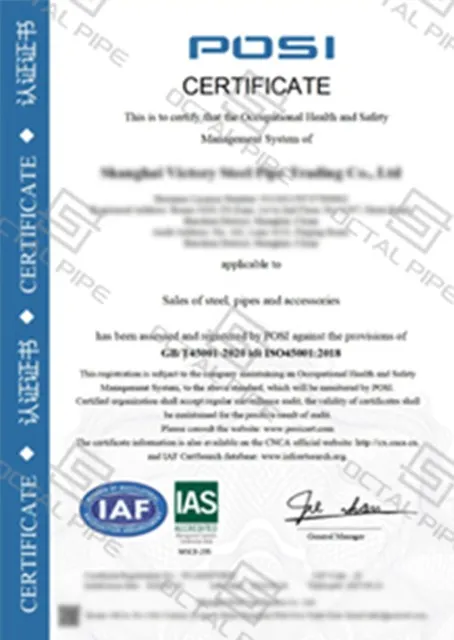
CE Certificate
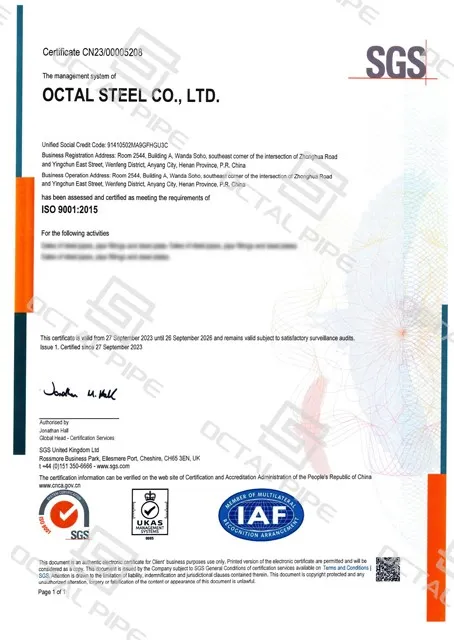
ISO 9001 Certificate

API Q1 Certificate
ABS Certificate
AP-5L Certificate
API-5CT Certificate