Product Profile
ASTM A335 Gr. P9 is a seamless ferritic alloy steel pipe designed for continuous service at elevated temperature and pressure. With about 9% chromium and 1% molybdenum, it sits in the 9Cr-1Mo family that is widely used in power generation, petrochemical heaters, reformers, and hot process lines.
At Octal Pipe, P9 pipes are supplied in normalized and tempered condition, fully tested, and traceable to heat/batch, suitable for boilers, headers, superheaters, steam lines and high-temperature process piping where plain carbon steel and low-Cr alloys cannot maintain oxidation or creep resistance.
Material Basis and Metallurgy
Unlike ordinary carbon steel, P9 is formulated to keep strength and surface integrity after thousands of hours at high metal temperature.
- Chromium (~9%) forms a compact, adherent Cr₂O₃ film on the surface, slowing scaling and oxidation in hot steam or mixed-gas atmospheres.
- Molybdenum (~1%) strengthens the ferritic matrix and delays creep deformation by hindering dislocation movement.
- After normalizing + tempering, the steel shows a tempered ferrite–carbide structure with stable grain boundaries and controlled carbides (mainly M₂₃C₆ / M₆C) along boundaries - this is what keeps creep-rupture strength and avoids grain boundary embrittlement during long exposure.
So, in high-temperature service (superheater coils, reformer transfer lines), P9 stays dimensionally stable longer than P5/P11-type alloys.
Chemical & Mechanical Requirements
Chemical Composition (typical range)
| Element | Content, % | Role |
|---|---|---|
| Chromium (Cr) | 8.0 – 10.0 | Oxidation / scaling resistance, high-temp stability |
| Molybdenum (Mo) | 0.90 – 1.10 | Creep and rupture strength |
| Carbon (C) | ≤ 0.15 | Adjusts hardness and tensile |
| Manganese (Mn) | 0.30 – 0.60 | Hot workability |
| Silicon (Si) | ≤ 1.00 | Supports oxidation resistance |
| Phosphorus (P), Sulfur (S) | ≤ 0.025 | Keep ductility and toughness |
Mechanical Properties (ASTM A335 P9)
- Tensile strength: ≥ 415 MPa
- Yield strength: ≥ 205 MPa
- Elongation: ≥ 30%
- Hardness: ≤ 163 HBW
These values are for the normalized-and-tempered delivery condition and are intended to give the alloy enough margin for pressure and temperature design.
Manufacturing Route & Heat Treatment
To make sure the 9Cr-1Mo chemistry actually turns into the required high-temperature microstructure, Octal Pipe adopts a controlled seamless-pipe route:
- Billet & piercing
Clean Cr-Mo billets are heated to the proper piercing temperature (around 1100–1150 °C), then pierced/elongated to form hollows with uniform grain flow.
- Hot rolling / cold drawing
Wall thickness is brought to the ordered schedule (SCH 10 – SCH 160). Intermediate normalizing may be used when heavy reduction or close tolerances are involved.
- Normalizing (approx. 900–950 °C)
Refines ferrite, dissolves non-uniform carbides, removes internal stresses from forming.
- Tempering (approx. 675–760 °C)
Restores ductility and locks in the desired carbide distribution so that creep rupture properties match ASTM requirements.
- Quality control
- Ultrasonic / eddy-current NDT on pipe body and ends
- Hydrostatic test
- Hardness and mechanical sampling per batch
- EN 10204 3.1/3.2 certification for traceability
The result is a pipe with fine, evenly spread carbides and a stable tempered ferritic matrix - the structure you want for long-term hot service.


Dimensional Supply Range
| Parameter | Typical Supply |
|---|---|
| Outside Diameter | ½″ – 24″ (12.7 – 610 mm) |
| Wall Thickness | SCH 10 – SCH 160 (incl. special WT) |
| Length | Up to 12 m, SRL / DRL / cut-to-length |
| Ends | Beveled for welding, or plain |
| Tolerances | OD ±1 %, WT ±10 % (or as per order) |
Special lengths and tighter tolerances can be discussed for boiler/HRSG projects.
High-Temperature Service Behavior
When metal temperature rises toward 600–700 °C, P9 keeps two things that lower grades start to lose:
- Surface integrity – the Cr-rich oxide film slows scale growth and reduces oxide spallation, so tube fouling and wall thinning are slower.
- Creep stability – with Mo in solution and controlled carbides, the alloy can reach creep rupture strengths on the order required for 10⁴ h service around 600 °C.
That is why P9 is routinely specified for:
- Power plants: superheater and reheater tubes, steam headers, hot main steam lines
- Refinery / petrochemical heaters: reformer tubes, transfer lines, hot-gas piping
- High-temperature process plants: heat exchangers, manifolds, reactor feed lines
- Oil & gas thermal units: steam injection, hydrogen-processing lines working under hot and cyclic conditions
Compared with P5/P11, P9 offers better oxidation control and slower microstructural coarsening, which often translates to longer inspection intervals.
Octal Pipe Supply & Documentation
- Production to ASTM A335 / ASME SA-335 and related ISO/EN requirements
- Delivery in normalized and tempered condition
- Mechanical, NDT, hydrostatic test reports for every batch
- 3.1 / 3.2 certificates available
- Packing suitable for export and long-distance transport
- Project-level QA/QC support for power, refinery and chemical plant contractors
FAQ

Q1: What is ASTM A335 P9 (ASME SA335 P9) pipe used for?
Q2: What does "9Cr-1Mo" mean for P9 pipe?
Q3: How is P9 different from P22 or P91?
Q4: What heat-treatment condition is typically specified for A335 P9 seamless pipe?
Q5: What should I request to verify P9 pipe quality before purchase?
Certifications
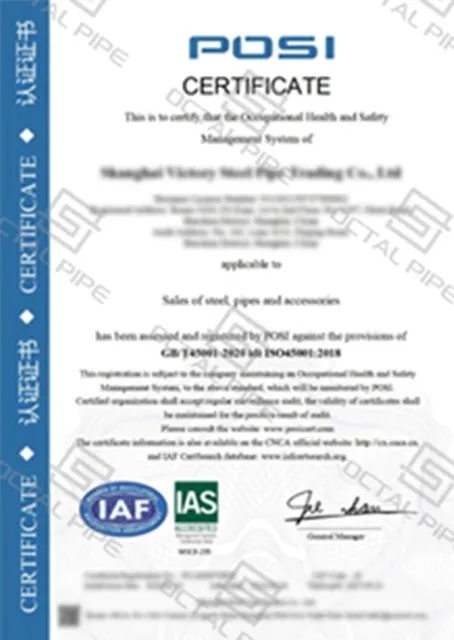
CE Certificate

ISO 9001 Certificate

API Q1 Certificate
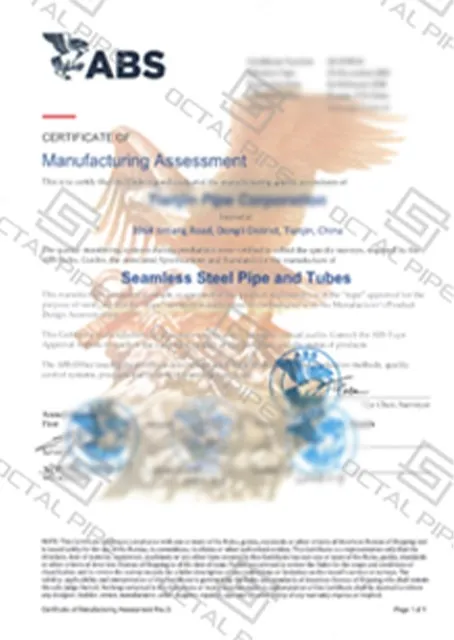
ABS Certificate
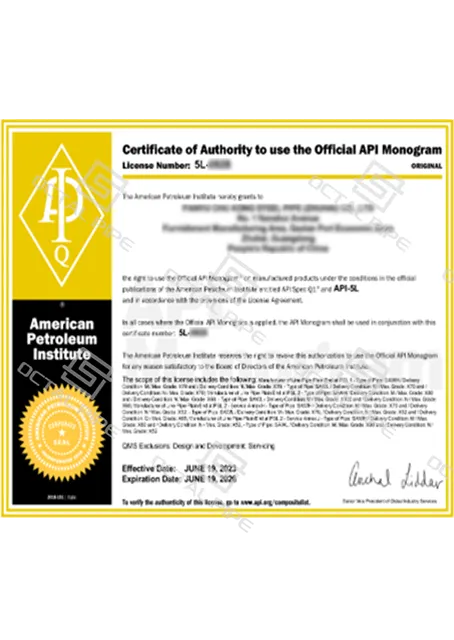
AP-5L Certificate
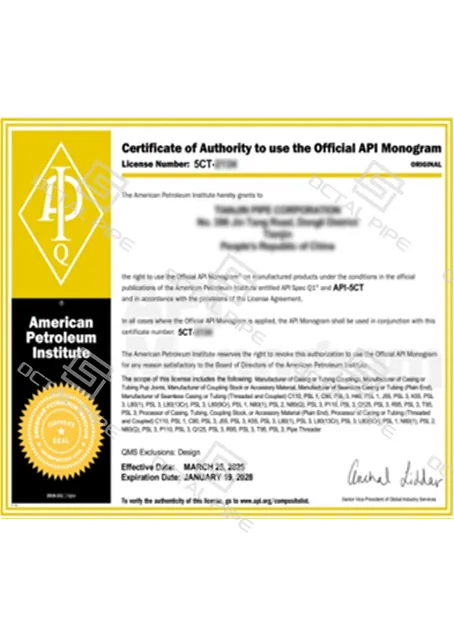
API-5CT Certificate