Material Overview
ASTM A335 Grade P5 is a ferritic chromium–molybdenum alloy steel pipe intended for elevated-temperature and pressure-bearing service. With chromium in the 4–6% range and molybdenum around 0.45–0.65%, P5 delivers a useful combination of oxidation resistance, creep strength, and weldability. This makes it a practical choice for boiler and steam lines, refinery heater piping, reformer and hot process lines where carbon steel would scale too fast or lose strength. When delivered in normalized and tempered condition, P5 maintains dimensional stability and mechanical reliability over long operating periods.
Chemical Composition (typical, %)
| Element | Content (%) | Function |
|---|---|---|
| Carbon (C) | ≤ 0.15 | Provides strength, kept low for weldability |
| Manganese (Mn) | 0.30–0.60 | Deoxidation, improves hot workability |
| Silicon (Si) | 0.50–1.00 | Supports oxidation resistance |
| Chromium (Cr) | 4.00–6.00 | High-temperature scaling and corrosion resistance |
| Molybdenum (Mo) | 0.45–0.65 | Creep and rupture strength |
| Phosphorus (P) | ≤ 0.025 | Maintains toughness |
| Sulfur (S) | ≤ 0.025 | Balanced machinability/toughness |
| Nickel (Ni) | ≤ 0.50 | Extra toughness in some media |
| Copper (Cu) | ≤ 0.40 | Additional oxidation protection |
| V, Nb | ≤ 0.02 each | Grain refinement, creep stability |
This alloy balance is lower than P22/P91, so it is easier to weld and to PWHT, but still gives better oxidation control than lower-Cr grades.
Mechanical Properties
| Property | Requirement | Purpose |
|---|---|---|
| Tensile strength | ≥ 415 MPa (60 ksi) | Resists fracture under load |
| Yield strength | ≥ 205 MPa (30 ksi) | Resists permanent deformation |
| Elongation | ≥ 30% | Allows forming and fabrication |
| Hardness | ≤ 163 HBW | Keeps toughness and weld compatibility |
These values correspond to the normalized-and-tempered delivery condition required by ASTM A335.
Manufacturing and Heat Treatment
P5 must be produced and heat-treated carefully to secure long-term performance at temperature. Octal Pipe uses a seamless route starting from clean Cr-Mo billets. Billets are heated and pierced to form hollows, then hot-rolled or cold-drawn to the ordered outside diameter and wall thickness. After forming, pipes are normalized at about 900–950 °C to refine the ferritic matrix, dissolve non-uniform carbides and remove stresses. A subsequent tempering step at about 675–750 °C restores ductility and fixes a stable tempered ferrite–carbide structure. This two-stage thermal cycle is what gives P5 its creep resistance and oxidation stability in service.
After heat treatment, each pipe is subjected to hydrostatic testing, dimensional inspection and non-destructive examination (ultrasonic or eddy current as ordered). Pipes are supplied in normalized and tempered condition with full heat traceability (EN 10204 3.1 or 3.2), which is important for power and refinery projects.


Dimensional Range
| Parameter | Range / Details |
|---|---|
| Outside Diameter | 12.7–610 mm (½–24 in) |
| Wall Thickness | 1.2–100 mm, incl. SCH 10–SCH 160 |
| Length | Up to 12 m (SRL / DRL / cut-to-length) |
| End Type | Beveled for welding or plain end |
| OD Tolerance | Typically ±1% (per ASTM A999 or agreement) |
| WT Tolerance | Typically ±10% |
| Straightness | Typically ≤ 0.8 mm per m |
This range covers both medium-bore steam lines and larger refinery/chemical process headers.
High-Temperature Performance
At service temperatures up to about 565 °C (1050 °F), P5 forms a compact chromium-rich oxide that slows scaling and metal loss. Because molybdenum strengthens the ferritic matrix, creep deformation proceeds more slowly than in plain carbon steel. The tempered microstructure also helps resist thermal cycling and surface degradation, so heat transfer surfaces and wall thickness remain more predictable over inspection intervals. For applications requiring higher temperature or higher stress, engineers may move to P11 or P22, but for oxidation-critical, medium-temperature service, P5 is often the cost-effective choice.
Applications
Power and boiler systems: steam lines, boiler headers, superheater and reheater coils in the medium temperature band
Refining and petrochemical units: furnace and reformer piping, hot transfer lines, flare and relief headers
Chemical and fertilizer plants: high-temperature heat exchangers, reactor and process manifolds
Oil and gas process facilities: steam injection and hot process lines where Cr-Mo pipe is specified
Comparison with Common Cr-Mo Grades
| Grade | Cr (%) | Mo (%) | Typical service tendency |
|---|---|---|---|
| P5 | 4.0–6.0 | 0.45–0.65 | Better oxidation resistance at medium-high temperature, good weldability |
| P11 | ~1–1.5 | ~0.5 | General steam/boiler piping where strength and ductility must be balanced |
| P22 | ~2–2.5 | ~1 | Hotter superheater/reheater conditions needing higher creep/rupture resistance |
This helps project engineers select the correct alloy when several ASTM A335 grades are allowed.
Inspection and Testing
Octal Pipe carries out testing in accordance with ASTM A335 and ASTM A999 requirements. This includes hydrostatic test, NDT of pipe body and ends, tensile and hardness verification, and flattening/flaring tests to confirm ductility. Impact or radiographic testing can be added when the project specification calls for a higher inspection class. All test results are summarized in mill test certificates and pipes are marked for complete identification.
Why Octal Pipe
Supplies genuine ASTM/ASME A335 P5 seamless pipe in normalized and tempered condition
Full dimensional, mechanical and NDT records suitable for power, refinery and chemical projects
Export-ready packing, end protection and marking
Ability to supply adjacent grades (P11, P22) for pipelines and boiler systems with different temperature zones
Content and specification written in a product-first, technical style suitable for web publishing and search indexing
FAQ

Q1: What is ASTM A335 P5 pipe used for?
Q2: What does "5Cr-0.5Mo" mean for P5 chrome moly pipe?
Q3: What is the welded-pipe equivalent to ASTM A335 P5?
Q4: How do I choose P5 vs P9 vs P11 vs P22?
Certifications
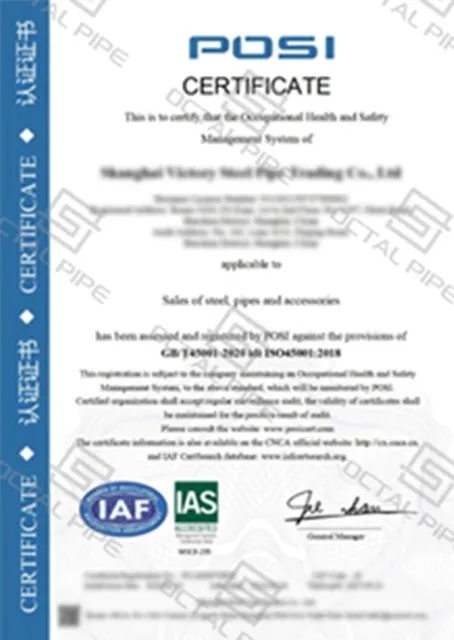
CE Certificate

ISO 9001 Certificate

API Q1 Certificate
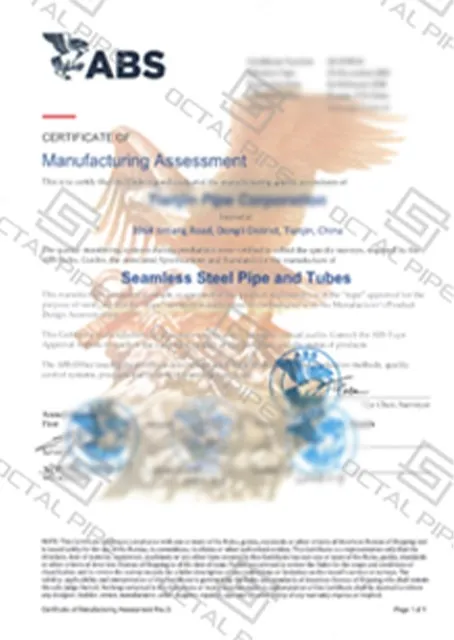
ABS Certificate
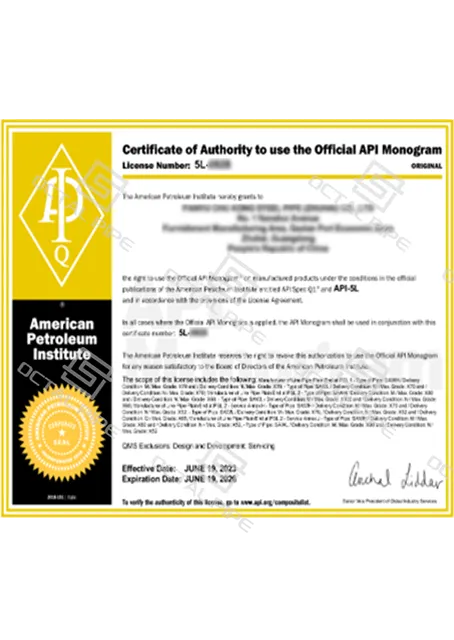
AP-5L Certificate
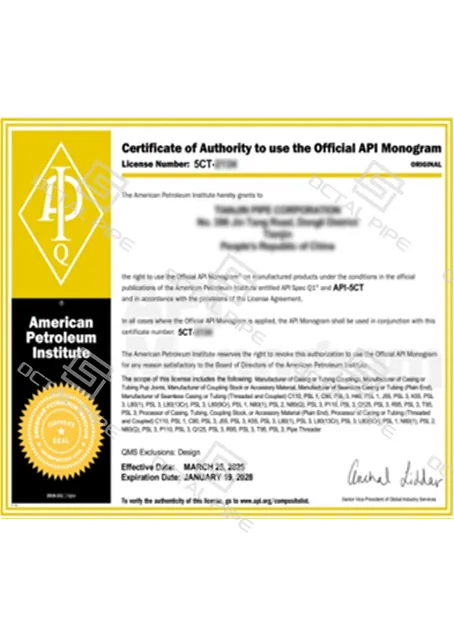
API-5CT Certificate