Product description
ASTM A213 Grade T11 is a seamless ferritic chromium-molybdenum (Cr-Mo) tube used in hot steam and flue-gas environments. The grade is formulated for pressure-bearing components in power boilers, HRSGs, petrochemical heaters and high-temperature heat exchangers where carbon steel can't hold oxidation resistance or creep strength.
Octal Pipe supplies T11 in normalized-and-tempered condition, with dimensional control, full testing to ASTM A213/A1016 and mill certificates, so it can go straight into boiler and process fabrication.

Chemical composition
| Element | Content (%) | Function |
|---|---|---|
| C | 0.05 – 0.15 | Provides strength and creep resistance, stays weldable |
| Mn | 0.30 – 0.60 | Ductility, hot workability |
| Si | 0.50 – 1.00 | Supports oxidation resistance |
| P | ≤ 0.025 | Limits embrittlement |
| S | ≤ 0.025 | Controlled for toughness |
| Cr | 1.00 – 1.50 | Scaling resistance in steam / flue gas |
| Mo | 0.44 – 0.65 | Creep and rupture strength |
This chromium–molybdenum balance is lower than T22 or other higher-Cr grades, which is why T11 bends and welds more easily, but still survives 500–600 °C service.
Mechanical properties
| Property | Requirement | Purpose |
|---|---|---|
| Tensile strength | ≥ 415 MPa (60 ksi) | Overall load capacity |
| Yield strength (0.2%) | ≥ 205 MPa (30 ksi) | Prevents permanent deformation |
| Elongation | ≥ 30% | Needed for bending, coiling, welding |
| Hardness | ≤ 163 HBW | Keeps toughness for thermal cycling |
These values match the normalized-and-tempered delivery condition that power and refinery projects usually specify.
Manufacturing and heat treatment
For boiler tube service the route matters as much as the chemistry. Octal Pipe uses a seamless route under ASTM A213/A1016:
- alloy billet is hot-pierced or extruded to form a sound hollow
- the tube is hot-rolled or cold-drawn to the ordered OD, wall and surface finish (important for heat-exchanger tubes)
- the tube is normalized at about 940–980 °C to refine the ferritic matrix, remove banding and equalize mechanical properties along the length
- the tube is tempered at about 675–755 °C to restore ductility and lock a fine dispersion of carbides in place
This N+T cycle is what gives T11 its stable microstructure: chromium can build a tight oxide film, molybdenum can do its job in creep strengthening, and the tube doesn't become too hard to weld. After heat treatment, tubes are straightened, hydrostatically tested, and examined by the NDE method ordered (eddy-current or ultrasonic) before marking and packing. Every step is recorded so the tube is traceable back to the heat.
Dimensional range
| Parameter | Range / details |
|---|---|
| Outside diameter | 12.7 – 127 mm (0.5 – 5 in) |
| Wall thickness | 1.2 – 12 mm |
| Length | Up to 12 m; SRL / DRL / cut-to-length |
| End finish | Plain, beveled, or prepared for U-bending / finning |
| OD tolerance | typically ± 1% (per ASTM A1016) |
| Wall tolerance | typically ± 10% |
| Straightness | typically ≤ 0.8 mm/m |
This covers common boiler panel tubes, superheater/reheater coils, and refinery heater coils.
Service performance
In operation T11 forms a uniform chromium-rich oxide, so tube metal loss and scale build-up are slower than with carbon steel. Molybdenum slows creep and rupture, which is important for tubes that sit under temperature and pressure for thousands of hours. Because the structure is tempered ferrite, the tube tolerates start–stop cycles in HRSGs and cogeneration plants without losing straightness too quickly. Welds retain integrity after PWHT when qualified low-alloy filler metals are used.
Applications
- boiler waterwall, superheater, reheater and economizer tubes in thermal power plants
- HRSG / combined-cycle steam generators
- petrochemical and refinery process heaters
- high-temperature shell-and-tube heat exchangers
- hot utility and process lines inside power and chemical units
Inspection and documentation
Testing is performed in accordance with ASTM A213 and the general A1016 requirements. That includes hydrostatic or eddy-current examination for wall soundness, tensile and hardness tests per heat-treatment lot, flattening/flaring to prove ductility, plus visual and dimensional inspection. For projects with higher QA/QC, Octal Pipe can add ultrasonic or radiographic checks. All tubes are supplied with EN 10204 3.1 or 3.2 MTCs so the owner can file chemical, mechanical and NDE results by heat number.
Why source ASTM A213 T11 from Octal Pipe
- real seamless Cr-Mo tubing in normalized-and-tempered condition, not just generic carbon-steel tube
- dimensions, tests and marking aligned with power, boiler, HRSG and refinery specifications
- export-ready bundles with end protection for long-distance shipment
- engineering support to match T11 with related Cr-Mo grades (T22, A335 P11/P22) when the same unit uses several alloys
- page structure written product-first and technically specific, to help your new site get indexed as a supplier page, not template content
FAQ

Q1: What is ASTM A213 T11 tubing used for?
Q2: What does "1.25Cr-0.5Mo" mean for T11 tubing?
Q3: Is ASME SA213 T11 the same as ASTM A213 T11?
Q4: When should I choose T11 instead of T22 tubing?
Certifications
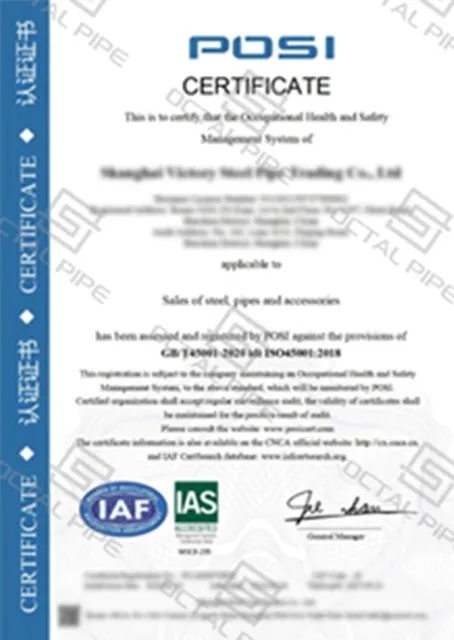
CE Certificate

ISO 9001 Certificate

API Q1 Certificate
ABS Certificate
AP-5L Certificate
API-5CT Certificate