Material Overview
ASTM A335 Grade P11 belongs to the low alloy Cr-Mo steel family (1–1.5% Cr, 0.5% Mo) engineered specifically for use in high-temperature and high-pressure steam systems.It represents a balance between mechanical strength, oxidation resistance, and fabrication flexibility-ideal for components such as superheater coils, pressure headers, and steam transfer lines . From a metallurgical standpoint, the ferritic–tempered microstructure of P11 features a fine dispersion of carbides (predominantly M₂₃C₆ and M₆C), which significantly enhances its creep-rupture life and dimensional stability.
Chromium promotes a dense oxide scale (Cr₂O₃) formation, protecting against scaling and oxidation up to 600 °C (1110 °F), while molybdenum strengthens the ferrite lattice and slows dislocation creep.
Together, these alloying elements provide:
- Long-term creep resistance under sustained load and temperature.
- Stable oxide formation ensuring surface protection and predictable corrosion behavior.
- Excellent weldability and low susceptibility to embrittlement after thermal cycling.
- Controlled carbon levels that maintain toughness and prevent grain coarsening.
Because of this metallurgical stability, ASTM A335 P11 remains one of the most commonly specified materials for boiler tubes, superheaters, and process piping in power generation and refinery service.
Chemical and Mechanical Properties
| Element | % Range | Primary Function |
|---|---|---|
| Carbon (C) | 0.05 – 0.15 | Increases strength and creep resistance |
| Manganese (Mn) | 0.30 – 0.60 | Improves hot workability and ductility |
| Silicon (Si) | 0.50 – 1.00 | Enhances oxidation resistance |
| Phosphorus (P) | ≤ 0.025 | Controls brittleness |
| Sulfur (S) | ≤ 0.025 | Aids machinability |
| Chromium (Cr) | 1.00 – 1.50 | Forms protective oxide film |
| Molybdenum (Mo) | 0.44 – 0.65 | Improves high-temperature strength |
Mechanical Requirements
Tensile ≥ 415 MPa • Yield ≥ 205 MPa • Elongation ≥ 30 % • Hardness ≤ 163 HBW
Manufacturing & Heat Treatment
ASTM A335 P11 pipes are produced by seamless hot extrusion or cold drawing, ensuring homogeneous microstructure and precise dimensional control.
Each step of the manufacturing process is closely monitored to maintain metallurgical consistency and minimize internal defects.
Production & Processing Sequence
Billet Heating & Piercing – Alloy billets are heated to 1100–1150 °C and pierced using rotary methods to form a hollow shell with uniform grain flow.
Hot or Cold Finishing – Pipes are rolled or drawn to final wall thickness, followed by air cooling or intermediate normalizing.
Normalization (940–980 °C) – Refines the ferritic grains, dissolves segregated carbides, and improves strength uniformity.
Tempering (675–755 °C) – Relieves internal stresses, restores ductility, and stabilizes carbide morphology for creep resistance.
Inspection & Testing – Includes ultrasonic or eddy-current NDT, hydrostatic pressure tests, hardness verification, and dimensional measurement.
This double-stage heat treatment produces a fine-grained ferrite-carbide matrix that resists embrittlement and maintains mechanical strength during long-term service.
For welded systems, post-weld heat treatment (PWHT) ensures microstructural restoration and hydrogen stress relief, critical for safe high-temperature operation.
Dimensional Range
| Parameter | Typical Range |
|---|---|
| Outside Diameter | 12.7 – 610 mm (½ – 24 in) |
| Wall Thickness | 1.2 – 100 mm |
| Length | Up to 12 m (SRL / DRL / cut length) |
| OD Tolerance | ± 1 % |
| WT Tolerance | ± 10 % |
| Straightness | ≤ 0.8 mm / m |
Available in plain, beveled, or threaded ends according to installation requirements.
High-Temperature Performance & Applications
At operating temperatures approaching 600 °C, ASTM A335 P11 demonstrates a unique balance between oxidation resistance, thermal stability, and mechanical retention.
The formation of a continuous chromium-rich oxide layer minimizes scaling and metal loss during prolonged exposure, while molybdenum contributes to creep strength retention and resistance to microvoid coalescence.
This alloy performs exceptionally well in environments subject to thermal cycling, steam oxidation, and pressure fluctuations, maintaining both toughness and weld integrity.
Performance Advantages
- Creep Strength Retention: Reliable tensile and rupture resistance over thousands of service hours.
- Thermal Fatigue Resistance: Fine-grained microstructure reduces cracking from expansion-contraction cycles.
- Low Thermal Expansion: Dimensional stability preserves weld alignment in complex piping systems.
- Surface Protection: Stable oxide film ensures minimal corrosion and extended inspection intervals.
Applications
- Power Generation: Boiler tubes, superheater coils, reheater headers.
- Refineries & Petrochemical Plants: Process and transfer piping, reformer tubes.
- Industrial Process Lines: Steam manifolds and high-pressure feedwater systems.
- Pressure Vessels: For long-term service under temperature and stress cycling.
Inspection, Certification & Supply
All P11 pipes are tested and certified according to ASTM A335 / A999 and ASME SA335 standards.
Each delivery is accompanied by Mill Test Certificates (EN 10204 3.1 / 3.2), ensuring complete traceability and compliance.
Testing protocols include:
- Ultrasonic or hydrostatic inspection for wall soundness.
- Tensile, hardness, flattening, and bending verification.
- Optional radiography or impact testing as per project specification.
Octal Pipe provides comprehensive QA/QC support, documentation for welding procedure qualification (WPS/PQR), and international logistics to ensure reliable delivery for EPC and energy projects worldwide.
FAQ

Q1: What is ASTM A335 P22 (ASME SA335 P22) pipe used for?
Q2: What does "2.25Cr-1Mo" mean for P22 chrome moly pipe?
Q3: What heat treatment is typically required for ASTM A335 P22 seamless pipe?
Q4: When should I choose P22 instead of P11 or P91?
Q5: What should I request to verify P22 pipe quality before purchase?
A5: EN 10204 3.1/3.2 MTC with heat traceability, mechanical/chemistry results, hardness, and hydrostatic or UT testing as specified.
Certifications
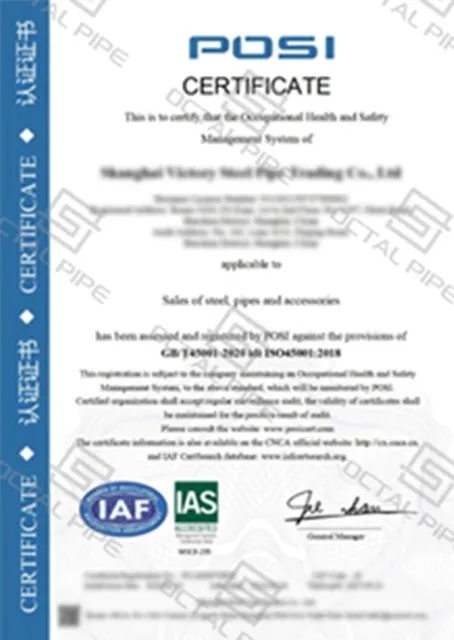
CE Certificate

ISO 9001 Certificate

API Q1 Certificate
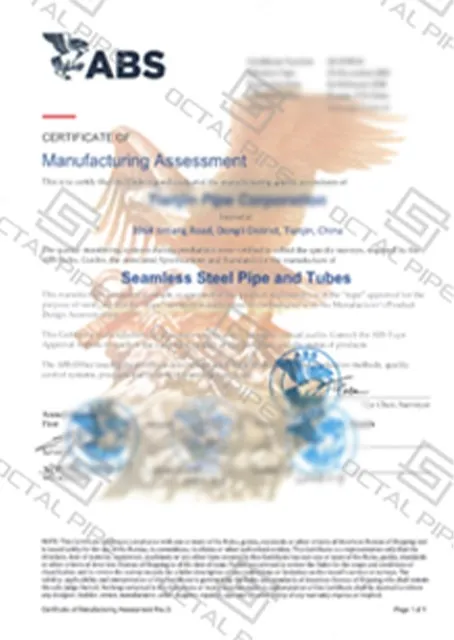
ABS Certificate
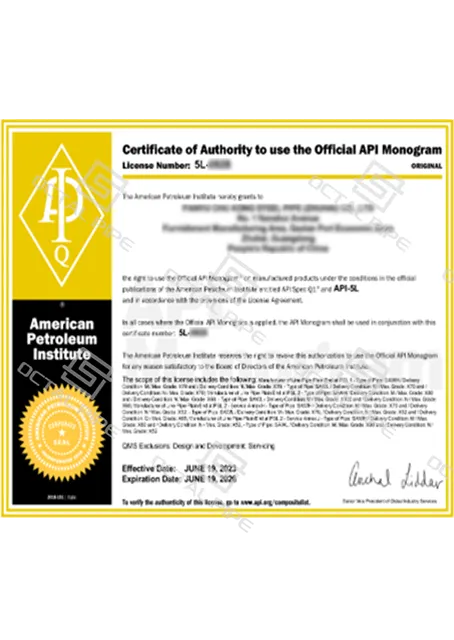
AP-5L Certificate
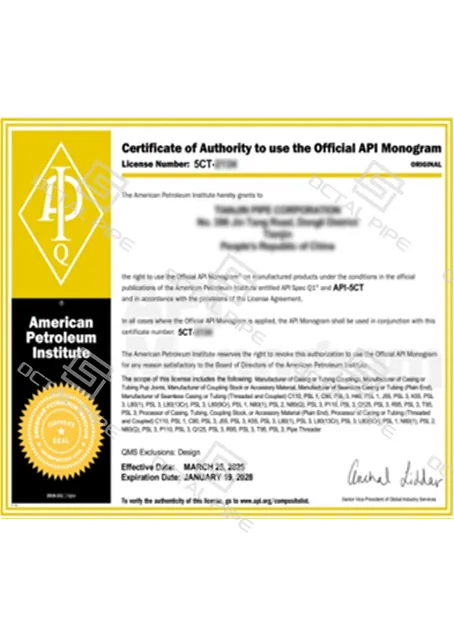
API-5CT Certificate