Engineering Background
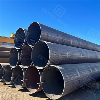
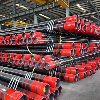
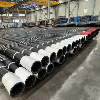
Among all Cr-Mo alloy steels, ASTM A335 Grade P22 represents one of the most versatile solutions for high-pressure and high-temperature pipelines.
It combines 2.25% chromium and 1% molybdenum, forming an alloy matrix capable of resisting creep, oxidation, and carburization during prolonged exposure at temperatures up to 620 °C (1150 °F).
This material has long been the workhorse of power generation, refinery, and petrochemical piping systems, bridging the performance gap between lower grades like P11 and advanced ferritic-martensitic alloys such as P91.
Its balance of mechanical reliability, fabricability, and long-term stability makes it ideal for steam headers, reheater tubes, and high-temperature transfer lines.
Alloy Design and Metallurgical Fundamentals
Grade P22 belongs to the ferritic–tempered class of steels. Its performance derives from a precisely engineered microstructure composed of tempered ferrite and stable chromium–molybdenum carbides (M₂₃C₆, M₆C).
| Alloy Element | Content (%) | Role in Performance |
|---|---|---|
| Cr (Chromium) | 1.90 – 2.60 | Forms a protective oxide layer and improves scaling resistance |
| Mo (Molybdenum) | 0.87 – 1.13 | Provides solid-solution strengthening and creep resistance |
| C (Carbon) | 0.05 – 0.15 | Controls hardness and ductility balance |
| Mn (Manganese) | 0.30 – 0.60 | Improves weldability and toughness |
| Si (Silicon) | 0.50 – 1.00 | Enhances oxidation and corrosion resistance |
| P / S | ≤ 0.025 | Maintains ductility and prevents grain boundary brittleness |
This metallurgical configuration ensures:
- Stable ferrite-carbide microstructure resistant to coarsening under thermal load.
- Creep-rupture stability over 100,000 service hours at 540–600 °C.
- Excellent weld integrity when post-weld heat-treated (PWHT).
- Controlled oxidation scaling, reducing tube surface roughness and metal wastage.
Mechanical Integrity and Temperature Resistance
| Property | Requirement | Engineering Purpose |
|---|---|---|
| Tensile Strength | ≥ 415 MPa (60 ksi) | Withstands long-term axial stress |
| Yield Strength | ≥ 205 MPa (30 ksi) | Prevents plastic deformation |
| Elongation | ≥ 30 % | Provides fabrication ductility |
| Hardness | ≤ 163 HBW | Ensures weld toughness and fatigue resistance |
At elevated temperatures, P22 maintains a creep-rupture strength above 60 MPa at 600 °C, retaining its shape and integrity even under cyclic pressure and vibration.
Manufacturing Technology and Heat Treatment
Unlike lower carbon steels, P22 requires precise thermal–mechanical control throughout manufacturing.
Octal Pipe employs advanced seamless forming techniques combined with multi-stage heat treatment to ensure metallurgical uniformity and dimensional precision.
Manufacturing Route:
- Billet Piercing & Hot Forming – Cr-Mo billets are pierced at 1100–1150 °C using rotary extrusion.
- Cold Drawing / Hot Rolling – Refines grain size and wall uniformity.
- Normalization (940–980 °C) – Refines ferritic grains and dissolves segregated carbides.
- Tempering (675–760 °C) – Relieves internal stresses, restores ductility, and stabilizes carbides.
- Hydrostatic / Ultrasonic Testing – Validates pressure capacity and structural soundness.
The dual-stage heat treatment (normalize + temper) is critical. It yields a fine-grained, tempered ferrite matrix that resists embrittlement, sustains weld ductility, and provides predictable creep performance over decades of service.
Dimensional Scope
| Parameter | Range |
|---|---|
| Outer Diameter | ½″ – 24″ (12.7 – 610 mm) |
| Wall Thickness | 1.2 – 100 mm |
| Length | Up to 12 m (SRL/DRL/custom) |
| Straightness | ≤ 0.8 mm / m |
| End Type | Beveled / Plain / Threaded |
Custom fabrication such as U-bends, spools, and header assemblies are available upon request for thermal power and refinery systems.
Performance Under Elevated Temperature
At working conditions above 550 °C, P22 forms a dense Cr₂O₃ oxide layer that adheres to the base metal, preventing spallation and metal loss.
This film acts as a self-healing barrier, maintaining heat transfer efficiency and surface smoothness throughout prolonged exposure.
Key performance characteristics:
- High Creep Strength: Stable under continuous load and pressure cycling.
- Thermal Fatigue Resistance: Fine-grained matrix prevents cracking under expansion cycles.
- Dimensional Stability: Low thermal expansion ensures consistent weld alignment.
- Weld Performance: PWHT restores ductility and eliminates residual stress.
- Oxidation Resistance: Reliable protection up to 620 °C, extending inspection intervals.
Industrial Implementation
ASTM A335 P22 alloy pipe is widely deployed in power generation, petrochemical, and refining sectors, particularly in superheater, reheater, and high-pressure feedwater circuits.
Representative Applications:
- Boiler & Reheater Tubing for subcritical and supercritical units.
- Process Steam Headers and economizers in power plants.
- Refinery and Petrochemical Furnaces where carburizing and oxidizing gases coexist.
- Heat Exchanger Shells and reformer manifolds requiring long-term metallurgical stability.
Its service record in energy infrastructure confirms its suitability for continuous operation and minimal downtime, making P22 a key material in global high-efficiency plants.
Testing & Quality Assurance
All products conform to ASTM A335 / A999 and ASME SA335 standards, verified through:
- Hydrostatic or ultrasonic testing
- Flattening and flaring tests
- Mechanical property validation (tensile, hardness)
- Dimensional and visual inspection
- Optional impact and radiographic testing
Every batch is delivered with EN 10204 3.1/3.2 certification, full traceability, and mill test records.
Engineering Reliability with Octal Pipe
Octal Pipe supplies ASTM A335 P22 pipes in normalized and tempered condition, ensuring predictable high-temperature performance and weld compatibility.
With ISO-certified manufacturing, QA/QC integration, and project-level documentation, Octal Pipe delivers dependable alloy pipe systems for thermal, refinery, and process industries worldwide.
FAQ

Q1: What is ASTM A335 P22 (ASME SA335 P22) pipe used for?
Q2: What is the typical alloy system for P22 pipe?
Q3: What heat treatment is commonly required for P22 pipe?
Q4: When should I choose P22 instead of P11 or P91?
Q5: What should I request to verify P22 pipe quality before purchase?
Certifications
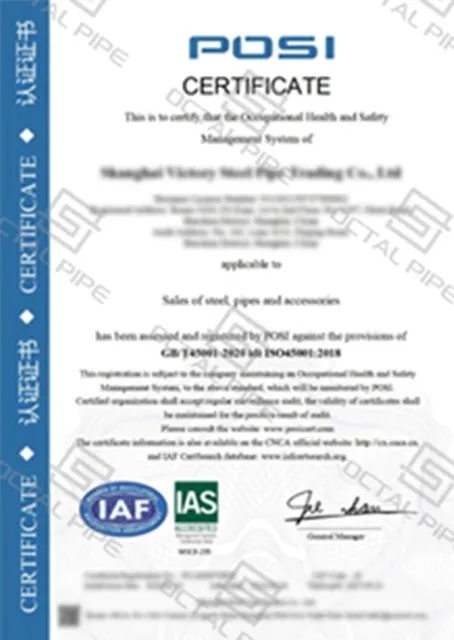
CE Certificate

ISO 9001 Certificate

API Q1 Certificate
ABS Certificate
AP-5L Certificate
API-5CT Certificate