Introduction: Advanced Alloy for Harsh Chemical Environments
Incoloy 825, also known as Nickel Alloy 825 or UNS N08825, is a high-performance nickel–iron–chromium alloy enhanced with molybdenum, copper, and titanium.
It is specifically designed to perform under acidic, chloride, and high-temperature corrosive conditions, making it one of the most versatile materials in chemical, petrochemical, and marine process systems.
The alloy exhibits a rare combination of properties:
- Excellent resistance to reducing and oxidizing acids (including sulfuric and phosphoric acid).
- High stability against pitting, crevice corrosion, and stress-corrosion cracking.
- Exceptional performance after welding or prolonged exposure at elevated temperatures.
Its reliability has made Alloy 825 a preferred material for heat exchangers, condensers, evaporators, and offshore piping, where corrosion and mechanical fatigue coexist.


Chemical Composition and Structural Stability
The performance of Alloy 825 originates from its carefully balanced composition:
| Element | Content (%) | Metallurgical Role |
|---|---|---|
| Nickel (Ni) | 38.0 – 46.0 | Corrosion resistance, structural stability |
| Chromium (Cr) | 19.5 – 23.5 | Oxidation resistance, passive film formation |
| Iron (Fe) | Balance | Structural matrix for toughness |
| Molybdenum (Mo) | 2.5 – 3.5 | Resistance to reducing media and pitting |
| Copper (Cu) | 1.5 – 3.0 | Improves resistance to sulfuric and phosphoric acids |
| Titanium (Ti) | 0.6 – 1.2 | Stabilizes against intergranular corrosion |
| Mn, Si, C, S | ≤ 1.0 / 0.5 / 0.05 / 0.03 | Maintain cleanliness and workability |
The titanium stabilization ensures resistance to sensitization and intergranular attack after welding or exposure to 540–870 °C service environments.
Manufacturing Process and Heat Treatment
Incoloy 825 pipes and tubes are manufactured through precision-controlled melting, forming, and solution annealing to guarantee uniform microstructure and superior corrosion behavior.
Production Process Overview
- Vacuum or Argon Melting – Removes impurities and prevents segregation during alloying.
- Hot Extrusion / Cold Drawing – Ensures tight dimensional control and concentricity.
- Automatic Orbital Welding (for welded types) – Produces fine, fully penetrated seams.
- Solution Annealing (940–980 °C) – Dissolves carbides and restores ductility.
- Rapid Air or Water Quenching – Prevents re-precipitation and residual stress.
- Pickling and Passivation – Restores the chromium-rich oxide film on the surface.
- Final NDT and Hydro Testing – Confirms internal integrity and weld soundness.
Each production batch conforms to ASTM B423 / B705 / ASME SB423 and undergoes ultrasonic, eddy current, and hydrostatic testing as per ASTM B829.
The resulting microstructure is a uniform austenitic matrix with fine dispersion of carbides and intermetallic phases, offering superior stability in acidic service.
Corrosion Resistance and Service Behavior
Alloy 825 is engineered to resist a wide spectrum of industrial corrosive environments:
| Environment | Corrosion Resistance Behavior |
|---|---|
| Sulfuric, Phosphoric, Nitric Acids | Exceptional performance under both oxidizing and reducing conditions |
| Seawater and Chloride Solutions | Strong resistance to pitting, crevice, and stress-corrosion cracking |
| Sour Gas / H₂S | Nickel and molybdenum inhibit sulfide stress cracking |
| Mixed Acid Environments | Copper and molybdenum enhance resistance to reducing acids |
| Post-Weld Exposure | Titanium prevents intergranular attack after welding cycles |
The alloy forms a self-healing oxide layer, ensuring long-term protection even after mechanical abrasion or cyclic exposure.
This makes Alloy 825 ideal for acid-handling units, seawater cooling lines, pollution control systems, and chemical reactors.
Mechanical and Dimensional Performance
| Property | Metric | Imperial | Description |
|---|---|---|---|
| Tensile Strength | ≥ 550 MPa | ≥ 80 ksi | Sustains high internal pressure |
| Yield Strength (0.2%) | ≥ 220 MPa | ≥ 32 ksi | Maintains shape under stress |
| Elongation | ≥ 30 % | ≥ 30 % | Ensures ductility and forming capability |
| Hardness | ≤ 90 HRB | ≤ 90 HRB | Retains machinability and toughness |
Dimensional Range
- Seamless Pipes: 6 – 610 mm OD, 1 – 50 mm WT
- Welded Pipes: 25 – 1200 mm OD, 1.5 – 60 mm WT
- Tubes (Instrumentation / Heat Exchanger): 6 – 76 mm OD, 0.8 – 10 mm WT
- Length: Up to 12 m, in SRL / DRL / custom sizes
Testing, Certification, and Quality Control
Each pipe and tube undergoes a comprehensive QA program before shipment:
- Hydrostatic / Eddy Current Test (ASTM B829)
- Visual and Dimensional Inspection
- PMI (Positive Material Identification)
- Intergranular Corrosion Test (ASTM G28 Method A)
- Optional Third-Party Inspection (SGS, TUV, BV)
All products are supplied with EN 10204 3.1 / 3.2 MTC, full traceability, and ISO 9001 quality documentation.
Industrial Applications
The versatility of Alloy 825 enables its use in diverse industrial sectors:
- Chemical and Fertilizer Plants – Acid evaporation, reaction towers, scrubbers
- Oil & Gas Offshore Systems – Seawater cooling, produced-water injection
- Heat Exchangers and Condensers – High corrosion zones in refineries and power plants
- Pollution Control Systems – Flue gas desulfurization, acid recovery units
- Marine Engineering – Cooling loops and desalination pipelines
Its combination of corrosion endurance, weldability, and thermal stability ensures reliable service in highly corrosive or mixed chemical atmospheres.
Supply Reliability and Project Support
Octal Pipe provides Incoloy 825 / Nickel Alloy 825 / UNS N08825 pipes and tubes through certified manufacturing routes, full documentation, and international project compliance.
Each heat batch is traceable, tested, and delivered with inspection dossiers suitable for EPC projects and refinery qualification packages.
With long-term partnerships and logistics experience, Octal Pipe ensures consistent delivery and technical support for chemical, marine, and high-temperature applications worldwide.
FAQ

Q1: Which standard should I specify for seamless Incoloy 825 (UNS N08825) pipe and tube?
Q2: Which standard is commonly used for welded UNS N08825 pipe?
Q3: What environments is Incoloy 825 best suited for?
Q4: What heat-treatment condition is typically required for Incoloy 825 pipe/tube?
Certifications
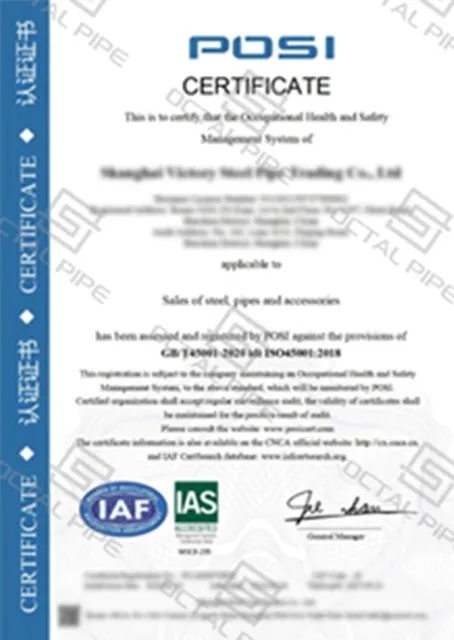
CE Certificate

ISO 9001 Certificate

API Q1 Certificate
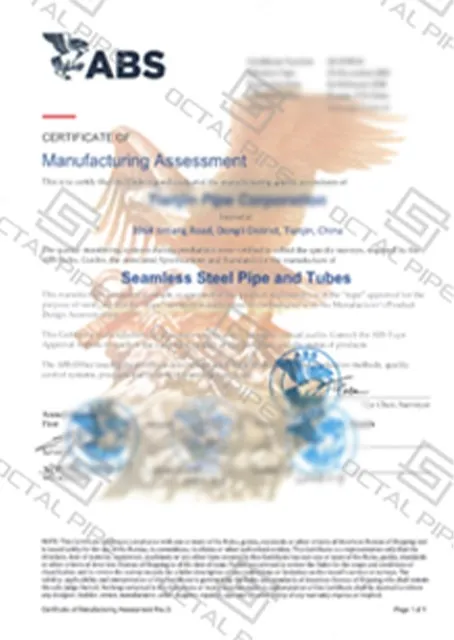
ABS Certificate
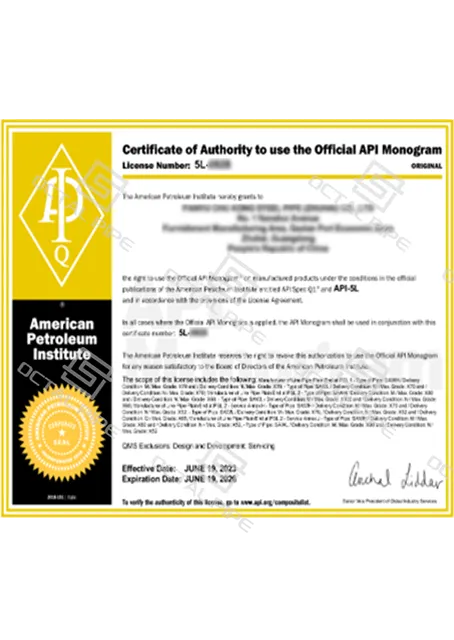
AP-5L Certificate
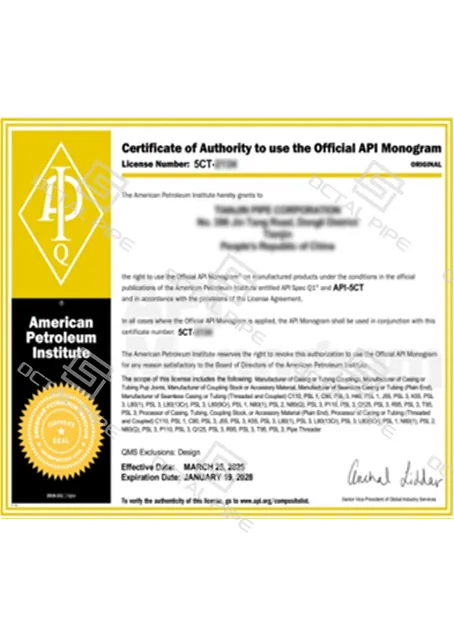
API-5CT Certificate