Scope and the Situations Where A312 Fits
ASTM A312 covers seamless, welded, and heavily cold-worked austenitic stainless steel pipe for corrosive and elevated-temperature service across chemical processing, refining, desalination, and balance-of-plant utilities; heat-exchanger/boiler tubing instead falls under A213/A269, sanitary lines under A270, and dimensions typically follow ASME B36.19M (Sch 5S/10S/40S/80S); in chloride-bearing or oxygenated media, seawater-adjacent cooling circuits, and retrofit projects prioritizing cleanliness and uptime, A312's grade options and surface finishes are especially advantageous.
Grades You Actually Procure
Most purchase orders concentrate on a small family of grades. Dual-marking such as 304/304L or 316/316L simplifies welding near the HAZ while preserving strength targets in the same stock line.
Table 1 - Common A312 grades and typical use
|
Grade (TP) |
Why it's chosen |
Representative applications |
|
304 / 304L / 304H |
Broad chemical compatibility at competitive cost |
General process, utility steam/water |
|
316 / 316L / 316H |
Mo-bearing; superior pitting/crevice resistance |
Seawater proximity, chloride-bearing systems |
|
321 / 321H |
Ti-stabilized to control sensitization at high temp |
Hot service with welding and thermal cycling |
|
347 / 347H |
Nb-stabilized; wider stabilization window |
Furnace/boiler piping where cycling is expected |
|
310S / 309S* |
Elevated Cr/Ni; oxidation/scale resistance |
Oxidizing hot gas, ducting, expansion joints |
|
904L* |
High Ni/Mo/Cu for aggressive chloride/acid service |
Harsh chloride or mixed-acid duty |
* Availability and economics vary by region and mill route.

Chemistry and Baseline Properties
Use these figures for early screening; final requirements must follow the latest ASTM/ASME editions and purchaser specifications.
Table 2 - Indicative chemistry (wt.%)
|
Grade |
C (max / H range) |
Cr |
Ni |
Mo |
Stabilizer (typ.) |
|
304(L/H) |
0.03 / 0.04–0.10 |
18–20 |
8–11 |
- |
- |
|
316(L/H) |
0.03 / 0.04–0.10 |
16–18 |
10–14 |
2.0–3.0 |
- |
|
321(H) |
0.08 / 0.04–0.10 |
17–19 |
9–13 |
- |
Ti ≈ 5×C to ≤0.7% |
|
347(H) |
0.08 / 0.04–0.10 |
17–19 |
9–13 |
- |
Nb+Ta ≈ 10×C–1.0% |
Table 3 - Typical minimum room-temperature tensile
|
Family / grade |
Tensile min |
Yield min |
Elongation min |
|
304/304L/316L |
≈ 515 MPa |
≈ 205 MPa |
≈ 35% |
|
321/347 (incl. H) |
≈ 515 MPa |
≈ 205 MPa |
≈ 30–35% |
|
310S/309S |
≈ 515 MPa |
≈ 205 MPa |
≈ 30% |
Design calculations depend on allowable stresses vs. temperature from applicable codes rather than room-temperature numbers alone.
Dimensions, Schedules, and End Prep - What Affects Fabrication
Pipe sizes usually follow ASME B36.19M. Selecting 5S/10S/40S/80S schedules should balance pressure, corrosion allowance, and welding access. For construction efficiency, many projects choose cut-to-length pieces to reduce field welds. End preparation aligns with the joint: plain or square-cut for orbital and socket work, beveled for butt welds. When orbital welding or critical leak testing is planned, tighter OD and wall tolerances help reduce fit-up scatter. Surface options include pickled/passivated or bright-annealed (BA); projects with strict cleanliness or low roughness on the ID should specify both finish and acceptance metrics.
Seamless and Welded Under A312 - How Teams Decide in Practice
Both routes belong to A312 and can behave equivalently in service when heat treatment and NDE are specified correctly. Welded (ERW/EFW) offers capacity and cost efficiency in larger NPS and long runs, provided seams are fully solution-annealed and passivated. Seamless is often preferred where pressure transients, tight bends, or complex spools demand extra robustness. The datasheet should define which route is acceptable and what verification proves equivalence for the intended duty.


Fabrication, Heat Treatment, and Surface Integrity
Successful A312 systems start in the shop rather than in service. Austenitic stainless pipe should leave production in a fully solution-annealed and rapidly cooled condition so chromium carbides are redissolved and a uniform austenitic matrix is restored. Where welded pipe is used, seams are brought to the same solution-annealed state; partial or local anneals are discouraged because they leave mixed microstructures and uneven corrosion response.
Surface integrity is managed as a sequence: fabrication, cleaning, passivation, and verification. Heat tint, embedded iron, and chloride residues are the three most common triggers of premature corrosion. If any discoloration remains after welding, remove it mechanically and then restore the passive film by chemical treatment as defined in the project specification (many owners reference industry practices such as ASTM A380/A967). For services that demand a very smooth ID or low rouging tendency, bright-annealed (BA) product may be specified together with acceptance criteria for ID finish and cleanliness.
Weld-adjacent performance often depends more on procedure discipline than on grade selection. Using L-grades or stabilized grades near welds helps resist sensitization; high-quality inert gas purging on the ID minimizes heat tint and oxide scale; and thorough post-weld cleaning prevents crevice sites. Tooling and media must be stainless-only-carbon-steel brushes, shot, or grinding dust can embed free iron that later rusts and undermines the passive film.
Cleanliness and preservation close the loop. Define how the ID is rinsed, dried, and protected, how end caps are fitted, and how bundles are wrapped to control chloride pickup and particulate ingress during storage and shipment. A practical evidence set for handover includes heat-treatment charts, passivation records, ID cleanliness results, and if specified, roughness or ferrous-contamination checks. When these controls are written into the datasheet and executed consistently, welded and seamless A312 lines behave equivalently in the field and keep their corrosion resistance over the long term.
Test and Inspection Plan
Rather than a checklist of bullets, think in terms of evidence. One item demonstrates pressure integrity (hydrostatic or nondestructive electric test per A312). Another confirms wall and ID continuity (eddy-current or UT over 100% length for critical systems). Where sensitization is a risk, an intergranular corrosion method (ASTM A262) is added. PMI verifies alloy identity on bundles. The documentation set provides MTC traceability from heat to bundle, with acceptance criteria and reporting formats agreed in the ITP. When the owner requires it, third-party witnessing (e.g., BV, SGS) can be arranged.
Ordering Information - Fields to Populate on the Datasheet
Table 4 - Datasheet fields and typical entries
|
Field |
Typical entry |
|
Grade / dual grade |
304/304L, 316/316L, 321/321H, 347/347H; H-grade where higher hot strength is needed |
|
Size and schedule |
NPS, schedule (5S/10S/40S/80S), measured wall if required |
|
Length and ends |
Cut-to-length or random; end prep (plain/square-cut/beveled) |
|
Manufacturing route |
Seamless and/or welded acceptable; equivalency criteria and NDE coverage |
|
Heat treatment & surface |
Solution anneal; pickled/passivated or BA; ID cleanliness criteria |
|
NDE and acceptance |
Hydrostatic or electric test; EC/UT coverage; acceptance and reporting |
|
Packaging & cleanliness |
End caps, dryness, chloride limits, ID protection |
|
Documentation & traceability |
MTC (EN 10204) details, PMI scope, marking/barcoding |
|
Third-party involvement |
Witnessing/inspection scope when specified by owner |
Project Support
For projects built around ASTM A312 stainless steel, Octal Pipe supplies 304/304L, 316/316L, 321/321H, 347/347H and selected special grades with solution-annealed finishes, pickling/passivation, cut-to-length service and documentation aligned to project ITPs. Independent third-party inspection can be arranged on request.
FAQ
Q1: What is ASTM A312 (ASME SA312) stainless steel pipe used for?
A1: It's austenitic stainless steel pipe for high-temperature and general corrosive service piping.
Q2: How do I choose between TP304/304L and TP316/316L for ASTM A312 pipe?
A2: Choose 304/304L for general corrosion; choose 316/316L for better pitting/crevice resistance in chlorides.
Q3: What should I request to verify ASTM A312 pipe quality before purchase?
A3: Ask for MTC/traceability, hydrotest or NDE test results, PMI, and any specified corrosion testing (e.g., ASTM A262) plus dimensional/finish checks.
Certifications
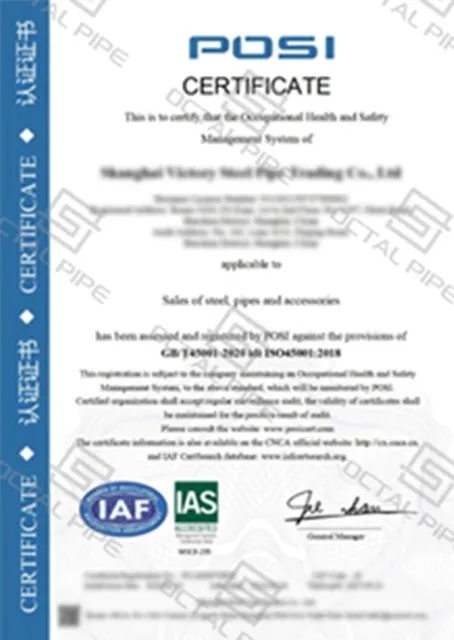
CE Certificate

ISO 9001 Certificate

API Q1 Certificate
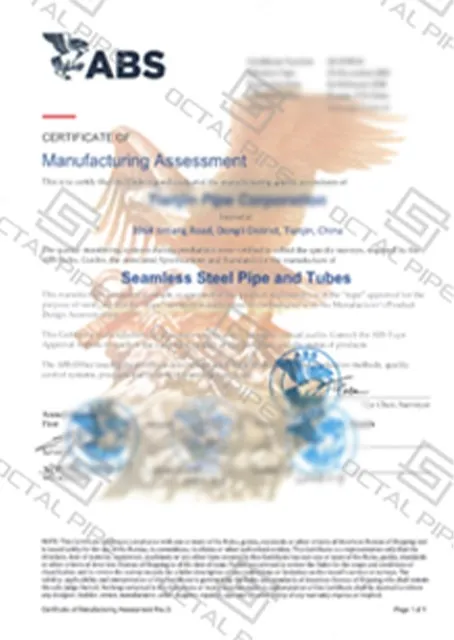
ABS Certificate
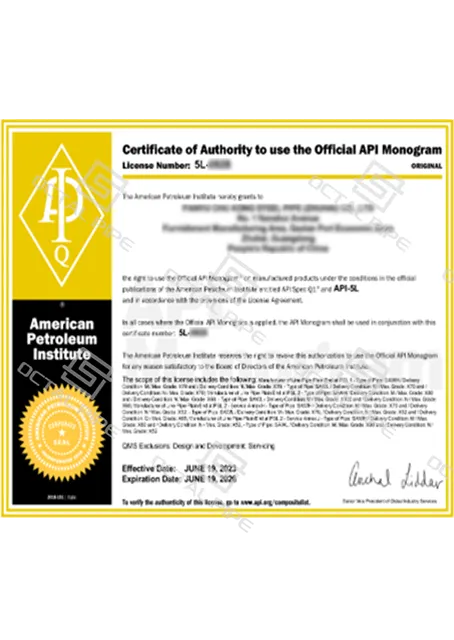
AP-5L Certificate
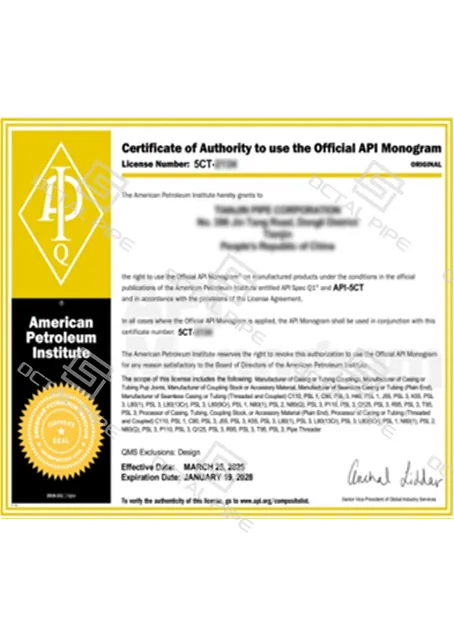
API-5CT Certificate