Operating Window and Typical Duties
ASTM A213 T5 is used where tube-metal temperature and oxidation control dominate the design brief. In boilers, HRSGs and fired heaters, T5 occupies the band above 1.25–2.25Cr alloys when scale resistance and creep strength must be improved without moving to the 9Cr family. Service hours are long, temperature gradients are real, and coil integrity matters more than aqueous corrosion.
Metallurgy in One Page
T5 is a 5Cr–Mo ferritic steel. Chromium builds a slow-growing oxide to limit scale spallation, while molybdenum stabilizes carbides and delays creep deformation. The manufacturing route aims to deliver a uniform ferritic matrix that survives bending and operation without local over-hard or over-soft regions.
Chemistry Snapshot
The composition targets below are for early screening; purchasing follows the governing standard text.
Table - Chemical composition (wt.%)
|
Element |
T5 Range |
Role in service |
|
C |
≤ 0.15 |
Strength–ductility balance, creep support |
|
Mn |
0.30–0.60 |
Deoxidation, solid-solution strengthening |
|
Si |
≤ 0.50 |
Deoxidation; excess can harm toughness |
|
P |
≤ 0.025 |
Weldability and toughness control |
|
S |
≤ 0.025 |
Hot-workability improvement at low S |
|
Cr |
4.00–6.00 |
Oxidation and hot-strength contribution |
|
Mo |
0.44–0.65 |
Creep resistance and carbide stability |
Property Benchmarks at Room Temperature
These minima help early sizing; high-temperature allowables are taken from the applicable code during design.
Table - Minimum mechanical properties
|
Property |
T5 Minimum |
|
Tensile strength |
≈ 415 MPa (60 ksi) |
|
Yield strength |
≈ 205 MPa (30 ksi) |
|
Elongation |
≈ 20% |
Dimensional Program for Coils and Bundles
ASTM A213 governs tubing rather than pipe schedules. Datasheets define OD, wall and cut lengths to suit coil shops and tube-to-tubesheet work.
Table - Typical dimensional window
|
Parameter |
Typical range |
Notes |
|
Outside diameter |
~12.7–101.6 mm (½–4 in) |
Larger OD by mill route |
|
Wall thickness |
~1.2–12.7 mm |
Heavy walls by enquiry |
|
Length |
Up to ~12 m |
Longer pieces reduce field welds |
|
Geometrics |
Tight straightness/ovality |
Supports bundle fit and leakage control |
Forming Windows and Heat-Treatment Discipline
Thermal history governs the service life of T5 tubing, so the WPS/PQR should lock in a qualified temperature band for heating, soak time, and cooling rate. Bends are produced by induction or controlled hot forming with uniform temperature through the wall; excessive interpass heat or prolonged holds coarsen grains and reduce creep capability.
After bending, properties are verified rather than assumed. A hardness map from parent metal across extrados, mid-wall, and intrados confirms that the bend remained inside the qualified window. Dimensional checks-ovality, wall thinning, springback, and centerline radius-ensure the coil or U-bend will seat into tube-sheets and supports without overstress.
Cold straightening and local corrections stay conservative. Accumulated cold strain is tracked, and once it exceeds the project trigger the tube is re-heated within the qualified envelope to recover ductility and stabilize carbides. Uncontrolled torch heating is avoided because it can create spot over-tempering or hard rims.
Heat treatment is planned as a system, not a patch. Material is supplied in the normalized-and-tempered condition; when forming temperatures exceed the prior temper-or when procedures require-perform a full re-normalize-and-temper (or an agreed subcritical cycle) to restore a uniform ferritic matrix before hydrotest and NDE. Recorded temperature charts for each cycle are filed in the turnover package so the installed coil can be traced to its actual thermal history.

Surface Integrity and Cleanliness
Scale residues and embedded debris shorten life and reduce heat-transfer efficiency. A clean, dry ID with capped ends and protected bundles limits particulate ingress during storage and shipment. Acceptance criteria for ID/OD appearance and cleanliness are written into the ITP when fouling control is critical.
Inspection and NDE Matrix
Each tube is verified by either a hydrostatic test or a nondestructive electric test as required by ASTM A213. Critical coils add full-length eddy-current or ultrasonic continuity checks. Flattening, flare and flange exercises demonstrate ductility for installation. Positive material identification (PMI) by bundle closes the alloy-identity loop.
Table - Typical verification plan
|
Topic |
Typical requirement |
|
Pressure integrity |
Hydrostatic or electric NDE |
|
Continuity |
100% EC/UT for critical service |
|
Workability |
Flattening / flare / flange tests |
|
Identity & traceability |
PMI, heat/lot on MTC, bundle ID |
Handover Package and Supplier Note
A clean turnover includes MTCs tied to heats and bundles, heat-treatment charts, NDE records and PMI results in the agreed format. For projects built around ASTM A213 T5, Octal Pipe supplies seamless tubing with qualified bending/heat-treatment procedures and can arrange independent witnessing on request so quality evidence drops neatly into the owner's QA/QC system.
FAQ
Q1: What is ASTM A213 T5 (ASME SA213 T5) tubing used for?
A1: Seamless 5Cr-0.5Mo ferritic alloy tubing for boilers, superheaters, and heat exchangers in high-temperature service where oxidation and creep performance matter.
Q2: When should I choose A213 T5 instead of T11/T22/T9?
A2: Choose T5 when you need stronger high-temperature oxidation resistance than lower-Cr grades; step up to higher-Cr options when the duty demands higher temperature/corrosion margin per the design code.
Q3: What should I request to verify ASTM A213 T5 tubing quality before purchase?
A3: Ask for 3.1 MTC with heat number, heat-treatment condition, chemistry/mechanical results, required NDE (hydrotest or electric test as specified), dimensional checks, and full traceability/marking.
Certifications
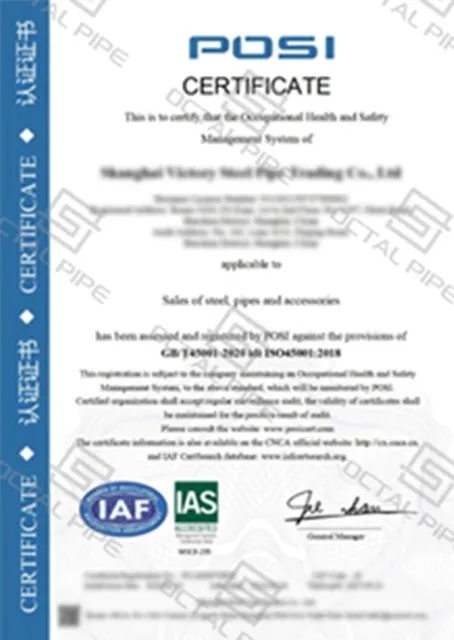
CE Certificate

ISO 9001 Certificate

API Q1 Certificate
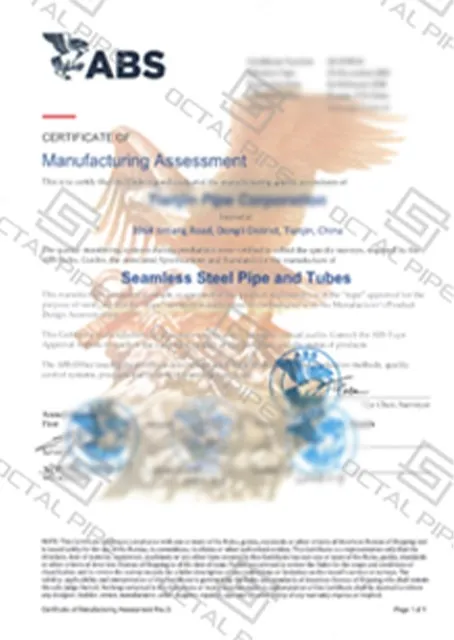
ABS Certificate
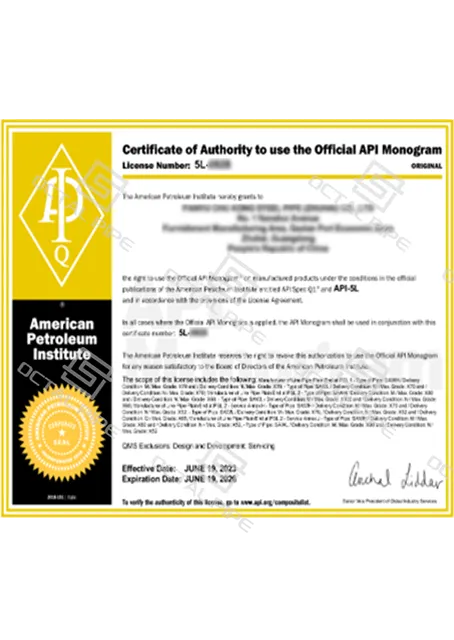
AP-5L Certificate
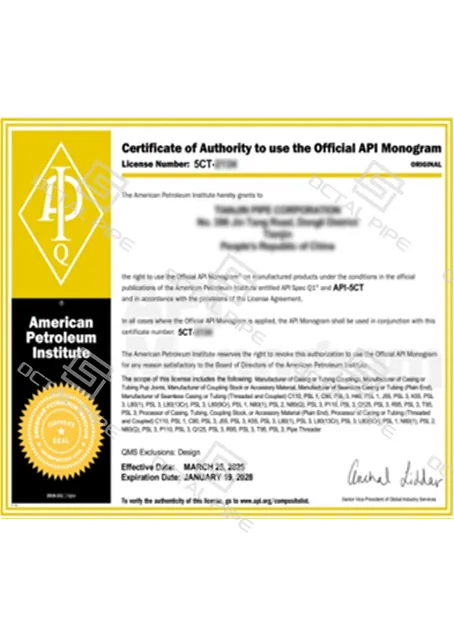
API-5CT Certificate