Where These Tubes Work Best (and Why Stainless Often Wins)
Power boilers, HRSGs, petrochemical heaters, and compact heat exchangers all rely on ASTM A213/SA213 seamless tubes. When chloride-bearing condensate, frequent wet–dry cycles, or tight cleanliness demands are on the table, austenitic stainless grades (TP series) tend to outperform chrome-moly ferritic grades thanks to superior general corrosion and pitting resistance, smoother internal finish, and easier cleaning. High-temperature, dry service with strict creep margins still keeps T-grades in play-especially for superheater and reheater banks.
Typical use cases:
Stainless (TP304/304H, TP316L/316H, TP321/321H, TP347/347H): heat exchangers, condenser bundles, feed-water heaters, corrosive or cyclic-wet service.
Alloy ferritic (T9, T11, T22, T91): hotter superheater/reheater sections and headers where long-term creep strength dominates.


Choosing Stainless vs. Chrome-Moly: A Practical Path
A simple way to frame the decision is to map medium + temperature + life target to a grade family.
Table 1 – Quick selection cues
|
Service cue |
Stainless TP family (typical) |
Ferritic T family (typical) |
|
Chlorides / wet–dry cycles / cleanliness |
TP316L/316H; TP304/304H if low chlorides |
Not preferred |
|
Sensitization control at high temp |
TP321/321H (Ti-stabilized); TP347/347H |
- |
|
Highest creep margin (dry, very hot gas) |
TP347H/321H in select cases |
T91 > T22 > T11 ≈ T9 |
|
Lowest risk of pitting in seawater service |
TP316L (Mo-bearing) |
- |
|
Cost-efficiency at moderate hot service |
TP304/304H |
T11/T22 (when corrosion is mild) |
Project specs always prevail; the table is a shortcut for early screening.
Stainless Grades at a Glance (TP Series)
Table 2 – Common stainless tubing choices under A213
|
Grade |
Core chemistry highlights |
What it's good at |
Typical applications |
|
TP304 / 304H |
~18Cr-8Ni (H = high-temp carbon range) |
Broad utility; clean surfaces; good fabricability |
Condenser/heat-exchanger bundles, heaters |
|
TP316L / 316H |
Adds ~2–3% Mo; L = low C; H = high-temp |
Better pitting/crevice resistance vs 304/304H |
Seawater-adjacent cooling, chloride media |
|
TP321 / 321H |
Ti-stabilized |
Sensitization control at elevated temperature |
Superheater coils, high-temp exchangers |
|
TP347 / 347H |
Nb-stabilized |
Similar to 321; stronger stabilization window |
Furnace/boiler coils with thermal cyclingH-grades target elevated-temperature strength; L-grades target weldability and resistance to sensitization in aqueous service. |
Ferritic Alloy "T" Grades in Context
Table 3 – Where T9, T11, T22, T91 typically fit
|
Grade |
Concept (nominal) |
Strength outlook (hot) |
Typical role |
|
T11 |
~1.25Cr-0.5Mo |
Baseline |
Moderate-temp boiler/heat-exchanger tubes |
|
T22 |
~2.25Cr-1Mo |
↑ vs T11 |
Hotter banks; cost-efficient creep margin |
|
T9 |
~9Cr-1Mo (ferritic) |
Similar band to T22 |
Select hot services and transition zones |
|
T91 |
9Cr-1Mo-V-Nb (tempered martensite) |
Highest of group |
Very hot superheater/reheater sections |
Chemistry Snapshots (Reference Ranges)
Table 4 – Austenitic stainless (TP series, wt.%)
|
Grade |
C (L/H) |
Cr |
Ni |
Mo |
Stabilizer |
|
TP304/304H |
≤0.035 / 0.04–0.10 |
~18–20 |
~8–11 |
- |
- |
|
TP316L/316H |
≤0.035 / 0.04–0.10 |
~16–18 |
~10–14 |
~2.0–3.0 |
- |
|
TP321/321H |
≤0.035 / 0.04–0.10 |
~17–19 |
~9–13 |
- |
Ti |
|
TP347/347H |
≤0.035 / 0.04–0.10 |
~17–19 |
~9–13 |
- |
Nb/Ta |
Table 5 – Ferritic alloy (T series, wt.%)
|
Grade |
C (typ.) |
Cr (typ.) |
Mo (typ.) |
V/Nb/N (when applicable) |
|
T11 |
≤0.12 |
~1.0–1.5 |
~0.44–0.65 |
- |
|
T22 |
≤0.15 |
~1.9–2.6 |
~0.87–1.13 |
- |
|
T9 |
≤0.15 |
~8–10 |
~0.9–1.1 |
- |
|
T91 |
0.08–0.12 |
~8–9.5 |
~0.85–1.05 |
V, Nb, N small additions |
Consult the latest ASTM A213/SA213 for governing limits and product analysis tolerances.
Mechanical & High-Temperature Benchmarks (Minimums at Room Temp)
Table 6 – Indicative minimums (check current code/standard)
|
Family / Grade |
Tensile min |
Yield min |
Elongation min |
|
Austenitic (e.g., TP304/316L) |
≈ 515 MPa (75 ksi) |
≈ 205 MPa (30 ksi) |
≈ 35% |
|
TP321/347 (H grades) |
≈ 515 MPa |
≈ 205 MPa |
≈ 30–35% |
|
T11/T22 |
≈ 415 MPa |
≈ 205 MPa |
≈ 20% |
|
T91 |
≈ 585 MPa |
≈ 415 MPa |
≈ 20% |
Manufacturing Notes - Seamless Only (A213 Scope)
- Routes: hot-finished then cold-finished to size; stainless often solution-annealed and pickled/passivated for a clean ID.
- Heat treatment: austenitic stainless-solution anneal + rapid cool; T91-normalize & temper (per spec); T11/T22-normalizing or subcritical treatments as specified.
- Surface & cleanliness: stainless tubing routinely supplied with low-roughness ID for efficient heat transfer and clean-in-place routines.
- Geometry: tight OD/thickness tolerances and straightness help bundle assembly and tube-to-tubesheet welding.
- U-bends: commonly supplied for stainless heat-exchanger bundles with controlled bend radii and stress relief when required.
Testing & Inspection You Should Specify
Table 7 – Common requirements under A213 (project-dependent)
|
Item |
Stainless TP series |
T-series (T11/T22/T91) |
|
Hydrostatic or NDE electric test |
Mandatory (one or the other) |
Mandatory (one or the other) |
|
Eddy current / ultrasonic (NDE) |
Often specified for 100% coverage |
Often specified for 100% coverage |
|
Flattening / flare / flange tests |
As specified by A213 |
As specified by A213 |
|
Grain size (austenitic) |
Required where applicable |
- |
|
Intergranular corrosion test (IGC) |
By order (e.g., ASTM A262 methods) |
- |
|
Hardness control |
Usually informational |
Critical for T91 per procedure |
|
PMI & documentation |
PMI on bundles; full MTC package |
PMI on bundles; full MTC package |
Dimensional Availability (Octal Pipe Reference)
Table 8 – Typical supply envelope (project-specific)
|
Parameter |
Stainless TP series |
T-series (T11/T22/T91) |
|
Outside diameter |
~12.7–114.3 mm (½ in–4½ in) |
Similar range |
|
Wall thickness |
~1.24–12.7 mm (per schedule/draw) |
~2–16 mm (heavy walls avail.) |
|
Lengths |
Up to 12 m typical; cut-to-length |
Up to 12 m typical |
|
Finishing |
Pickled/passivated, polished on req |
Normalized/tempered finish |
|
Tube ends |
Plain ends; tube-to-tubesheet prep |
Plain ends; beveled if req |
Ordering Checklist (What to Put in the Datasheet)
- Grade and condition: TP304/316L/321/347 (L/H as needed) or T11/T22/T91 with required heat treatment.
- Dimensions: OD, wall, cut lengths; U-bend radii and leg tolerance if applicable.
- Heat treatment & surface: solution anneal + pickling/passivation (stainless); normalize/temper (as applicable).
- NDE plan: hydrostatic or electric test; 100% eddy current/UT if required; acceptance criteria.
- Corrosion control: IGC test for stabilized grades if specified; chloride limits; cleaning protocol.
- Documentation: MTC per EN 10204 (e.g., 3.1), traceability, packing, marking.
- Third-party: witnessing/inspection available on request (BV, SGS, etc.).
FAQ
Q1: How do I choose between stainless TP grades and chrome-moly T grades under ASTM A213/SA213?
A1: Use TP grades for wet/dirty or chloride service and cleanliness needs; use T grades when dry high-temperature creep strength is the main driver.
Q2: What's the practical difference between SA213 T11, T22, and T91 tubing?
A2: T11 is the baseline for moderate temperature, T22 adds creep margin for hotter sections, and T91 is used for the highest-temperature superheater/reheater duty.
Q3: What inspections and documents should I request for ASTM A213/SA213 tubing?
A3: Ask for hydrotest or NDE electric test, 100% eddy current/UT if required, PMI, and a complete EN 10204 3.1 MTC with heat-treatment records.
Certifications
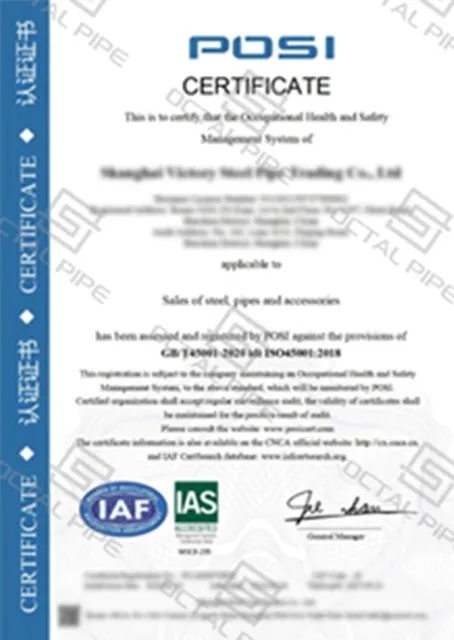
CE Certificate

ISO 9001 Certificate

API Q1 Certificate
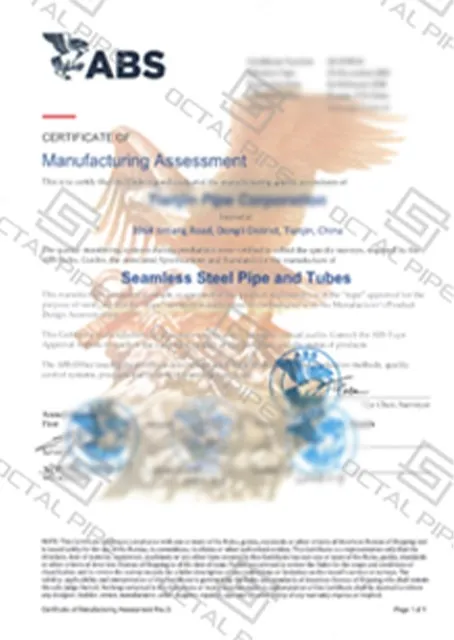
ABS Certificate
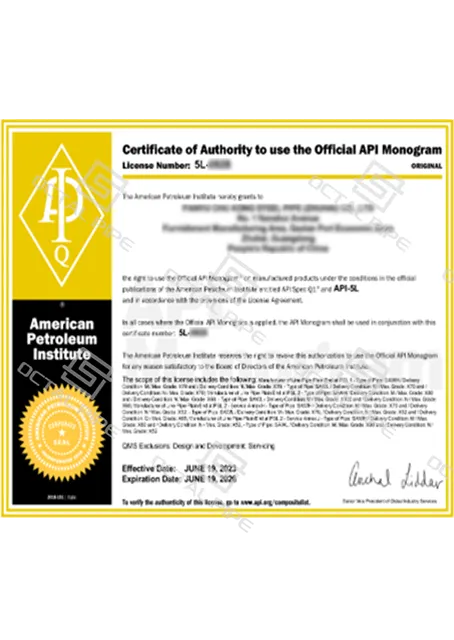
AP-5L Certificate
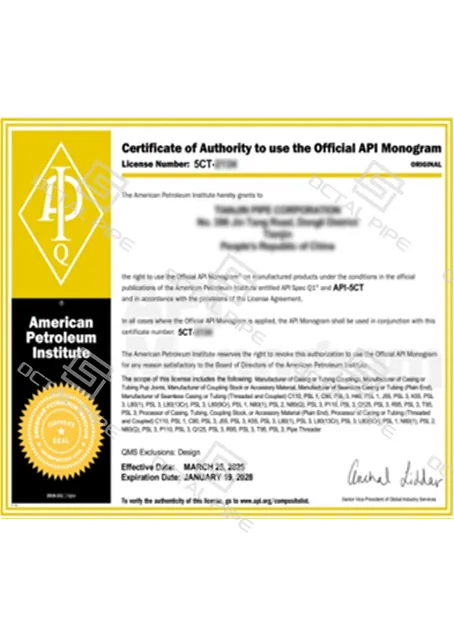
API-5CT Certificate