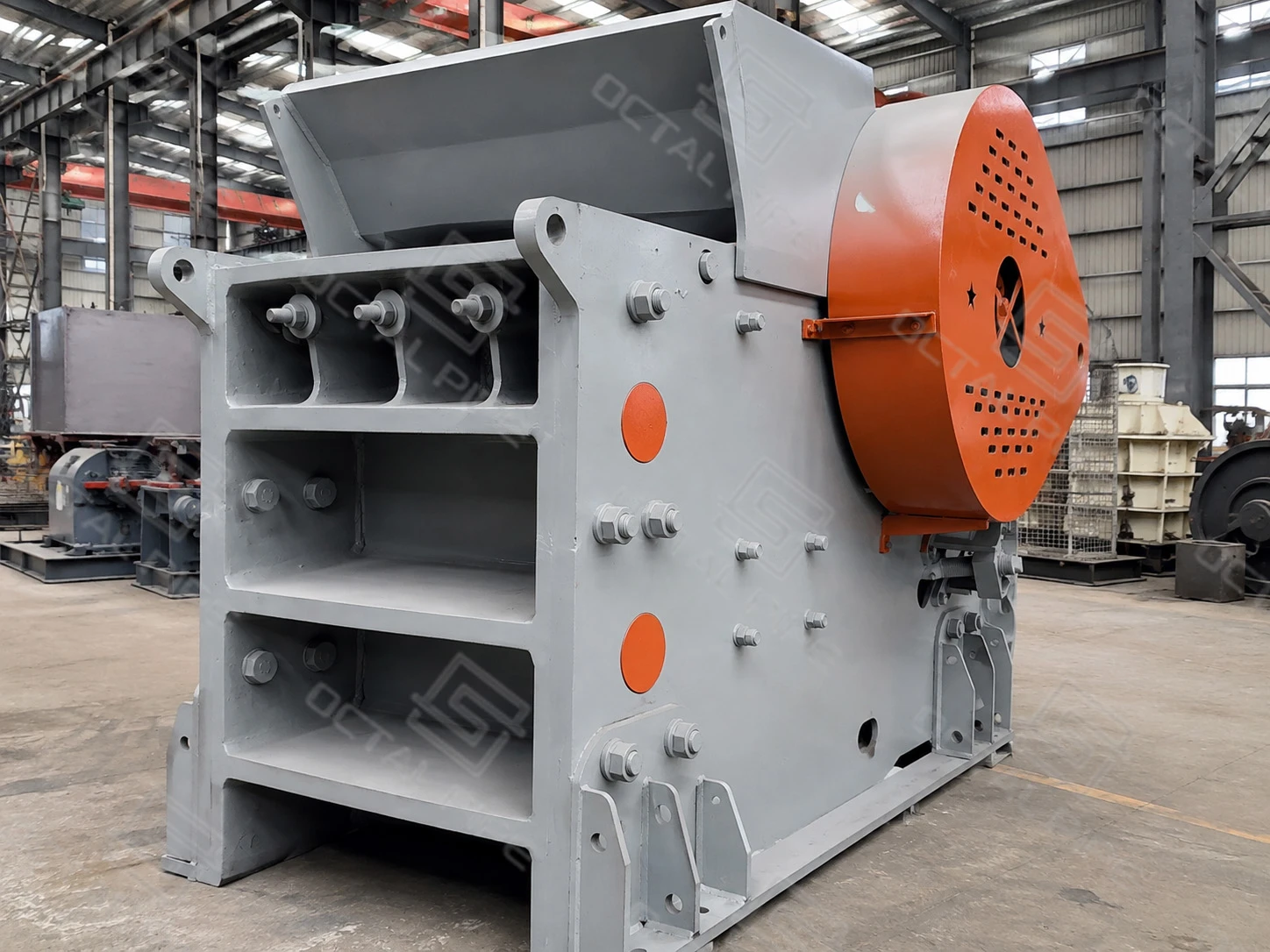
Jaw crusher reduces large rock, ore, concrete, and other brittle materials through repeated compression between a fixed jaw and a reciprocating moving jaw. As the moving jaw closes, feed material is gripped and compressed until fracture occurs; when the chamber opens, the broken particles move downward and enter the next crushing cycle. This process continues until the material becomes small enough to pass through the discharge opening.
This compression mechanism makes jaw crushers suitable for the first stage of size reduction, where large and irregular feed must be reduced before screening, secondary crushing, or grinding. Actual crushing performance depends on feed gradation, material strength, abrasiveness, moisture, chamber geometry, jaw profile, stroke, feeding consistency, and the closed-side setting.
How Does a Jaw Crusher Work?
Jaw crushing takes place through a repeated cycle of gripping, compression, fracture, and downward movement rather than through a single crushing stroke. Feed enters the upper part of the tapered crushing chamber between the fixed jaw plate and the moving jaw plate. Rotation of the eccentric shaft drives the movable jaw toward the fixed jaw, reducing the space between the two surfaces and increasing compressive stress until the rock fractures. As the movable jaw returns, the chamber opens and the broken particles move downward under gravity. The material is then gripped and compressed again during the next stroke. This sequence continues progressively through the chamber until the particles become small enough to pass through the discharge opening.

| Crushing Stage | What Happens Inside the Jaw Crusher | Technical Effect |
|---|---|---|
| Feed Entry | Large particles enter through the upper feed opening and settle between the fixed and moving jaw plates. | Positions coarse material inside the crushing chamber. |
| Gripping | The tapered chamber and jaw surfaces hold the particles as the moving jaw approaches the fixed jaw. | Prevents suitable feed from slipping directly through the chamber. |
| Compression | The movable jaw applies force against the fixed jaw as the eccentric shaft drives the crushing stroke. | Builds compressive stress within the feed material. |
| Fracture | Compressive stress exceeds the material's fracture resistance and the feed breaks into smaller fragments. | Produces the primary size-reduction event. |
| Downward Movement | The chamber opens during the return stroke and fractured material moves lower under gravity. | Transfers partially crushed material toward the narrower lower chamber. |
| Recompression | Material is gripped again and subjected to another compression stroke. | Further reduces particles that are still larger than the discharge opening. |
| Discharge | Particles leave the crusher once they are small enough to pass through the lower chamber opening. | Produces the crusher discharge for the next processing stage. |
Jaw crusher performance is closely linked to how material moves through each crushing cycle. Properly graded, free-flowing feed passes progressively through the chamber, while oversize slabs, excessive fines, wet clay, or irregular feeding can restrict material flow and create uneven chamber loading.
How Crushing Force Travels Through a Jaw Crusher
The construction of a jaw crusher is defined by the way drive torque is converted into reciprocating jaw motion and then transferred as compressive load through the crushing chamber. Power from the drive rotates the eccentric shaft, which generates the cyclic movement of the pitman or movable-jaw assembly. During the crushing stroke, the moving jaw plate forces the feed against the fixed jaw plate, creating the compressive stress required for fracture. The resulting reaction load is carried through the fixed-jaw support and crusher frame, while the toggle mechanism, bearings, and structural members maintain alignment and support the repeated cyclic loading generated during operation.

| Component | Role in the Load Path | Engineering Function |
|---|---|---|
| Eccentric Shaft | Receives rotary input from the drive and generates eccentric motion. | Converts continuous rotation into the cyclic movement required for jaw crushing. |
| Movable Jaw / Pitman Assembly | Transfers eccentric motion toward the crushing chamber. | Carries the moving jaw plate and applies compressive force to the feed. |
| Moving Jaw Plate | Forms the active crushing surface. | Transfers load directly from the movable assembly into the material being crushed. |
| Fixed Jaw Plate | Provides the opposing reaction surface. | Resists the compressive force applied by the moving jaw and completes the crushing interface. |
| Toggle System | Transfers and supports load between the movable assembly and crusher structure. | Maintains the mechanical relationship of the moving system and, in applicable designs, may also contribute to overload protection. |
| Flywheel | Stores rotational energy during the drive cycle. | Helps smooth the fluctuating energy demand created by repeated compression strokes. |
| Bearings | Support the eccentric shaft and associated rotating components. | Maintain shaft alignment while carrying radial and cyclic operating loads. |
| Crusher Frame | Receives the reaction forces generated within the chamber. | Provides the structural stiffness needed to keep the jaw assembly aligned under repeated crushing loads. |
Jaw plates are therefore not only replaceable wear components. Their profile directly influences particle gripping, local contact pressure, material movement, and the distribution of crushing load across the chamber. As the jaw profile wears, these conditions gradually change, which can affect chamber filling, discharge behavior, and the uniformity of the crushing process.
What Controls Jaw Crusher Output?
Jaw crusher output is governed by the interaction between crushing-chamber geometry, jaw motion, discharge setting, and feed behavior, rather than by nominal capacity alone. The feed opening determines what can enter the chamber, while the closed-side setting and jaw stroke control how much material can be compressed and discharged during each crushing cycle. At the same time, feed gradation, bulk density, particle shape, crushability, abrasiveness, moisture, clay content, and feeder distribution influence how effectively the chamber fills and how freely broken material moves toward the discharge. As jaw plates wear, the chamber profile also changes, which can alter gripping conditions, effective crushing volume, and product-size consistency. For this reason, actual throughput must be evaluated together with the feed characteristics and operating condition of the crusher, not from the rated capacity of the machine alone.
| Operating Variable | Engineering Meaning | Main Effect on Crushing |
|---|---|---|
| Feed opening | Maximum chamber entrance dimensions | Controls the size of feed that can physically enter the crusher |
| Feed-size distribution | Proportion of coarse, intermediate, and fine particles | Influences chamber filling, particle interaction, and throughput stability |
| Closed-side setting (CSS) | Minimum jaw separation near the discharge during the crushing cycle | Strongly influences discharge size, circulating load, throughput, and crusher loading |
| Open-side setting (OSS) | Maximum jaw separation during the cycle | Helps describe total jaw movement and chamber opening |
| Stroke | Magnitude and pattern of movable-jaw motion | Affects material movement, compression frequency, and chamber evacuation |
| Chamber geometry | Shape and taper of the crushing cavity | Influences gripping, material flow, and where breakage occurs |
| Jaw profile | Surface geometry of the wear plates | Affects bite, wear pattern, and interaction with different feed shapes |
| Material crushability | Resistance of the feed to fracture | Influences energy demand and achievable throughput |
| Abrasiveness | Tendency of the material to wear contacting surfaces | Primarily affects jaw-plate wear and maintenance frequency |
| Moisture and clay | Amount of water and cohesive fine material in the feed | Can interfere with flow and promote packing or bridging |
| Feeding consistency | Uniformity of feed across time and chamber width | Influences stable loading, wear distribution, and capacity |
Why Is a Jaw Crusher Used for Primary Crushing?
A primary jaw crusher is positioned at the front of a crushing circuit because it can accept large, irregular feed and reduce it to a size that downstream equipment can handle more consistently. Run-of-mine ore and blasted quarry rock normally arrive with a broad particle-size distribution, including coarse lumps that are too large for secondary crushers, screens, or grinding equipment. The jaw crusher performs the first controlled reduction step before finer size classification or secondary crushing begins.
Large Feed Requires a Coarse Crushing Stage
Primary crushing starts with material that has not yet been conditioned into a narrow size range. Feed may contain angular blocks, slab-shaped fragments, and particles with significant differences in size.
The large feed opening and tapered chamber of a jaw crusher allow coarse material to enter the machine while the moving jaw progressively reduces each particle through repeated compression. This makes the machine suitable for receiving blasted rock or run-of-mine ore without requiring the feed to be pre-sized to the same degree as many downstream machines.
Compression Provides Controlled Size Reduction
A jaw rock crusher breaks material by forcing it between fixed and moving jaw surfaces. The objective at this stage is not to produce the final product size, but to reduce large feed without relying on high-speed impact.
For hard rock and ore, this compression mechanism provides a practical first reduction step:
Coarse feed → gripping → compression fracture → repeated reduction → controlled discharge
In quarry processing, a rock jaw crusher commonly reduces blasted stone before secondary crushing or screening. In mineral processing, a mining jaw crusher performs the same first-stage function before the material moves to cone crushing, screening, or grinding.
Primary Crushing Stabilizes the Downstream Circuit
The quality of primary crushing affects every process stage that follows. Secondary crushers and screens operate more consistently when feed size and flow are kept within a predictable range.
Primary jaw crushing therefore serves three main process functions:
- Reduces oversized run-of-mine or blasted material to a manageable size.
- Limits the amount of excessively coarse material reaching downstream equipment.
- Produces a more controlled feed stream for secondary crushing, screening, conveying, or grinding.
A primary jaw crusher should therefore be evaluated as part of the complete crushing circuit rather than only by its standalone capacity. Feed size, discharge setting, throughput requirement, and the allowable feed size of the next machine must be considered together.

What Materials Can a Jaw Crusher Crush?
Jaw crushers can process a broad range of rock, ore, concrete, and other brittle mineral materials, but crushing suitability depends on more than material name alone. Hardness, abrasiveness, particle shape, moisture, clay content, fines, and embedded uncrushable material all affect how the feed enters, fractures, and moves through the crushing chamber.
| Feed Material / Condition | Typical Examples | Behavior in a Jaw Crusher | Main Engineering Concern |
|---|---|---|---|
| Hard and Abrasive Rock | Granite, basalt, hard quarry stone | Compression between the jaw plates produces progressive fracture and coarse size reduction. A jaw rock crusher is commonly used where large blasted rock requires primary reduction. | High abrasiveness accelerates jaw-plate and cheek-plate wear; wear gradually changes chamber profile and gripping conditions. |
| Mine Ore | Run-of-mine metallic and non-metallic ore | A mining jaw crusher reduces coarse ore before secondary crushing, screening, or grinding. Performance can change as ore hardness, particle shape, moisture, and fines vary across the feed. | Feed characterization is required because nameplate capacity alone does not represent actual throughput under changing ore conditions. |
| Concrete and Demolition Material | Demolition concrete, masonry, recycled mineral construction waste | A concrete jaw crusher can reduce large concrete fragments through compression, including irregular pieces generated during demolition. | Reinforcing steel, wire, embedded fixtures, and other tramp material require sorting or metal removal before they interfere with chamber movement or impose abnormal loads. |
| Wet, Sticky, or Fine-Rich Feed | Clay-bearing rock, wet fines, cohesive mineral feed | Cohesive material may adhere to jaw surfaces or fill voids between larger particles, restricting downward movement through the chamber. | Packing, bridging, unstable throughput, and uneven chamber loading become more likely as moisture, clay, and fines increase. |
| Slabby or Elongated Feed | Flat blasted rock, elongated fragments | Particles may bridge across the chamber or orient poorly before being gripped by the jaws. | Feed preparation and controlled distribution may be required to prevent intermittent feeding and poor chamber utilization. |
| Mixed Recycled Feed | Concrete mixed with soil, timber, plastics, or metal | Crushable mineral fractions can be reduced, while non-mineral contaminants do not behave as normal crusher feed. | Pre-sorting and removal of uncrushable contaminants are necessary to maintain predictable crushing conditions. |
Material suitability should therefore be evaluated together with feed condition and downstream requirements. A material that is mechanically crushable can still produce unstable operation when excessive fines, moisture, unfavorable particle shape, or tramp material restrict movement through the chamber.
What Happens Inside a Jaw Crusher When Feed Conditions Change?
Feed condition directly changes how effectively a jaw crusher uses its crushing chamber. During normal operation, coarse particles must enter the chamber, be gripped by the jaw profile, fracture under compression, and then move downward during the opening portion of each stroke. Any condition that interferes with one of these steps changes the effective chamber loading. Oversize or slab-shaped particles can interrupt entry and gripping; excessive fines can occupy the voids required for broken material to move downward; wet clay can increase cohesion and restrict discharge; uneven feeder distribution can concentrate crushing load and wear on one side of the chamber. The result is not only a change in throughput, but also a change in load distribution, jaw-plate wear pattern, chamber utilization, and discharge consistency.
| Feed Condition | Behavior Inside the Crushing Chamber | Likely Operating Effect |
|---|---|---|
| Stable, graded feed | Chamber fills relatively evenly and particles move progressively downward | More consistent loading and throughput |
| Oversize block | Feed may not enter or orient correctly | Bridging, interrupted feeding, or need for pre-breaking |
| Slabby or elongated rock | Particle can span the chamber instead of dropping freely | Poor gripping or bridging |
| Excessive fines | Fine particles occupy void space between larger fragments | Reduced chamber permeability and possible packing |
| Wet, clay-rich feed | Material becomes cohesive and adheres to surfaces | Restricted flow and unstable discharge |
| Very abrasive rock | Frequent sliding and compression against wear surfaces | Faster jaw-plate wear |
| Uneven feed across chamber width | One side receives more material | Uneven wear and asymmetric chamber loading |
| Tramp metal or other uncrushable object | Material does not fracture as intended | Abnormal load and potential mechanical damage |
Download:Jaw Crusher Feed Condition and Chamber Behavior Guide
Feed-related problems rarely occur as isolated variables. Chamber condition, CSS, jaw-plate profile, and feeder performance interact with the physical properties of the material. A restricted discharge combined with fine-rich or cohesive feed can reduce the rate at which material clears the lower chamber, increasing retained material and cyclic loading. Uneven feeding can progressively wear one side of the jaw profile, further changing gripping conditions and load distribution. Oversize or poorly oriented particles can interrupt material flow even when their nominal dimensions appear compatible with the feed opening.
Operational assessment should therefore distinguish between crusher capacity limitations and feed-induced restrictions. When throughput becomes unstable, inspection should include feed-size distribution, particle shape, moisture and clay content, feeder distribution, jaw-plate wear, and the actual operating CSS. Evaluating these conditions together provides a more reliable basis for correcting poor chamber utilization than changing the crusher setting or increasing feed rate alone.
Jaw Plate Wear and Its Effect on Crushing
Jaw plate wear changes the working geometry of the crushing chamber. As tooth height, corrugation profile, and surface contour are gradually lost, the contact between the feed and jaw surfaces changes as well, affecting gripping, compression, material movement, and load distribution.
- Reduced gripping efficiency: Worn teeth provide less effective bite on coarse or slab-shaped particles, allowing more sliding before fracture occurs.
- Changed chamber profile: Loss of jaw profile alters the effective crushing volume and the path material follows toward the discharge.
- Uneven material movement: Localized wear can cause one side of the chamber to carry more feed, producing asymmetric loading and irregular discharge.
- Higher local loading: When the original contact pattern is lost, crushing force may become concentrated over a smaller area of the jaw surface.
- Less stable product size: Progressive wear changes the effective geometry near the discharge zone, which can reduce consistency even when the nominal setting remains unchanged.
- Accelerated secondary wear: Uneven jaw-plate wear can increase loading on cheek plates and other chamber surfaces exposed to moving rock.
Uneven wear often reflects a combination of feeding pattern, material characteristics, and operating duty rather than a problem with the jaw plate alone. One-sided feeding, segregated material, slab-shaped rock, restricted chamber flow, or an unsuitable setting can concentrate load on a limited area of the jaw surface, while continuous abrasive service accelerates the effect. A heavy duty jaw crusher therefore experiences a much higher wear and cyclic-load demand than a small jaw crusher used intermittently, while a mini jaw crusher applies the same compression principle under much lower feed-size, throughput, and structural-duty requirements.
From Jaw Crusher Definition to Actual Machine Selection
Jaw crusher selection should be based on the actual feed condition and the duty required from the crushing circuit. Feed size alone is not sufficient; material behavior, required discharge, throughput, operating cycle, feeding method, and downstream equipment all affect the machine configuration and operating setting.
| Selection Input | What Should Be Confirmed | Why It Matters |
|---|---|---|
| Maximum Feed Size | Largest lump dimensions and particle shape | Determines whether material can enter and orient correctly within the crushing chamber. |
| Feed-Size Distribution | Proportion of coarse, intermediate, and fine particles | Affects chamber filling, material movement, and achievable throughput. |
| Required Product Size | Target discharge range and downstream feed limit | Determines the required crusher setting and whether additional crushing stages are needed. |
| Target Throughput | Required continuous or batch production rate | Defines the crushing duty and must be evaluated together with feed characteristics. |
| Material Hardness and Crushability | Resistance of the material to fracture | Influences crushing load, energy demand, and achievable capacity. |
| Abrasiveness | Expected wear severity of the feed | Affects jaw-plate selection, wear rate, and maintenance interval. |
| Moisture and Clay Content | Free moisture, sticky fines, and cohesive material | High levels can restrict chamber flow and increase packing or bridging risk. |
| Operating Duty | Continuous or intermittent service and daily operating hours | Influences structural loading, wear rate, bearing duty, and maintenance planning. |
| Feeding Arrangement | Feeder type, feed consistency, and distribution across chamber width | Affects chamber utilization and wear uniformity. |
| Downstream Equipment | Allowable feed size for secondary crusher, screen, or mill | Ensures the jaw crusher discharge matches the next process stage. |
| Plant Arrangement | Stationary or mobile installation and available space | Affects equipment layout, feeding, discharge, maintenance access, and integration. |
These inputs must be evaluated together because the same jaw crusher machine can produce different results under different feed gradations, material properties, discharge settings, and operating duties.
FAQ

01.What is the difference between jaw crusher feed opening and maximum feed size?
02.Why does nip angle matter in a jaw crusher?
03.What does reduction ratio mean in a jaw crusher?
04.Can a jaw crusher produce the final aggregate product in one stage?
Certifications
CE Certificate

ISO 9001 Certificate

API Q1 Certificate
ABS Certificate
AP-5L Certificate

API-5CT Certificate