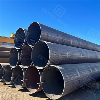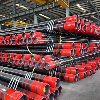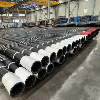
ASTM A106 is the standard seamless carbon steel pipe most designers specify when the line has to carry hot fluid or gas under pressure. It is made for elevated-temperature service, is dimensioned in accordance with ASME B36.10M, and can be supplied with plain or beveled ends for welding, bending and flanging. Among Grades A, B and C in ASTM A106, Grade B is used the most because it gives a reliable mix of strength, ductility and weldability for steam lines, refinery headers, process piping and power plant circuits.
Standards and Delivery
- Standard: ASTM A106 / ASME SA106
- Grade: B (also available A, C if the project allows)
- Form: Seamless, hot-finished or cold-finished
- Ends: Plain end (PE) or beveled end (BE) for welding
- Dimensions: ASME B36.10M, NPS and schedule-based
Chemical Composition
The grade is based on a simple, well-controlled carbon–manganese–silicon design. Control of P and S keeps the pipe weldable and tough.
| Grade | C (%) | Mn (%) | P (%) max | S (%) max | Si (%) min |
|---|---|---|---|---|---|
| A | ≤ 0.25 | 0.27–0.93 | 0.035 | 0.035 | 0.10 |
| B | ≤ 0.30 | 0.29–1.06 | 0.035 | 0.035 | 0.10 |
| C | ≤ 0.35 | 0.29–1.06 | 0.035 | 0.035 | 0.10 |
Why this matters: carbon gives the grade its base strength; manganese helps stabilize the ferrite–pearlite structure and improves toughness; silicon improves scale/oxidation resistance when the pipe is carrying hot steam or process media.
Mechanical Properties
Grade B is the "middle" grade but already strong enough for most plant applications.
| Grade | Tensile Strength (MPa) | Yield Strength (MPa) | Elongation (%) |
|---|---|---|---|
| A | ≥ 330 | ≥ 205 | ≥ 20 |
| B | ≥ 415 | ≥ 240 | ≥ 20 |
| C | ≥ 485 | ≥ 275 | ≥ 20 |
Interpretation for design and fabrication: tensile strength protects against bursting and axial loads; yield strength is the limit before permanent deformation, especially important for high-pressure runs; elongation ensures the pipe can be field-bent, welded and installed without cracking.
Performance in High-Temperature Service
A106 Grade B is intended to stay in service at metal temperatures roughly up to the 400–450 °C band. At this level the ferrite–pearlite microstructure remains stable, silicon helps the surface resist scaling, and the pipe keeps its pressure-bearing capability. That is why it is specified for boiler feed lines, steam headers, heat-exchanger piping, hot oil service and refinery utility systems. With proper PWHT and welding procedures, the pipe can also run in cyclic service without rapid loss of toughness.
Manufacturing and Heat Treatment
For A106 Grade B the manufacturing route is not an accessory point – it is the reason the pipe can actually work at high temperature and pressure. A typical mill route for seamless A106 Grade B at Octal Pipe looks like this:
1. Billet selection and chemistry control
Production starts from killed (fully deoxidized), fine-grain carbon steel billets that already meet the A106 chemical range. This ensures low P and S, good cleanliness and weldability. Heats are checked before rolling so the mechanical targets for Grade B can be reached after forming and heat treatment.
2. Billet heating
Billets are heated in a rotary or walking-beam furnace to the piercing/rolling temperature. Uniform heating is important here because uneven temperature would cause wall-thickness variation when the billet is pierced.
3. Hot piercing (hollow making)
The hot billet is pierced on a cross-roll or mandrel piercing mill to form a hollow shell. This is where the pipe turns from a solid round into a seamless tube. The aim is to produce a shell with no central burst and with even wall around the circumference.
4. Elongation and plug/mandrel rolling
The hollow shell is then elongated and rolled over a mandrel or plug mill to reach closer to the ordered diameter and wall thickness. Several rolling stands may be used to refine wall and improve surface. This step is key for making the inner surface smooth and for keeping wall thickness within tolerance.
5. Sizing/reducing mill
A sizing or reducing mill brings the pipe to its final OD and roundness. For higher schedules (thicker walls), rolling parameters are adjusted to maintain concentricity. Accurate sizing here means easier welding and better fit-up on site.
6. Cooling and straightening
After hot working, pipes are cooled in a controlled way and then passed through a straightening machine. Straightness is important for prefabricated spools and for automatic welding.
7. Heat treatment (as required)
Depending on the pipe size, reduction ratio and purchaser's requirement, pipes can be normalized or stress-relieved.
Normalizing refines the ferrite–pearlite structure, evens out properties along the length and improves toughness.
Stress relief removes forming stresses, which is useful if the pipe will be welded into a system that will later see thermal cycling.
This controlled heat treatment is what helps A106 Grade B keep its ductility and impact resistance in hot service.
8. Finishing, NDE and hydrotest
Finished pipes are cut to length, ends are faced/beveled, and each length is inspected visually for surface and dimensional accuracy. Then the pipe is tested:
- hydrostatic test to prove pressure containment
- eddy-current or ultrasonic NDE to look for internal/surface defects
- marking and coating/varnish for protection
- Only after all these steps is the pipe released with an MTC.
Because the whole route is seamless (no longitudinal weld), the pipe has uniform pressure resistance around the full circumference – the main reason A106 is chosen over welded pipe for high-temperature service.


Dimensional Range
(typical supply, can follow project request)
| Item | Specification |
|---|---|
| Size | NPS 1/8" – 36" (ASME B36.10M) |
| Wall thickness | SCH 10 – SCH XXS (incl. 40, 80, 160) |
| Length | 5–12 m (SRL / DRL) or cut-to-length |
| Ends | PE / BE, protector caps on request |
Testing and Inspection
To make the pipe acceptable for pressure and hot service, ASTM A106 refers to the general requirements in ASTM A999. Octal Pipe can provide the full testing route:
- Hydrostatic test on each length to prove pressure containment
- Nondestructive examination (eddy current or ultrasonic) to screen surface and internal flaws
- Tensile and hardness tests per heat of steel to verify mechanical compliance
- Flattening / bend tests to demonstrate ductility
- Visual, OD, wall and length checks to ensure dimensional conformity
- MTCs to EN 10204 3.1/3.2 for full heat and test traceability
Applications
| Sector | Typical uses |
|---|---|
| Power & boiler | Steam lines, feedwater lines, auxiliary boiler piping |
| Refinery & petrochemical | Process steam, high-temperature utility lines, heater piping |
| Chemical plants | Heat exchanger and condenser piping, hot media transfer |
| Oil & gas | Onshore high-temperature gathering and transmission lines where seamless CS is specified |
| General industrial | High-pressure air, hot water and thermal-fluid systems |
The key point is that A106 Grade B is specified when the service is both seamless and high-temperature. When the need is room-temperature or structural, buyers often go to ASTM A53 instead; when the need is line pipe with PSL requirements, they go to API 5L. Keeping this page clearly positioned for "high-temperature seamless CS pipe" will help Google understand what this URL is about.
Why Octal Pipe for ASTM A106 Grade B
- Seamless carbon steel pipe produced to ASTM A106 / ASME SA106
- Grade B as standard; Grade A or C when required by project
- Cut-to-length, beveled ends, coating / varnish and export packing available
- All tests (hydro, NDE, mechanical) documented and traceable
- Third-party inspection (BV, SGS, LR, etc.) can be arranged before shipment
- Supply experience for refinery, power and chemical plants where document packages must match EPC requirements
FAQ

Q1: What is ASTM A106 Grade B seamless pipe used for?
Q2: What's the difference between ASTM A106 Grade B and ASTM A53 Grade B?
Q3: What tests and documents should I request for ASTM A106 Grade B pipe?
Certifications
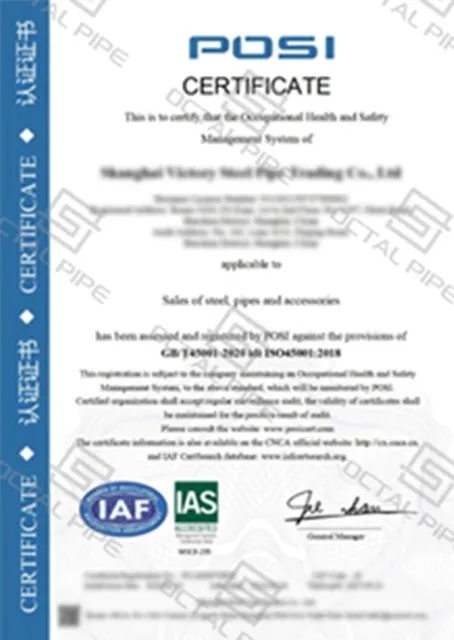
CE Certificate

ISO 9001 Certificate

API Q1 Certificate
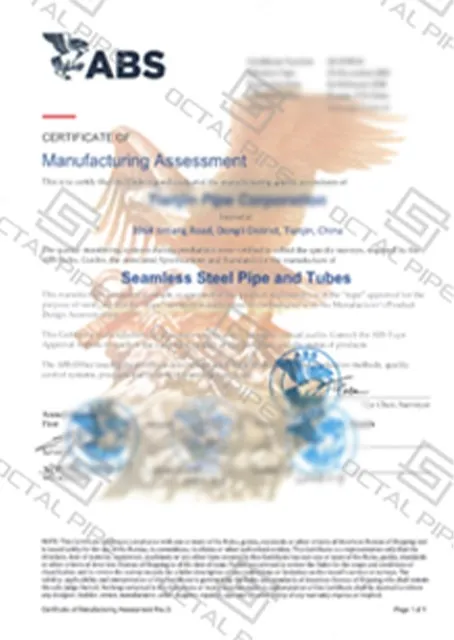
ABS Certificate
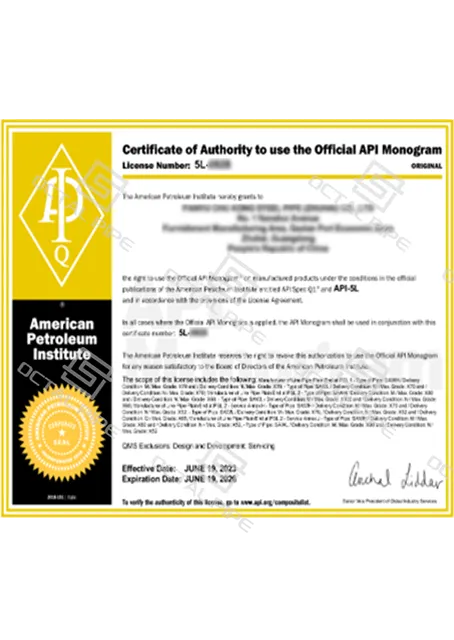
AP-5L Certificate
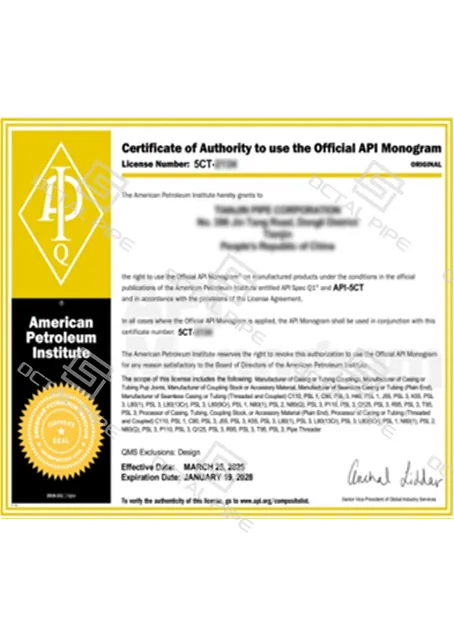
API-5CT Certificate