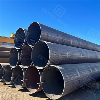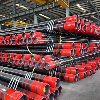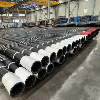
Stainless steel pipes expand and contract with heat due to the physical phenomena that occur when the material changes temperature. The extent of this expansion and contraction is affected by the material's composition, structure, and ambient temperature.
Stainless steel pipes, as a widely used metal material, play an important role in various industrial fields. However, during use, it's not uncommon to find that stainless steel pipes expand or contract with temperature fluctuations. This is thermal expansion and contraction. So, why do stainless steel pipes expand and contract with heat?
First, we must understand that thermal expansion and contraction are fundamental physical properties of matter. When a substance is heated, the movement of its particles accelerates, increasing the distance between them and causing the object to expand. Conversely, when a substance is cooled, the movement of its particles slows down, decreasing the distance between them and causing the object to contract. Stainless steel pipes, as a metal material, are no exception.
Second, the extent of thermal expansion and contraction of stainless steel pipes is closely related to factors such as its material composition, structure, and ambient temperature. Stainless steels with different compositions and structures will have different coefficients of thermal expansion and contraction. Furthermore, changes in ambient temperature can also affect the thermal expansion and contraction of stainless steel pipes. In high-temperature environments, stainless steel pipes will expand significantly; in low-temperature environments, they will contract significantly.
So, how can we address the thermal expansion and contraction of stainless steel pipes? First, when designing and installing stainless steel pipes, their thermal expansion and contraction characteristics should be fully considered, and appropriate pipe supports and fixtures should be installed to minimize the impact of thermal expansion and contraction on the system. Second, for stainless steel pipes that will be used in environments with large temperature fluctuations, materials with a low thermal expansion and contraction coefficient can be selected to reduce the degree of thermal expansion and contraction. Furthermore, devices such as compensators can be installed to absorb the deformation and stress caused by thermal expansion and contraction of the pipes.
Certifications
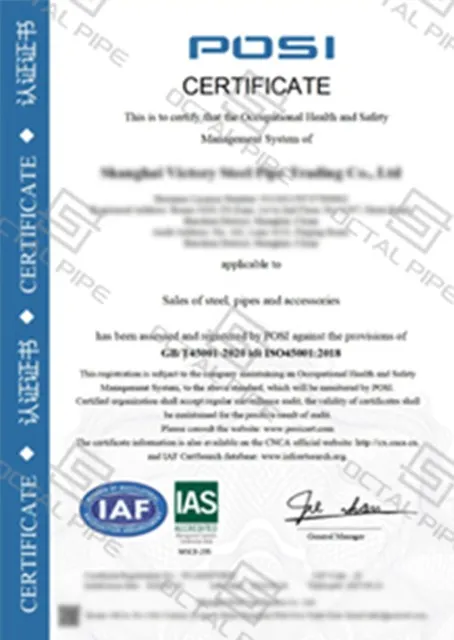
CE Certificate
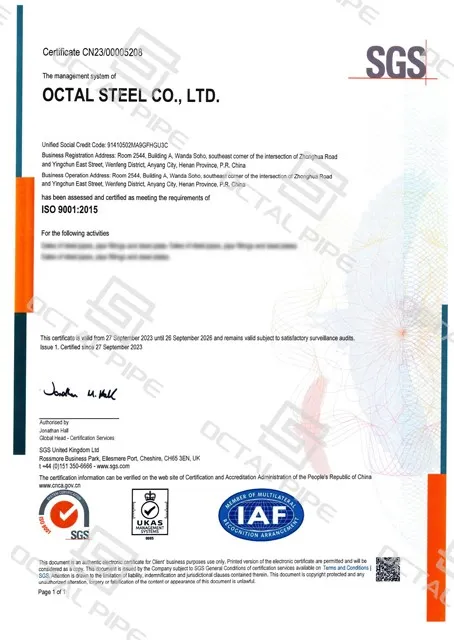
ISO 9001 Certificate
API Q1 Certificate
ABS Certificate
AP-5L Certificate
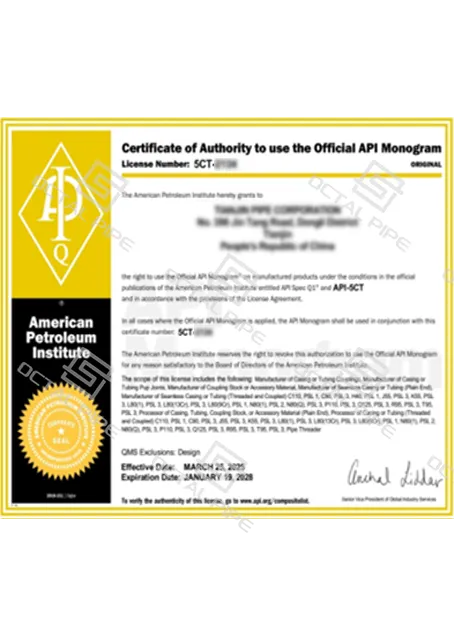
API-5CT Certificate